
You're probably a candidate if your hair loss follows a familiar pattern and has settled down, if the back and sides of your head still have dense hair to draw from, if your health is under control and if you know what the procedure can and can't give you. No article can give you the final yes. You only get that once a qualified surgeon has examined your scalp.
Below we go through what the surgeon actually looks for, point by point: age and stability, illnesses and medication, scalp skin conditions, your pattern and Norwood or Ludwig stage, your donor hair, your hair type, what applies to women and what you can realistically expect. We also explain the thinking behind each rule, so you understand why the answer turns out the way it does. At the very end you'll find a summary table and a two-minute self-test.
Worried the result will look artificial? That problem belonged to the old techniques. Read about the difference between hair plugs and a modern hair transplant.
- How stable your loss is counts for more than how old you are. If you're very young, or the loss is moving fast, you usually start with medication and are reassessed later.
- Donor hair matters most. Its density, the thickness of each hair and how wide the safe zone is together decide what can be done.
- Diffuse loss without a pattern (DUPA) and scarring alopecia in an active phase usually mean wait or treat first. Rarely a final no.
- If you have diabetes or thyroid problems, or take blood thinners, the surgeon looks at your specific situation. None of them automatically closes the door.
- The procedure moves hair you already have. It doesn't cure hereditary hair loss, and the hair that isn't moved is just as vulnerable as before.
Does your age matter for whether you can have surgery?
Age rarely decides it. What counts is whether the loss has stabilised, and there is no fixed age limit when your health and donor hair are good. If you are very young, or your hair loss is moving fast at any age, you usually get medication first, so the pattern can settle before anyone draws up a surgical plan.
Almost everyone asks about age first. The answer surprises many people: it is almost never the deciding factor. Hereditary hair loss is driven by genes and by how sensitive certain hair follicles are to DHT (dihydrotestosterone). The number of years you've lived isn't the driver. The surgeon would rather know whether your loss has settled into a pattern you can predict. The grafts that are implanted stay put for good, while the scalp around them can keep changing if the loss is young or still in progress.
Why does stability count for more than your year of birth?
The hairs that are moved usually resist DHT for the rest of your life. Your own hair around them doesn't. If it keeps thinning in the years ahead, a hairline or crown that looked completely natural on day one can end up as an island while everything else recedes. By waiting until the loss has settled, you protect two things at once: how the result looks in ten years, and the donor hair you have left.
What does the surgeon look for?
- Who in your family has lost hair, and how old you were when it started for you. Both say something about how fast the loss may progress.
- Photos taken over 12 to 24 months, if you have them. They show pace and direction better than anything else.
- Which Norwood or Ludwig stage you're at now, set against the density of your donor area. That tells the surgeon how much safety margin you have.
- How your hair has responded to any medication you already use. If it responds well, that in itself is a sign the loss is starting to settle.
What does stabilising first mean?
Take a 22-year-old man whose hairline is receding fast. He is usually advised to start finasteride, minoxidil or both, and then take new photos every six to twelve months. The operation waits. He isn't turned away. The order is simply rearranged: treatment first, then confirmation that the loss really has slowed, and then a plan for a scalp that has stopped changing. Many people in that situation have the procedure a couple of years later, when it's easier to see where the loss will end up.
Do you have to be 25?
No. The claim that you have to be 25 crops up again and again on forums, but it isn't a medical rule. A 22-year-old with slow, mild loss in a clear pattern can be a perfectly reasonable candidate. A 45-year-old whose pattern only became stable last year may be told to wait a little longer. The surgeon counts how long the pattern has stayed still, not how long it's been since you turned 18.
What changes as you get older?
The procedure has no upper age limit. In older patients the assessment shifts towards general health, how well the skin heals and how good the donor hair is. Density and thickness at the back of the head can drop a little over the years, even in the zone that otherwise resists hair loss. That doesn't mean no. It means the surgeon factors it in when you're examined.
Read more: The full guide to age: when are you too young, and when is it too late? →
Can you have a hair transplant if you have diabetes or another condition?
Usually yes. Well-controlled diabetes, thyroid disease and many other chronic conditions are common and can be planned around. Blood-thinning medication, uncontrolled diabetes and autoimmune diseases are assessed individually at the consultation, because they can affect healing or how many grafts survive. They don't rule you out in advance.
The procedure is done under local anaesthetic and is minor, but it is surgery. So the surgeon asks the same things any surgical team would. Is the condition under control? Do you bleed more than usual, or does your blood clot differently? Do wounds heal as they should? The vast majority of things in an ordinary medical history don't close the door on the procedure. They just change the plan.
Diabetes
High blood sugar leads to poorer circulation in the smallest blood vessels and slower wound healing. That matters a lot here, because a new graft lives on a tiny and fragile blood supply for the first few days. If your blood sugar is steady and your HbA1c is within what your GP calls well controlled, the procedure usually goes perfectly well. If your diabetes is poorly controlled, you'll usually be told to get it in order first. Otherwise the risk of slow-healing wounds, infection and fewer grafts taking increases.
Thyroid
An underactive and an overactive thyroid can both make hair fall out diffusely. The surgeon will want to see stable levels before the operation. That makes the anaesthetic safer, and an untreated thyroid condition can also both mimic and worsen the very hair loss you want help with. With stable test results on medication, this is one of the simplest items on the form you fill in before the procedure.
Blood-thinning medication
Warfarin, aspirin (acetylsalicylic acid), DOACs and similar medicines cause more bleeding during the procedure. Blood in the field makes it harder for the surgeon to work precisely. These medicines are usually paused for a period before the operation, but only by agreement with the doctor who prescribed them. Never on your own initiative. Stopping some of them carries its own medical risk, and that has to be weighed against the benefit of the procedure.
Autoimmune diseases
We need to be precise here. Alopecia areata is caused by the immune system attacking the hair follicles, but the disease doesn't cause scarring. The follicle usually survives, and the hair can return when the disease calms down. The surgeon looks at how active it is today, and it's usually stabilised with medication before an operation is put on the table. The scarring autoimmune and inflammatory diseases, which we come back to further down, are something else entirely. There the follicle is replaced by scar tissue for good. If you have lupus or rheumatoid arthritis affecting other parts of the body, that's no automatic barrier to a procedure on the scalp. The surgeon will still look at how active the disease is and at any immunosuppressive medication.
A tendency to keloids or heavy scarring
If you or anyone in your family has had keloids, this is discussed thoroughly. It affects how the donor area heals, especially with the strip method (FUT), and how visible the scars may become. In that case many choose FUE, which leaves small dots spread out instead of one long scar. The surgeon often proceeds cautiously in several stages.
Does a chronic illness close the door?
Many people think so and get needlessly discouraged. The normal, responsible route is a medical assessment before the procedure, sometimes with a letter from your GP. It ends with a clear yes, a clear not yet or a concrete list of what needs to be in place first. A blanket no is rarely the answer.
Read more: The full guide to hair transplants with diabetes, heart disease, high blood pressure and other conditions →
Can a scalp skin condition stop the procedure?
Yes, but usually only until it has calmed down. Psoriasis, eczema or folliculitis in an active phase, and any scalp infection, should be treated before you have surgery. Inflamed or infected skin means fewer grafts survive and raises the risk of complications, so your scalp needs to be calm and healthy on the day of the operation.
The scalp is the operating field itself. How the skin is doing on the day therefore decides more than your comfort. It decides whether the grafts take hold.
Why is inflammation a problem?
Inflammation and infection disrupt the blood supply in the area and make complications more likely, both on the day of surgery and in the weeks after. A freshly implanted graft has no blood vessels of its own for the first day or two. It only survives because the surrounding tissue is healthy while new vessels grow in. If the surgeon operates in skin that is inflamed or infected, the risk that the grafts won't take is clearly higher.
Psoriasis
Many people have psoriasis on the scalp, and it's rarely an obstacle as long as you're not in the middle of a flare. If you have thick, scaly patches exactly where the surgery will be, they're usually treated down first. Cutting through them raises the risk of infection and can make healing quite uncomfortable.
Eczema and seborrhoeic dermatitis
Both are usually long-term but easy to live with. They don't stop you. If the eczema is weeping, or flaring badly, it's treated before the procedure. Seborrhoeic dermatitis, the common flaky kind, is rarely a reason to postpone anything when it's under control. A severe flare may still lead the surgeon to ask you to wait until it has settled.
Folliculitis and other infections
Folliculitis means inflamed hair follicles, sometimes with pus. It, and any other active bacterial or fungal infection, should be gone before the procedure. Grafts planted in infected tissue are a recipe for a weak result. A short course of cream or tablets is often enough, followed by a check that confirms the infection has cleared. Then you can set a date.
What is checked at the consultation?
- Does your scalp look calm today, or is there redness, weeping, flaking or crusting where the surgery will be?
- Do you have open sores, small pus blisters or other signs of infection that should be treated before the procedure?
- If you have psoriasis or eczema, has it been quiet for a good while, or are you in the middle of a flare?
- Do you have scars from earlier procedures, injuries or past scarring alopecia that mean the plan has to be changed?
Is the skin condition a permanent obstacle?
For the vast majority of common non-scarring conditions, it isn't. This is a question of order. Let the flare pass, have it confirmed at the consultation that the skin is calm and intact, and set the date afterwards. Scarring alopecia is a separate category that we go through in detail further down. There it's the follicle itself that is affected, not just the skin above it.
That depends on your donor area, your hair loss and your health, and a doctor needs to look at it. Send three photos and get an honest answer from the medical team at the clinic at the top of our ranking.
Goes to the clinic at the top of our ranking.
Why does the surgeon ask about your pattern and Norwood or Ludwig stage?
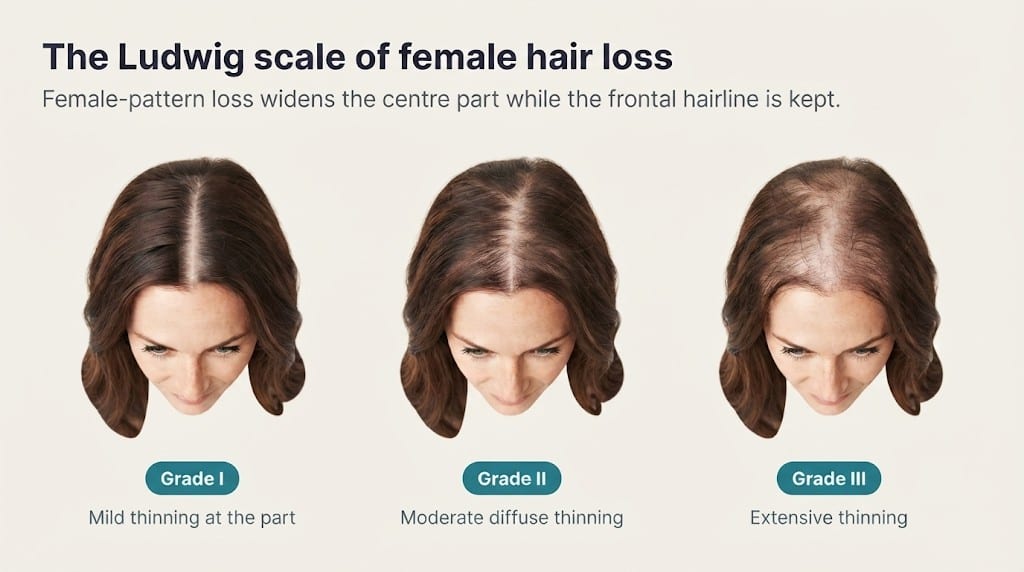
Because the procedure works best when the loss follows a pattern and the donor area is intact, and less well with diffuse thinning. Men are placed on the Norwood scale, which runs from I to VII. For women the Ludwig scale from I to III is used, where it's even thinning on top of the head that counts, more than a receding hairline.
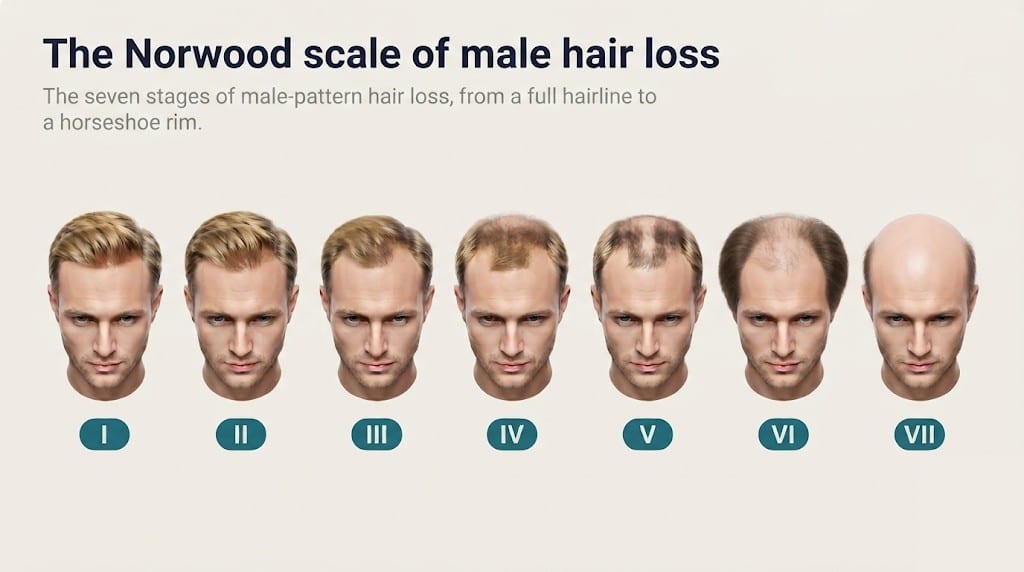
The reason is called donor dominance. For most people with hereditary hair loss, the follicles at the back of the head and above the ears are genetically resistant to DHT, the hormone that shrinks the hairs on top of the head and along the hairline. That resistance broadly comes along when the hairs are moved. The whole procedure is built on there being such a defined and stable area to harvest from. A clear pattern is proof you can see with your own eyes that this divide exists.
What do the Norwood stages mean in practice?
- Norwood I and II. Little or early loss at the temples. Usually too early for surgery. Monitor rather than operate.
- Norwood III and IV. A clear, established pattern at the hairline or early thinning at the crown. This is where most people who end up having surgery come for their first consultation.
- Norwood V and VI. Large areas at the front and crown that meet on top. Still very treatable, but the plan has to be matched carefully to the donor hair you have.
- Norwood VII. Only a thin horseshoe of donor hair remains. Often still possible, but now the donor hair sets the limit for almost everything.
What is the Ludwig scale?
In women, hereditary hair loss is usually graded on the Ludwig scale, which has three stages. It describes thinning on top of the head that becomes increasingly visible, while the front hairline usually stays. In men it's precisely the hairline that recedes. Because thinning in women is more often diffuse than sharply defined, the Ludwig stage alone tells the surgeon less than the Norwood stage does in men. How stable the donor area is carries more weight.
What happens when the loss is diffuse?
With diffuse loss without a pattern (DUPA), the donor area thins just as much as the rest of the head. Then the logic falls apart. If the hairs in the donor area itself are shrinking, the grafts have no resistance to take with them to their new location. We go into this in more detail in the section on who isn't a good candidate.
Is your Norwood number the final word?
Many people treat it that way, as a grade they look up and act on. In reality it's a snapshot. Has the loss increased over the past year? Is the donor area starting to thin? The answers to those questions weigh just as much as the stage itself.
Do you have enough donor hair for what you want?
It's the single most important question, because the density and quality of the hair at the back and sides of your head decide what the procedure can achieve. A dense, thick donor area leaves room for a bigger result that looks natural. If your donor hair is thin to begin with, or already starting to thin, the surgeon can only take a limited number of grafts before the back of the head itself looks sparse.
Every graft that ends up in the hairline or crown is taken from the horseshoe-shaped band around the back of the head that your genes have made resistant. That band runs out one day. A good surgeon thinks of it as a savings account that may have to last the rest of your life, not something you empty in one operation.
What does the surgeon measure?
- Density. The number of hairs per square centimetre. It's assessed by eye and, at the better clinics, with a densitometer or trichoscope. Normal density is between 65 and 85 follicular units per cm². A donor area like that can support a safer plan than one that is naturally sparse, with around 40 or fewer.
- The thickness of each hair. Coarse hairs cover more per graft. Two people with exactly the same density can therefore get results that look quite different.
- How elastic the scalp is. How easily the skin moves matters most with the strip method (FUT) and affects how large a session you can comfortably tolerate. With FUE it matters less.
- How wide the safe zone is. The area that truly holds isn't equally large in everyone. It can narrow with age or while the loss is still progressing, and that limits how far the plan can be stretched.
How many grafts do you have to work with?
A good donor area can realistically give somewhere between 5,000 and 8,000 grafts over a lifetime before it starts to look thinner itself. Some people have more. Some have much less. At Norwood 7 the need is often greater than the donor area can supply, so the goal becomes good coverage rather than full density. In one session, usually between 1,500 and 4,500 grafts are moved, depending on what the case needs. The surgeon has to weigh the loss you have today, the plan for this session and the loss that may come against each other. If the clinic takes too much the first time, the account may be empty on the day you need another session or your loss progresses on its own.
Is it simply a case of enough or too little?
Many people see their graft need as a fixed number that exists regardless of the plan. A better question is how many the surgeon can harvest without the donor area looking affected, both now and many years from now. The graft calculator gives you a rough first figure based on photos or your own estimate of density. An assessment face to face, or of close-up photos you send in for a free analysis, turns that figure into a plan.
Read more: The full guide to donor hair: do you have enough? →
Does your hair type or ethnic background matter?
Mostly for the technique and the plan, almost never for whether you can have surgery. Curly and Afro hair grows in a curve under the skin and needs extra care so the follicles aren't cut through during extraction. If your hair is fine and straight, or East Asian, density and angle are planned differently. Whether you're a candidate is decided by your pattern and donor hair.
The basic requirements are the same whatever your hair and skin colour: a clear area of loss and a healthy donor area. The difference lies in the technique, meaning how the grafts are extracted, handled and angled. Curly and Afro hair bends under the skin, so the surgeon should have solid experience with the right punch tools. In return, each curly graft covers a larger area. Coarse, straight hair, which is common in people of East Asian background, gives good density but leaves little room for error in angle and spacing. Whatever the hair type, the result looks fuller when the colour of the hair and the skin are close to each other. So hair type rarely decides whether you can have surgery. But it shapes the plan, and it should shape which surgeon you choose.
Read the full guide to curly, straight, fine and coarse hair types →
Can women have a hair transplant?
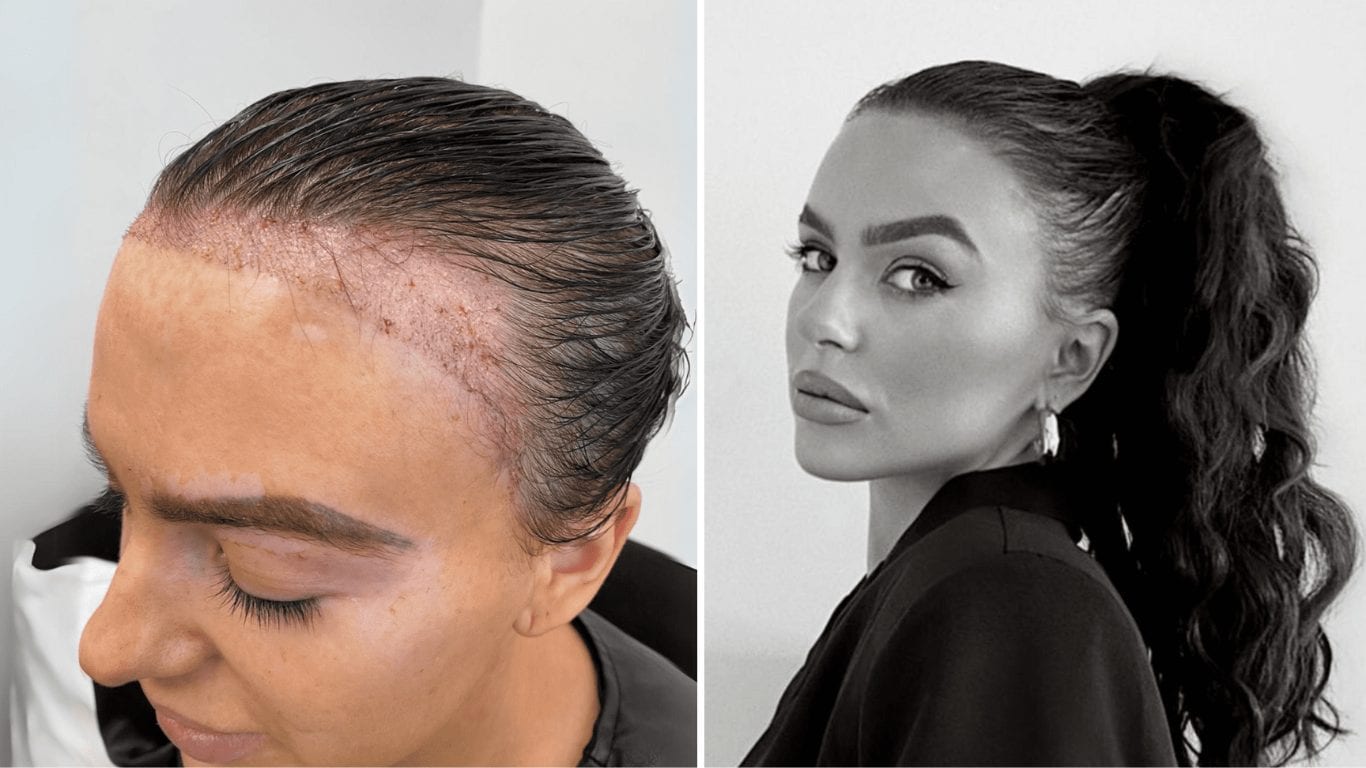
Yes, and many women are very good candidates. First the doctor has to rule out causes that can be corrected without surgery, such as thyroid disease, iron deficiency or telogen effluvium. In women the loss is also more often diffuse than clearly defined, so the donor area has to be assessed especially carefully before anyone recommends an operation.
Women can get very good results. The assessment simply starts one step earlier than for men. Before anyone talks about surgery, the doctor has to look for a cause that can be reversed without a scalpel.
Why is there an extra step for women?
Hereditary hair loss in women is both real and common. But several other treatable causes of hair shedding affect women far more often than men, and to the naked eye they can look almost the same. If you operate before they've been ruled out, you risk spending precious grafts on a scalp that is losing hair for a reason no surgeon can remove.
Thyroid
Both an underactive and an overactive thyroid can cause diffuse shedding all over the head. A simple blood test, in which the doctor usually measures TSH and often free T4, reveals it. Once the thyroid is treated and stable, the hair often comes back, at least partly, without any operation.
Iron deficiency
Low ferritin, meaning low iron stores in the body, is one of the most common reasons for diffuse hair shedding in women, and one of the most often overlooked. It can apply even when haemoglobin looks normal. If you correct the deficiency together with your doctor, the shedding in many cases stops or lessens.
Telogen effluvium
Giving birth, a high fever, an operation, rapid weight loss or a period of severe stress can push many hairs into the resting phase, telogen, at the same time. The hairs usually start falling two or three months after the trigger, and the shedding most often passes on its own within six months to a year, once the hair cycle is back in rhythm.
What about diffuse thinning?
Once the reversible causes have been cleared away, the logic is the same as for men: everything stands or falls on the donor area. But in women the loss is more often spread evenly over the top of the head, as the Ludwig scale describes, than sharply defined. That's why the donor area has to be examined especially thoroughly. If it too is affected by the same diffuse thinning, a transplant can waste hair you won't get back, and non-surgical treatment is usually a better next step.
If, on the other hand, the loss is clearly defined and the donor hair is stable, women are very good candidates. That applies, for example, to a widening parting, a high or receding hairline, loss from tight hairstyles (traction alopecia) or scars from earlier operations.
Does it work less well for women?
No, not when the pattern of loss is right. The claim that hair transplants don't really work for women doesn't hold up. The difference is that more women than men turn out to have loss that is either reversible or diffuse. That's why the assessment follows a different order. The results are just as reliable. You'll find everything about this in the guide to women, hair loss and transplants.
What can you realistically expect from a hair transplant?
The procedure moves hair you already have. It doesn't create new hair, and the total amount doesn't increase. A realistic goal is a natural hairline that frames your face and denser coverage where the grafts are placed, not the density you had as a teenager. Loss elsewhere continues, so many people use medication alongside.
An honest conversation about expectations before the operation is part of the treatment itself. When someone is unhappy afterwards, it's often because they were promised more than a transplant could ever deliver.
What can the procedure do?
It moves a limited number of your own hair follicles from the donor area, which resists DHT, to where they do the most good and look most natural, usually the hairline, temples and crown. Done by a skilled team, it can bring the hairline noticeably forward, fill in a crown that has thinned, give the face a natural frame again and hide scars or gaps. The result usually looks natural for many years, because the moved hairs generally keep the resistance they had where they came from.
What can't it do?
It creates no new hair follicles, and you don't end up with more hairs in total than you had. Hereditary hair loss (androgenetic alopecia) isn't cured either. The hair that isn't moved is just as vulnerable as before. That applies to the hair left around the grafts and, over decades, to the donor hair too. If someone promises you a specific percentage of density or a guaranteed final result, that's a warning sign. How you heal, and how many grafts take, varies from patient to patient.
What's the difference between density and coverage?
The surgeon usually plans for coverage and shape: an even hairline with a good frame and a crown that looks full. The aim is rarely to copy the density you had at 18. The grafts are spread out on purpose, both so the donor area doesn't look plundered and because supply is limited. For most people it looks full and natural even though the density is lower than in their youth, as long as the grafts are placed with care. Only in exceptional cases is it possible, or wise, to recreate the original density completely.
How long does it take?
- After two to three weeks: Most of the new hairs fall out. This is expected and doesn't mean anything has gone wrong.
- After three to four months: New hairs usually start to grow.
- From six months to a year: The hair gets denser and takes on its final texture, and most people see roughly the final result at around twelve months.
Why might you need medication as well?
Your own hair around the grafts isn't protected. Many surgeons therefore recommend that you continue with, or start, medication such as finasteride or minoxidil, so your original hair lasts longer. That doesn't mean the operation didn't work. It's standard practice so the whole head looks good over time.
Who should hold off, at least for now?
Typical examples are diffuse loss without a pattern (DUPA) where the donor hair is thinning too, too little or poor-quality donor hair, scarring (cicatricial) alopecia or autoimmune scalp disease in an active phase, and hair loss that is still moving fast. Most often it means waiting or treating the cause first, not a final no. The surgeon gives the final answer.
A candidate guide that only says yes isn't worth much. Here are the situations where a transplant usually isn't the right next step, at least not now. None of them is applied lightly. Each is a good reason for a responsible surgeon to pause, investigate further or suggest another route first.
Diffuse loss without a pattern (DUPA)
When thinning also affects the back and sides of the head, not just the top, the foundation of the whole procedure collapses: that the donor hair is genetically resistant. If you take grafts from an area where the hairs are themselves shrinking, the grafts can go the same way as the hair around them over time. DUPA is detected from the pattern, density mapping and sometimes trichoscopy. Usually the answer is to treat with medication and monitor, not to operate.
Too little or poor-quality donor hair
Some people have low density in the donor area from the start. Others have a lot of scarring from earlier procedures, for example a poorly performed strip operation (FUT), or a donor area that has already been heavily depleted by earlier transplants. In all these cases there's less to work with. A surgeon who takes you seriously tells you when the donor hair won't stretch to what you want, and chooses not to operate.
Scarring (cicatricial) alopecia and autoimmune scalp disease in an active phase
The names need to be precise here, because these diseases are very different. Three conditions belong to the scarring group: discoid lupus erythematosus, lichen planopilaris and frontal fibrosing alopecia. The inflammation destroys the hair follicle for good and leaves scar tissue in its place. If the disease is still active, new grafts in the affected area risk dying, and the procedure can reawaken the disease in the surrounding skin. The body doesn't reject the hair, because the grafts are your own tissue throughout. What happens is that the underlying disease takes the grafts and flares up. Surgery is usually only considered once the disease has been quiet, often for six months or longer, and a dermatologist has been following you.
Alopecia areata belongs in a completely different group. It's autoimmune but doesn't cause scarring, the follicle usually lives on, and the hair can return when the immune system calms down. It's usually stabilised with medication first and assessed according to how active it is now. It isn't treated as a scarring disease.
Loss that hasn't stabilised
If the surgeon places grafts in a pattern that is still changing, the hairline or crown may sit perfectly now and be left stranded in a few years, as the surrounding hair keeps receding. The answer is most often wait a little. The solution is medication and a period of monitoring, as we described in the section on age and stability.
Correctable causes that haven't been dealt with
Iron deficiency, thyroid disease and telogen effluvium cause shedding that no transplant can fix, because that shedding isn't caused by DHT-sensitive follicles. If a blood test or a few months of waiting can solve the problem, starting there is almost always right.
Expectations no operation can meet
Sometimes the obstacle isn't medical. If you're hoping for teenage density across your whole head, or want a guarantee of one exact result, you're asking for something no surgeon in the world can promise you. At a good consultation you'll be told so plainly, and nobody says yes to a plan that can't be delivered.
Does a no today mean no for ever?
Rarely. Most of the points above are reasons to wait, treat something else first or investigate further. Many people who are told to wait come back after a year or two and are well suited then, because the disease is under control or the pattern has settled. Only a qualified surgeon can say where you stand after examining your scalp.
How does suitability look overall, factor by factor?
The table shows the most common factors at three levels, from good candidate to usually not suitable. It's a simplification and meant only as a guide. How suitable you actually are depends on how the factors interact, and a surgeon assesses that from the whole picture, not from one row read on its own.
Six things decide most of it: how clear the pattern is, how much donor hair you have left, how long the loss has stayed still, your general health, how your scalp is doing and whether your expectations are realistic. If you land mostly in the left-hand column on all six, that's a good sign. If you land in several of the other columns, that's no verdict. It's a reason to get a proper assessment before you draw a conclusion either way.
| Factor | Good candidate | Needs closer assessment | Usually not suitable |
|---|---|---|---|
| Pattern | Clear pattern (Norwood or Ludwig) | Mixed pattern with some diffuse loss | Completely diffuse loss without a pattern (DUPA) |
| Donor hair | Dense, coarse and stable | Medium density, some thinning | Sparse, thinning or already heavily used |
| Age and stability | Loss has stayed still | Loss is slow and steady | Early loss that is moving fast and hasn't settled |
| General health | Healthy, any conditions well controlled | Conditions that can be managed but need reviewing | Uncontrolled conditions that impair healing |
| Scalp | Calm and healthy | A treatable flare that hasn't settled | Scarring alopecia or infection in an active phase |
| Expectations | Realistic goal of density with a good frame | Needs a more thorough talk about the result | Expects maximum density everywhere, for ever |
No row can be read on its own. Two people with identical donor areas can get very different advice once age, stability and scalp are taken into account. The surgeon therefore reads the table as a whole and doesn't score each line. If you land several times in the two right-hand columns, that's exactly when a free assessment is useful, without you committing to anything.
Where do you stand? Take the two-minute self-test
The self-test gives you a rough indication, not a diagnosis. It highlights what matters most, namely pattern, donor hair, stability, health and scalp, so you can see roughly where you stand. Only a qualified surgeon can confirm whether you're a candidate after a personal assessment.
Everything above boils down to five things the surgeon weighs against each other: the pattern, the donor hair, stability, general health and the scalp. The seven questions below take a couple of minutes and give you a first impression before you book anything at all.
The test only gives a general indication and is not a diagnosis. Your answers are not stored. Answer all seven questions to see your result.
Does your hair loss follow a pattern you recognise, such as a receding hairline or a thinning crown, rather than sudden or evenly spread shedding?
Do you still have fairly dense hair at the back of your head and above your ears, where donor hair is taken from?
Is your health good, and are any conditions such as diabetes or thyroid problems well controlled?
Is your scalp free of flaking, sores, infection and redness right now?
Has your hair loss stayed fairly still, or slowed noticeably, over the last twelve to twenty-four months?
Are you at least 25, or, if you're younger, has your loss clearly settled?
Do you accept that the procedure moves your own hair, that it won't give you teenage density and that it won't stop all future loss?
Answer all the questions first, then we'll show your result.
You look like a strong candidate
Your answers point to loss in a stable pattern, a healthy donor area and realistic expectations. That's exactly what a surgeon looks for. The next step is a personal assessment that confirms it and draws up a graft plan.
Book a free assessmentLikely candidate, but something needs checking
Most of your answers are good signs. One or two points still need a closer look before anyone can give you a yes. A free assessment shows where you stand.
Book a free assessmentPerhaps not yet
Your answers suggest a transplant probably isn't the right step just now. Often the reason is that the loss is still developing, that the donor hair needs assessing or that a correctable cause should be dealt with before anything else. Things like this often change. A free assessment gives you an honest answer, with no pressure.
Book a free assessmentWhat people ask most
Is there an upper age limit for a hair transplant?
No, not a fixed limit. The surgeon looks at your general health, whether any conditions are well controlled, how stable your hair loss has been and how dense and good the donor hair at the back of your head is. How well your skin heals and how elastic your scalp is are also taken into account, since both can change a little over the years, even in the resistant zone. Many older people are good candidates when these things are in order. It's decided when a qualified surgeon examines you, not by a number in a table.
Can I be too young for a hair transplant?
Being young isn't an obstacle in itself. If your loss is moving fast at a young age, you'll still usually start with medication, most often finasteride, minoxidil or both, so the pattern has time to settle before anyone makes a plan. If loss that is still in full swing is operated on, the result can look great today and be left stranded in a few years, as the surrounding hair keeps receding. Many young people who have to wait get a yes later, when photos taken over six months to a year show that the pattern has stabilised.
Can you have a hair transplant if you have diabetes?
Usually, yes. Well-controlled diabetes, where your blood sugar stays steady and your HbA1c is where your doctor wants it, is generally compatible with the procedure. What the surgeon is concerned about is how blood sugar affects wound healing and how many grafts take. Poorly controlled diabetes can lead to slower healing and more infection, so it's assessed individually before the operation and often clarified with your GP before you get a date. A reputable clinic won't turn you away just because you have diabetes.
How do I know if I have enough donor hair?
It depends on how dense, coarse and stable the hair at the nape and above your ears is, and how wide your genetically resistant zone is. A dense, wide donor area can give several thousand grafts, sometimes spread over several sessions over the years. If your donor hair is thin or already starting to shrink, the safe harvest is smaller. The surgeon assesses it by eye, from close-up photos or with a densitometer. Our graft calculator gives you a rough first figure, but only an assessment of your own donor area gives an answer you can rely on.
Can a woman have a hair transplant?
Yes. In women the doctor first has to rule out causes that can be corrected in other ways, such as thyroid disease, low iron stores (ferritin) or telogen effluvium after giving birth, illness or stress. A transplant does nothing for that kind of shedding. Once they're cleared away, the same requirements apply as for men: an area of loss with clear boundaries, such as a widening parting or a receding hairline, and a stable, dense donor area. Because loss in women is more often diffuse, the donor area is examined especially carefully before anyone recommends surgery.
Who should not have a hair transplant?
If you have completely diffuse loss without a pattern (DUPA) that also affects the donor area, too little or poor-quality donor hair, scarring (cicatricial) alopecia in an active phase, for example frontal fibrosing alopecia or lichen planopilaris, an active autoimmune scalp disease or loss that is still moving fast, you'll usually be advised to wait, treat the cause or investigate further. Iron deficiency and thyroid disease should also be dealt with before surgery is considered. Little of this is permanent. A great many people get a yes later, once the disease is under control or the pattern has settled, and that's confirmed at a new assessment.
The answer lies in your scalp, not in an article. Request a free hair analysis and you'll get an honest assessment from the clinic at the top of our ranking: what kind of pattern you have, how your donor area looks and what you can realistically achieve. You're not committing to anything further.
This is general information and not medical advice. Only a qualified surgeon can decide whether the procedure suits you, after a personal assessment.
Goes to the clinic at the top of our ranking.
Updated: October 2026 · How our editorial team works