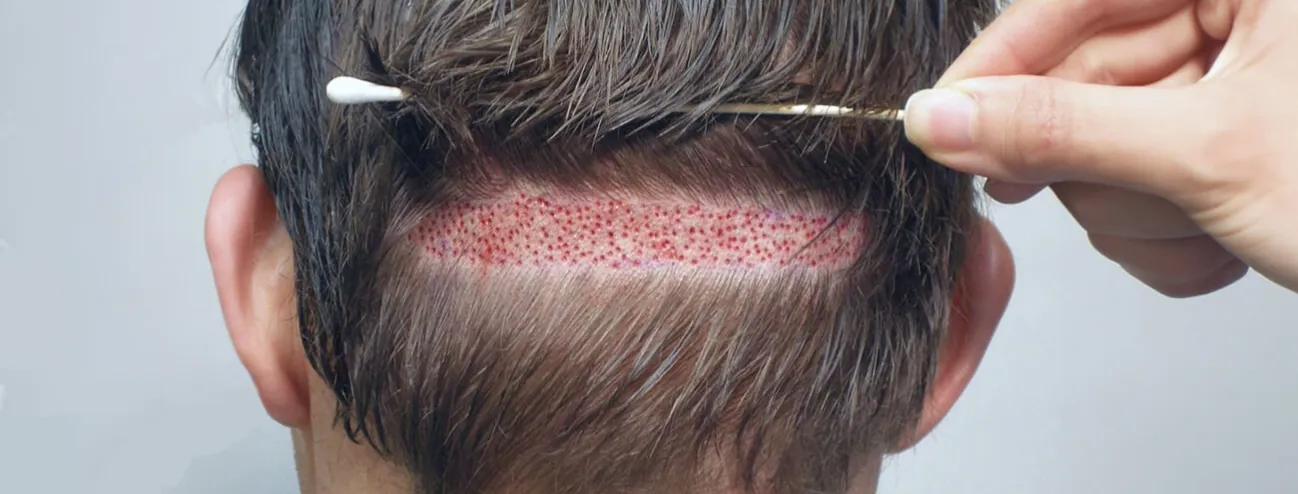
FUT stands for Follicular Unit Transplantation, but most people simply call it the strip method. The surgeon removes one narrow strip of scalp from the back of the head, a team dissects it into follicular units under a microscope, and the grafts are implanted in the thinning area in exactly the same way as after FUE. Of the two ways of harvesting donor hair, this is the older one. FUE dominates the market today, but FUT hasn't gone out of date. It's actively used, and in some cases it's the best choice.
Here we look at what the strip changes and what it leaves alone. We explain how the procedure works and what the scar looks like at different hair lengths. You'll learn why some surgeons are sticking with the strip in 2026, who it suits compared with FUE, and how it can fit into a long-term plan alongside FUE. Finally, we cover healing, price and what to check with the surgeon. If you want to see FUT, FUE, DHI and sapphire FUE compared, we have a separate methods guide. If you're unsure whether you're a candidate for surgery at all, start with the candidate guide. This page is only about FUT.
- With FUT, only the harvesting of donor hair is different: one strip instead of many small punch extractions. How the grafts are implanted, how well they survive and how long they last are the same.
- The price you pay is one linear scar at the back of the head. It hides well once the hair has some length, but shows if you cut your hair very short or shave it.
- The method has survived because one session can yield a very large number of grafts while the rest of the donor area is left untouched for a possible FUE later.
- FUT usually costs less per graft than FUE, because dissecting a strip takes less working time per graft than extracting each unit individually.
- With the strip, the result depends more on the surgeon and the team. That makes it all the more important to see their own results.
What is FUT, or the strip method?
In FUT, the surgeon removes a narrow strip of skin from the dense donor area at the back of the head, where the hair is largely resistant to DHT, and stitches the wound closed. A team then dissects the strip into follicular units of 1 to 4 hairs under a stereomicroscope, and the grafts are implanted just as in FUE, because the two methods differ only in how the donor hair is harvested.
The full name is Follicular Unit Transplantation. Patients and clinics nearly always say the strip method or strip surgery, though, because what defines the procedure is that the donor hair is removed as one continuous strip of skin. In FUE (Follicular Unit Excision), each unit is extracted individually instead. The strip method is the older of the two and in its day replaced the crude multi-hair plugs. It's still performed regularly in 2026, and a reputable clinic has no reason to keep quiet about it.
The procedure has three steps. First, the surgeon marks out and removes the strip, which usually runs across the safe donor zone at the back of the head. The wound is closed straight away with stitches or staples. Next, a team dissects the strip under a stereomicroscope, often with several technicians working at the same time. They separate out the follicular units, the natural small groups of one to four hairs on which every hair transplant is built. Finally, the grafts are implanted in the thinning area using the same judgements and tools as when the grafts come from FUE, whether the surgeon opens channels first or uses a DHI pen.
Where exactly is the difference between FUT and FUE?
Only in the harvesting. FUT doesn't change what a graft is or how it's implanted. Nor does it change how well the graft tolerates the move or how long the hair lasts once it has started growing. The grafts behave the same in the recipient area whichever method is used, because they are the same thing: your own follicular units, taken from the band at the back and sides of the head where the hair largely holds out against DHT, the hormone behind hereditary hair loss.
Why remove a whole strip?
Because the team then gets a piece of tissue that lies still under good light and magnification. In FUE, the punch has to follow each follicle down into the skin without seeing it. With the strip in front of them, the team can work through the tissue with little damage to the grafts, which is why FUT in skilled hands can yield a very large number of grafts in one operation. More on that further down. The downside is the linear scar the strip leaves, and that's what we turn to now.
What does the FUT scar look like, and does it ever disappear?
A well-closed FUT scar is a thin horizontal line at the back of the head, often sutured with a trichophytic technique so that hair grows through the scar itself and makes it harder to see. With some length on the hair it is completely hidden for most people, but with a buzz cut or a shave it shows as a pale strip. The scar never disappears. Over time it becomes easier to camouflage.
No part of FUT gets more questions than the scar, and you deserve a straight answer without sales talk in either direction. When a strip of skin is removed and the wound is closed, a real, permanent incision line is left at the back of the head, usually within the safe donor zone some way above the nape. What varies a lot is how fine the line turns out. That's largely decided by the closure technique and the surgeon's skill, not by luck.
What is a trichophytic closure?
It's standard practice for most surgeons with a lot of strip experience. The surgeon cuts one wound edge at an angle and then sutures the edges together. This lets the hair follicles right at the edge grow straight through the scar tissue, instead of the hair stopping abruptly at a bare strip. You get a scar with fine hairs in it, which breaks up the pale, hairless line that older closure techniques produced. The scar therefore blends in far better with the surrounding hair.
How short can you cut your hair?
When the hair has some length and simply lies over the area as it grows, a well-made scar is genuinely hard to find, even when you stand in front of the mirror looking for it. The limit is length. If you get a buzz cut, a skin fade right down the back of the head or use clippers on the lowest setting, the line shows as a pale horizontal strip. There simply isn't enough hair left to hide it. If you think you'll want to shave your head one day, in five or twenty years, you should see this as a permanent limitation. It's no small cosmetic detail.
What makes the scar wider or more visible?
- A strip that is too wide for how elastic your scalp is. A wound closed under too much tension is the most common reason a scar stretches and widens in the months afterwards.
- Several FUT procedures. In a second or third round, a new strip is often taken close to, or through, the old scar. Without good planning, the band can end up wider overall.
- A tendency to keloid or hypertrophic scarring. This is less common but real, and should be raised with the surgeon before you choose FUT.
- Poor closure technique. A closure done in a hurry or without a trichophytic technique heals into a harder, more obvious line, even in people who otherwise heal well.
Can a visible scar be made less noticeable?
Often, yes, but it never goes away. Many people use scalp micropigmentation (SMP), where tiny pigment dots in the skin soften the contrast between the pale scar and the surrounding scalp. Some surgeons also implant FUE grafts directly into the scar tissue so that hair grows in the line. Scar tissue has a poorer blood supply than normal skin, so grafts there tend to grow a little less predictably. It's a repair, not a plan. If you already know you'll want to go very short, it's simpler to choose FUE from the start.
What does "permanent" actually mean here?
The scar becomes part of your donor area for good. Over time it gets softer and flatter, usually also paler over the following year, and with a good trichophytic closure it's very well camouflaged. But it doesn't wear off the way the effect of a medicine does when you stop taking it. This is the very heart of choosing a method, and we go into it in depth further down. Weigh it up before the operation. Don't discover it afterwards.
Why does the strip method live on in 2026, when nearly every clinic advertises FUE?
Because in certain cases FUT beats FUE on two points: the method can yield a very large number of grafts at once with little damage to them, and since everything comes from one strip, the rest of the donor area is left untouched for a possible FUE later. In the international Practice Census that ISHRS published in 2025, FUE accounted for around 85.4 per cent of procedures in men and FUT for around 12.5 per cent, so FUT is in the minority, but a minority chosen on purpose.
FUE took over for good reasons. Most people would rather not have a line at the back of their head and want to be able to cut their hair very short whenever they like. That shift in what patients want is real and has changed the market. But the fact that most people prefer FUE doesn't mean FUT has lost its place. Surgeons who keep up their strip surgery skills usually do so for concrete medical reasons. Not out of old habit.
What do the figures say?
The professional society for hair surgeons, ISHRS, collects figures from its members in its Practice Census survey. In the 2025 edition, FUE was used to harvest donor hair in about 85.4 per cent of procedures in men. Strip or linear harvesting, in other words FUT, accounted for about 12.5 per cent, and the rest were combinations or other methods. FUT is clearly in the minority, then. Even so, the strip is still used in nearly one in eight procedures on men worldwide, which is far more than a handful of stragglers.
Why does FUT yield so many grafts in one session?
A trained team working at the same time on a strip under the microscope can often prepare a very large number of grafts in a day, and faster than if the same units were extracted one by one. If you have extensive hair loss and want as much as possible done in one operation, instead of splitting it over two or more, that's a real practical advantage.
How does FUT spare the rest of the donor area?
The strip is taken from one defined band. FUE spreads the extractions across the whole donor area. After FUT, the density of the surrounding hair can therefore often look less affected than when the same number of grafts has been taken with FUE. This matters most if you may need another procedure in a few years, and that's exactly the strategy we look at in the next section.
Why are large sessions easier to plan with FUT?
Because the dissection happens on a strip that lies still. With FUE, each graft has to be extracted individually throughout the session, whether the surgeon uses a manual instrument or a motorised punch. With FUT, a clinic with enough staff can plan very large sessions and divide the work predictably between the surgeon and the team dissecting the strip. On the blog we have a shorter, more practical piece on when FUT is the right choice, which you can read alongside this one.
It depends on your donor area, your hair type and where the loss is. Send three photos and the medical team at the clinic at the top of our ranking will suggest a method and number of grafts.
Goes to the clinic at the top of our ranking.
FUE or FUT: who actually gains from choosing the strip?
FUT suits you best if you have extensive hair loss and want as many grafts as possible in one session, if you're happy keeping some length on your hair for the rest of your life, and if your scalp and donor density allow a strip to be closed without too much tension. Almost everyone else is better served by FUE, especially if you want to be able to shave your head. Neither method is best for everyone. It depends on the extent of your case and your plans for hair length.
The question isn't which one wins. The question is which trade-offs you can live with most easily. A few concrete factors tip the balance from FUE, the default choice, towards FUT.
What speaks in favour of FUT?
- Extensive loss that needs many grafts at once. Higher Norwood stages, where getting a lot done in one go matters more than avoiding a scar.
- You know you'll want some length on your hair, for good. Not "I probably won't shave", but that you really don't want to. The scar is the whole trade-off.
- An elastic scalp and good donor density. The surgeon needs enough give in the skin to close a strip of useful width without pulling too tight.
- A donor area not previously used for FUE. If you're starting from scratch, the tissue is intact and suited to a clean closure. If you've already had large FUE harvests, the tissue may be less suitable.
- Price, but only together with the points above. It gets its own section further down. On its own, it's rarely enough of an argument for the strip.
How do they compare, point by point?
| What you're comparing | FUT (strip) | FUE |
|---|---|---|
| Scar in the donor area | One linear scar for life, hidden when the hair has some length | Many small dots spread out, much less visible even with short hair |
| Freedom to choose hair length later | Limited. The line shows when the back and sides are shaved or buzzed | Wide. Most people can go very short without anyone noticing |
| Grafts per operation | Can be very high. This is where the method is strong | Also high, but takes more time and more hands per graft when the number gets very large |
| Typical price per graft | Usually lower | Usually higher |
| The first days at the back of the head | More tightness and tenderness | Faster healing, usually less discomfort |
| What happens to the rest of the donor area | Left untouched for a possible FUE later | The extractions, and so the thinning, are spread over the whole area |
If you want to see all the methods together, including DHI and sapphire FUE, you'll find them in the methods guide. Before you talk to a surgeon, it's also a good idea to have a rough picture of how many grafts you need. The graft calculator gives you a first estimate.
Can you use both FUT and FUE if you need several procedures?
Yes. Many people do so deliberately, and it doesn't mean the first round failed. FUT is often used for an early, large session, with FUE coming later to top up with grafts from the area around the scar or other parts of the donor band. Planned like this, the surgeon gets the most out of a donor area that realistically yields somewhere between 5,000 and 8,000 grafts over a lifetime.
Donor hair doesn't grow back once it's used. Think of it as a budget for your whole life, and a first procedure can either manage it wisely or squander it. FUT and FUE draw from the same limited band, just in different ways. A well-thought-out plan therefore often uses both, each at the right time, rather than treating the choice of method as a one-off decision. You'll find the full picture of donor supply on the page do I have enough donor hair? Here we only look at where FUT fits in.
Which order is most common, and why does it work?
A widely used approach starts with the strip, in the largest session. That's typically when the loss is extensive and the graft count matters most. Later, sometimes several years after, FUE follows for smaller refinements, with grafts taken around the scar once it has healed or from other parts of the donor band. Because FUT takes everything from one strip, more of the rest of the donor area stays untouched and ready for FUE. It's the same mechanism as in the previous section.
Does FUT have to come first?
No. The reverse order is just as valid. If you started with FUE, and another round of FUE can't give you enough without thinning the donor area too much, FUT can come in at that point. That way you only take on the scar when it's really needed. No order is right for everyone. The answer lies in what you need today, what you'll probably need in a few years, and how important it is for you to be able to shave your head along the way.
What is the surgeon actually calculating?
A responsible plan treats every session as a withdrawal from the same account, whatever the method. The surgeon weighs what you need today, how large and how good the safe donor zone is, and a cautious estimate of how much more you might lose in the years ahead. The classic mistake is to use up the whole lifetime budget early, in one big session, whatever the method. You're then left with no reserve if the loss continues.
How does healing after FUT differ from healing after FUE?
At the back of the head the difference is clear: after FUT you have a wound closed with stitches or staples that is under tension for the first few weeks, so the area tends to be more tender and stiffer than after FUE's scattered small holes, and you have to wait longer before hard exercise. In the recipient area, though, the course is the same for both methods, with shedding two to three weeks after the procedure, new hairs from the third or fourth month and the final result after about 12 months.
Keep apart two things that are often mixed up. One is how the donor wound heals, and there FUT and FUE differ. The other is how the transplanted hair grows, and there they are the same.
Why is the donor wound harder going after FUT?
Once the strip wound is closed, it's under a certain amount of tension straight away. You'll feel that clearly in the first 7 to 14 days. The back of the head is more tender, the neck stiffer and less mobile, and the wound needs a check-up, usually after one to two weeks. If the surgeon used stitches or staples that need removing, they come out then. Heavy strength training, swimming, contact sports and anything that makes you strain usually have to wait longer than after FUE. Anything that stretches the scalp pulls directly on a healing incision. Scattered small holes cope with it better.
How does the donor area heal after FUE?
The many small extraction sites close and scab over individually. There's no long wound pulling tight across the whole area. That's why most people feel clearly less tenderness at the back of the head after FUE, and get back to normal movement and light activity sooner than after FUT.
Is the growth in the recipient area any different?
No. The differences above don't apply to the recipient area or the growth timeline, because that's governed by the graft and where it's implanted, not by how it was harvested. Whatever the method, you'll usually shed the transplanted hairs two to three weeks after the procedure. That's supposed to happen, and it doesn't mean the grafts are lost. The roots stay in the skin. New hairs appear from the third or fourth month, and after about 12 months you can see what you've actually got. The usual routine for sleeping position, hair washing and sun is in the aftercare guide. Here we only cover what's specific to the donor area after FUT.
What are the differences, point by point?
- Tenderness and tightness. More noticeable at the back of the head after the strip, especially in the first 14 days. After FUE the donor area usually feels better, and sooner.
- Check-up. After the strip, the wound usually needs checking one to two weeks after the operation, and stitches or staples are removed if they don't dissolve on their own. After FUE this is rarely necessary.
- Activity restrictions. Heavy weights, running at a high heart rate and contact sports usually have to wait longer after FUT, because tension on the wound is exactly the risk you need to avoid.
- The recipient area and growth. The same for both. The hairs fall out in week 2 or 3, start growing again after three to four months and reach their full result after a year.
Does the strip method cost less than FUE, and why?
Usually, yes. At clinics that price by method, FUT tends to come out cheapest per graft, often below standard FUE, DHI and sapphire FUE. The explanation is working time: when a team dissects a strip that has already been removed, it takes less time per graft than extracting each unit directly from the scalp, and that shows in the price.
Price differences between methods come down mostly to one thing, and it runs through our whole price guide: how much skilled working time each individual graft requires. DHI usually costs more than standard FUE for exactly that reason. It takes longer, demands more precision and often staff with narrower specialist skills. The same logic works the other way for FUT, which is why the method tends to sit at the lower end of the price range per graft.
Why do the sums favour FUT?
Removing the strip is a single surgical step, and it's relatively quick. Afterwards, several technicians dissect the strip at the same time under the microscope. With FUE, one person has to extract graft after graft, in sequence, straight from the scalp. Over a large session, the difference in working time per graft becomes so big that the clinic can charge less for FUT and still make the numbers add up.
When is a low price not a real saving?
When you don't get the same for your money. A low price is only worth something if the graft count and the quality of the work hold the same standard. The rule is the same for every method. Ask for the total price and the expected graft count together, in writing, and don't compare the advertised figures alone. If a clinic offers FUT at a strikingly low price and is vague about the graft count or about who dissects the strip, that's a warning sign. FUT is no exception just because the method is cheaper on average.
What are you actually trading away?
Let's be honest. The lower price isn't a free discount. You pay with the linear scar and a longer, more restricted healing period at the back of the head, as described above. If you have extensive loss and know you'll always want some length on your hair, the trade can be worth it. If you can picture yourself one day taking the clippers right down, it rarely pays off, however tempting the price difference looks.
What should you check with a surgeon who offers FUT?

With FUT, two skills have to come together at once: the surgeon's hand when closing the wound, with the right tension and an angled trichophytic edge, and the precision of the team dissecting hundreds or thousands of grafts under the microscope without damaging them. With an inexperienced team, the same strip can end in a wide, clearly visible scar and few usable grafts. With a skilled team, it becomes a fine line and a strong result.
Every method rewards experience, but with FUT the gap between a good and a poor procedure is wider. More of the result depends on judgements made by hand, and less on a standard tool used the same way from patient to patient. That's why checking the clinic matters more before you book FUT than before you book FUE.
What should you ask a FUT surgeon to show you?
- Photos of donor scars with short hair. Ask whether you can see the scars of the surgeon's own FUT patients with the hair cut short around them, not just with grown-out hair. Only then can you see how good the closure really is.
- Who closes the wound. A named, qualified surgeon should do it. Ask directly whether trichophytic closure is standard, or only something you get if you ask for it.
- Who dissects the strip. A permanent, experienced team of technicians matters as much as the surgeon. A graft damaged during dissection can't be used, however neatly the strip was removed.
- How the width of the strip is decided. It should be adapted to how elastic your scalp is, not a fixed measurement used on everyone.
- A concrete plan for the donor wound. What's normal along the way, when you go for the check-up to have stitches or staples removed, and who you contact if something seems wrong.
These questions come on top of the general checklist in the guide to red flags at clinics. It covers named surgeons, accreditation you can verify and transparent pricing, whatever the method. In the guide to choosing a clinic, we take you through the choice step by step. Then compare in the ranking and look through the clinics that meet our threshold. Finally, take the FUT questions above to the ones on your shortlist.
Should you avoid FUT because the result depends so much on the team?
No. With an experienced, well-organised team, FUT still generally gives a fine, well-hidden scar and plenty of good grafts. The point isn't that the method is dangerous in itself. The point is that a mediocre team can get more wrong with the strip. That's why the checklist above carries more weight than anything else on this page.
Can verteporfin make the strip scar smaller?
The strip scar is the biggest drawback of FUT, which is why many people are following verteporfin. In animal studies, the drug blocked the signal that makes stretched skin form scars, and the wounds healed without a visible scar. A study in Odense is due to test the drug on incisions in humans, but it hasn't started yet, and no study has looked at strip scars after hair transplants. Until results are available, good suturing technique and the right skin tension are what decide how wide the scar becomes. More on verteporfin and scarring in the donor area.
Frequently asked questions
Are FUT and the strip method the same thing?
Yes. FUT (Follicular Unit Transplantation), the strip method and strip surgery are three names for the same procedure. The term strip method simply describes how the donor hair is harvested: in one piece, not unit by unit.
Is FUT more painful than FUE?
Not during the operation itself. Both are done under local anaesthetic, and what you notice is pressure and the sense that something is happening, not pain. For the first couple of weeks afterwards, the donor area is usually more tender and stiffer after FUT, because one long wound under tension heals differently from many small holes that each close on their own.
Can I shave my head after FUT?
Yes, but then the scar shows. With some length on the hair, a well-closed scar is usually completely hidden, but a buzz cut or a shave on a low clipper setting reveals it as a pale horizontal line at the back of the head. If you want to be able to shave your head in ten or twenty years, that's the main reason to choose FUE.
How many grafts can I get from one FUT operation?
FUT has no upper limit of its own. The number depends on donor density, how elastic the scalp is and how wide a strip the surgeon can close without too much tension. It falls within the same broad range as other large procedures, often somewhere between 2,000 and 4,000 grafts, sometimes more. The advantage of FUT is that it efficiently reaches the upper part of that range in one day. You don't get access to more grafts in total than with FUE.
Does the FUT scar fade away completely over time?
No. The incision line itself is permanent, even with a good trichophytic closure where hair grows through the edge. What happens is that the scar softens, flattens and gets paler in the first year, and becomes very hard to see once the surrounding hair has some length.
Can FUT and FUE be part of the same treatment plan?
Yes. Many people plan exactly that way over several years. A typical approach starts with the strip in an early, large session and uses FUE later to top up from the area around the scar or other parts of the donor band. That way you make use of the same limited donor hair with two different harvesting methods over time.
Whether the strip method is worth the trade-offs for you depends on your donor area, how extensive your loss is and what hair length you want in the years ahead. No article can answer that. Ask for a free hair analysis and you'll get an honest review of your donor area, scalp and options from the clinic ranked number 1 in our ranking. You're not committing to anything.
This page provides general information and does not replace medical advice. Only a qualified surgeon who has assessed you in person can decide whether the strip is right for you.
Goes to the clinic at the top of our ranking.
Updated: October 2026 · How our editorial team works