Is FUT still worth it? When the strip method is the right choice
FUE has taken over the market, but the strip method still delivers many grafts in one day without shaving your head. The price is a scar at the back of the head. Here's how to judge whether the trade-off is worth it.
Is FUT outdated?
No. FUT is older than FUE, and most people choose FUE today. Even so, the strip method hasn't passed its sell-by date, and for some patients it's still the best choice. The question is whether you're one of them, and the answer depends mostly on how short you want to cut your hair for the rest of your life.
How does FUT work?
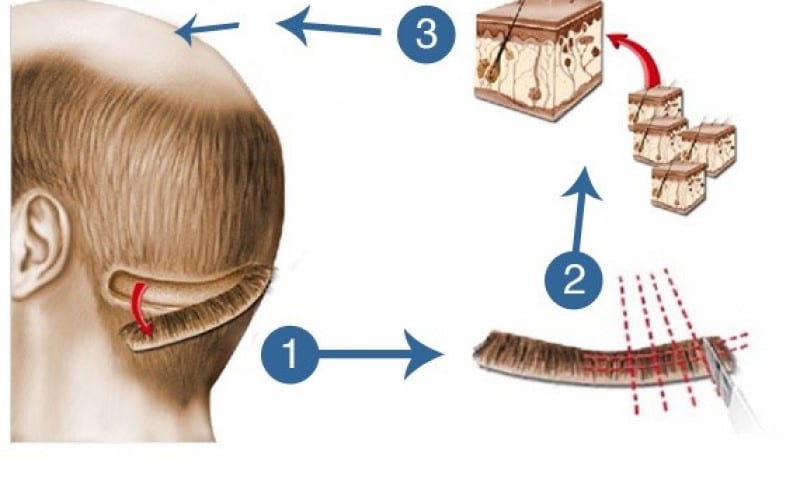
The surgeon cuts out a narrow strip of skin from the donor area at the back of the head. The strip is then divided under a microscope into the small groups of hairs that naturally grow together, the follicular units. These are what we call grafts, and they're implanted exactly as with FUE.
The name stands for Follicular Unit Transplantation, and many people simply call it the strip method. So the difference from FUE is about how the hair is harvested. With FUT, everything comes from one strip, while FUE removes each follicle individually. See also the comparison of FUE and DHI.
What's the big advantage of FUT?
Many grafts in one day. FUT can deliver a large number of good-quality grafts in one session, and you don't need to shave your whole head. Because everything is taken from one dense strip, the harvest can be very large. That matters a lot if your hair loss is advanced.
Some surgeons also point out that grafts from the strip can be of very high quality. They're dissected under a microscope, and the surrounding tissue protects the follicles while they're removed.
How visible will the scar be?
It depends entirely on your hair length. Where the strip was removed, there's a linear scar running from side to side across the back of the head. If your hair has some length, the surrounding hair covers it. If you cut it very short, for example clippered right down, it becomes visible. For many people, this is the point that decides the choice.
When the job is done well, you end up with a thin, horizontal line that disappears under your hair as long as it isn't clippered right down. With trichophytic closure, a technique that lets hair grow through the scar itself, the line can become even less visible. If you have no plans to go very short, the scar rarely causes problems in everyday life.
The wound at the back of the head also takes a little longer to heal than with FUE, and you may feel more tenderness there in the first few days.
Who is FUT best suited for?
FUT can be the right choice if you:
- need many grafts in one day because your hair loss is advanced
- have low density in the donor area, where the strip makes good use of what you have
- have long hair and can't ever see yourself getting a buzz cut
- don't want to shave your whole head before surgery
Even so, most people choose FUE today. They want to avoid visible scars and be free to choose their hair length later on. You can read about how much you have to work with in the donor area in the article on donor capacity.
Who should decide whether you have FUT or FUE?
You, together with a surgeon who knows both methods. Neither is better in absolute terms. The right choice depends on your hair loss, your donor area and how short you want your hair in the future. A skilled surgeon starts from your head and doesn't let the clinic's sales targets drive the advice. If a clinic only offers one of the methods, you'll rarely get a neutral assessment.
What should you do now?
Think through one question before your consultation: will you ever want to clipper your hair right down? If the answer is no, and you need many grafts, ask the clinic to consider FUT alongside FUE and explain the difference for you specifically. Compare the methods in more depth in the methods overview. When it's time to choose where to go, the clinic guide will help you with the rest.
This article is general information and can't replace an assessment of your own head.
It depends on your donor area, your hair type and where the loss is. Send three photos and the medical team at the clinic at the top of our ranking will suggest a method and number of grafts.
Goes to the clinic at the top of our ranking.