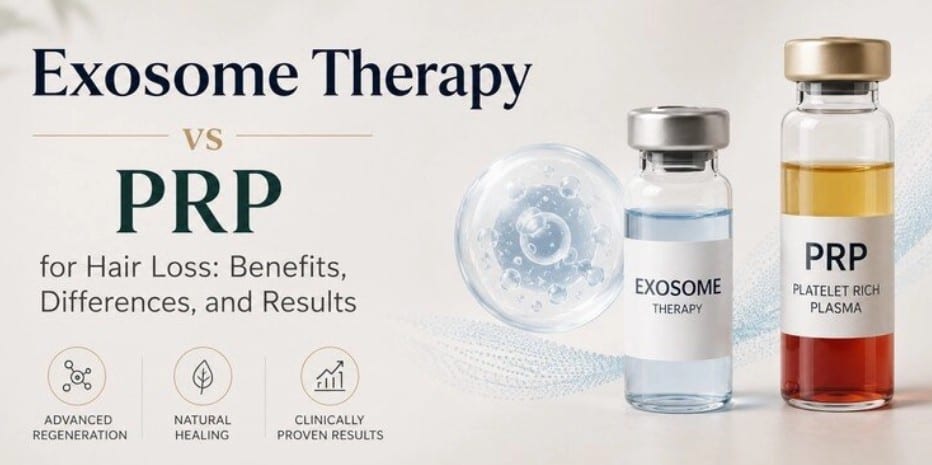
PRP stands for platelet-rich plasma. It is your own platelets, gathered in a small amount of plasma. The clinic takes a blood sample, spins it in a centrifuge and injects the platelet-rich part into the scalp. The treatment belongs to regenerative medicine, is based on your own material, and has been studied more than most of the newer options in the same category.
Even so, the evidence is mixed. For hereditary hair loss there are quite a few reviews and meta-analyses, but they are limited by the fact that every clinic prepares PRP in its own way. As an add-on to a hair transplant the basis is thinner, and no study has followed patients on regular PRP for several years. Below you get both sides.
- Because PRP comes from your own blood, its safety is good. The uncertainty is about the effect and how consistent it is.
- PRP has the best support as an add-on to minoxidil, not as a replacement.
- No two clinics prepare PRP the same way, so a result from one clinic doesn't automatically apply at another.
- For transplants the figures are uncertain, and no study has shown that more grafts grow after twelve months.
- Always ask for the price of PRP on its own, separate from the package.
What is PRP, and why would platelets help hair?
PRP is your own platelets, concentrated in plasma. Blood is drawn, centrifuged, and the platelet-rich part is injected into the scalp because platelets carry growth factors involved in tissue repair. Since everything comes from you, safety is good, and the open question is how well and how consistently it works, not whether it does harm.
Most people know platelets for their role in blood clotting. But they also contain growth factors and signalling substances that help the body repair tissue. The idea is to gather lots of these signals and deliver them to the scalp, where they may support follicles that have become thinner but are still alive.
The mechanism is plausible. It isn't proven. And PRP works on follicles that already exist. It doesn't create new ones.
Everything comes from your own blood and goes back into you (it is autologous), so there are no questions about rejection or tissue types. But PRP isn't a single ready-made, standardised product. Clinics prepare it differently, and that is the biggest obstacle when anyone tries to compare results.
How is PRP made, and why does the recipe matter so much?
The clinic takes a little blood, centrifuges it to concentrate the platelets and injects the platelet-rich part into the area of scalp being treated. Centrifuge speed and time, activation, how many platelets the final preparation contains, injection depth, volume and how often you come back all vary from clinic to clinic. Two treatments with the same name can therefore be completely different, and that is the main reason the studies disagree: they aren't testing the same thing.
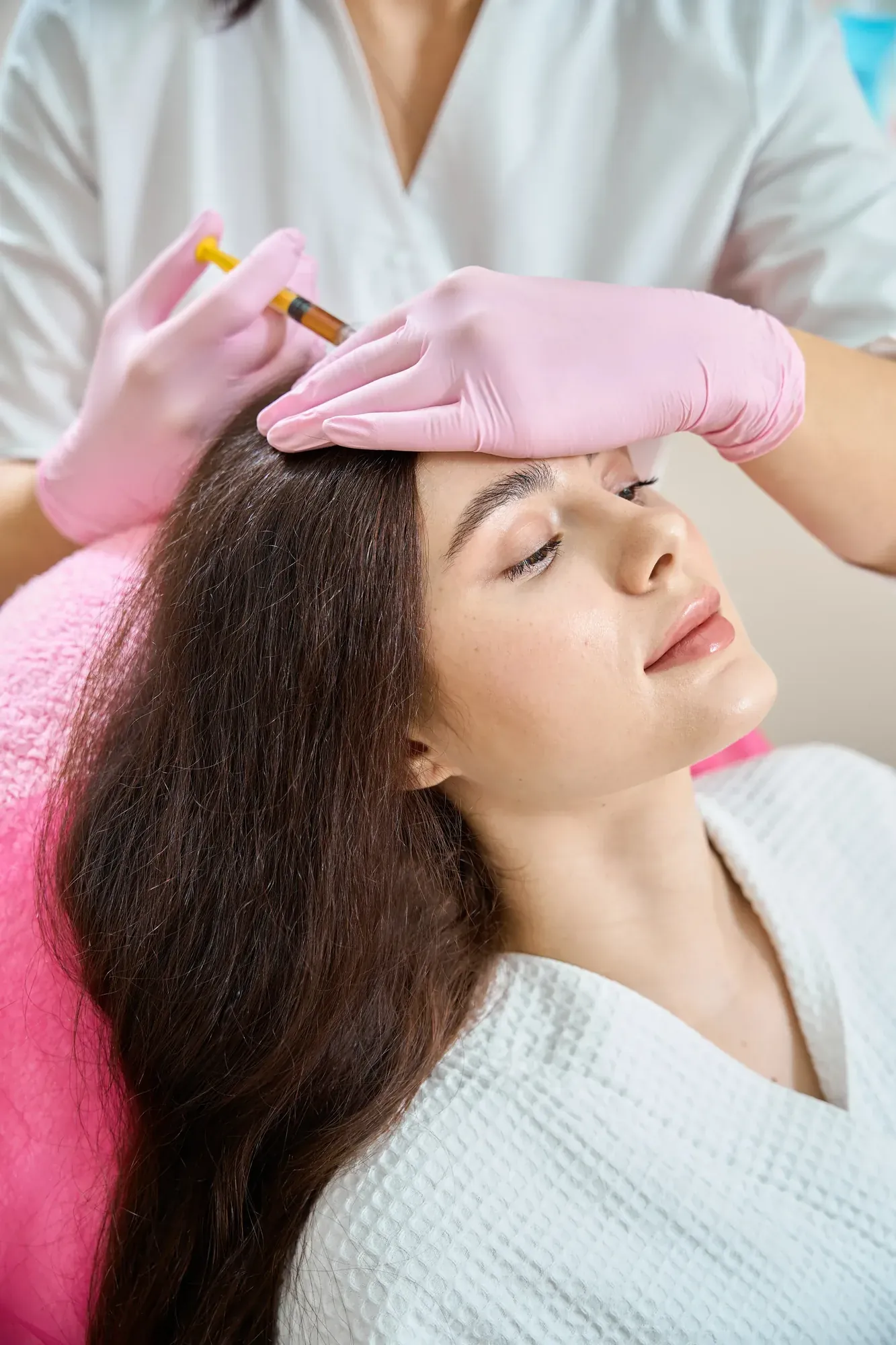
The basic steps are the same everywhere. The differences are in the details:
- The centrifuge. How fast it spins, and for how long.
- Activation. Whether the platelets are activated before injection, and if so, how.
- Concentration. How many platelets the finished preparation actually contains.
- The injection. How deep, how much and with which technique.
- The plan. The number of sessions, the gap between them, and whether maintenance follows.
A good result with one clinic's recipe tells you nothing certain about another clinic's. Keep that in mind every time you read a PRP study or a brochure.
Does PRP work for hereditary hair loss?
A reasonable body of research suggests a benefit in hereditary hair loss (androgenetic alopecia), although differences in preparation make it hard to pool the studies with confidence. A 2024 meta-analysis combined six studies with 343 participants and found that PRP together with minoxidil gave a greater increase in hair density and hair diameter than either treatment alone.
Two published papers deserve a mention by name:
- Kieling and co-authors examined, in a systematic review with meta-analysis published in Anais Brasileiros de Dermatologia in 2024, whether PRP from your own blood gives denser hair in androgenetic alopecia.
- Xiao and co-authors, in a meta-analysis in Aesthetic Plastic Surgery (2024), pooled six studies in which PRP was given together with minoxidil, 343 participants in total.
That last finding supports PRP as an add-on to minoxidil. It says nothing about replacing minoxidil. The weaknesses of the research are well known. The studies are small, they measure different things, follow-up usually lasts only a few months, and blinding is difficult. The result for any individual also depends on age, how far the hair loss has progressed, and how the PRP was prepared.
That doesn't mean PRP is ineffective. It means nobody knows how large the effect is, or how long it lasts.
If your hair loss has only just started, a procedure may not be the right step yet. The medical team at the clinic at the top of our ranking can look at your photos and tell you honestly whether to wait, start with treatment or consider more.
Goes to the clinic at the top of our ranking.
How does PRP compare with SVF, exosomes and hyperbaric oxygen?
Of the four, PRP is the best studied. Exosomes and hyperbaric oxygen therapy have less research behind them, and SVF (stromal vascular fraction) has not beaten PRP in any published study. In a 2024 randomised trial, one group received two PRP sessions plus one SVF injection and another received three PRP sessions, with no significant difference. Exosomes are at an even earlier stage of research, and many of the products don't come from your own body.
- SVF. A mix of cells from your own fat tissue, collected with a small liposuction. In the 2024 study both groups got more and thicker hairs, and the difference between them was not significant.
- Exosomes. Tiny vesicles released by cells, neither platelets nor whole cells. The research is at an early stage, and the contents vary enormously from supplier to supplier.
- Hyperbaric oxygen. A completely different kind of add-on, given in a pressure chamber. The hair research here consists of a letter to a journal, a pilot in nine healthy volunteers, a case report on five patients and one randomised trial with 34 patients.
Having more research doesn't prove that PRP will help in your particular situation. Almost everything about PRP concerns injections into a scalp that is thinning from hereditary hair loss, not protecting grafts during surgery. Stacking add-on treatments and hoping the gains add up has no support. Several uncertain effects don't add up to one certain one. Hyperbaric oxygen combined with PRP or exosomes after a transplant has never been tested either.
Is PRP safe?
Yes, safety is good because PRP comes from your own blood, and the remaining questions are about effect and how consistent the results are. The practical downsides are that many people find the scalp injections painful, and that the treatment almost always has to be repeated, which makes it more expensive.
Your own material means no rejection. It doesn't mean the procedure is risk-free. As with any injection, technique and hygiene matter, and both are the clinic's responsibility.
What you'll notice most often is the discomfort and the bill. Many people find the injections genuinely unpleasant, and almost every clinic sells PRP as a course, spread over months or years.
What don't we know about PRP?
There is no standard recipe, follow-up in the studies is mostly measured in months, little has been studied in connection with transplants, and nobody has followed regular PRP over several years. The authors of a 2025 systematic review on PRP in hair transplantation also call for longer studies with standardised protocols.
Four gaps matter when you are deciding:
- The recipe. Centrifugation, platelet count, activation and injection technique differ. The name covers many products, and figures from one clinic won't necessarily hold at the one next door.
- Time. The studies follow patients briefly. PRP courses sold to maintain density for years lack long-term data in people who have had a transplant.
- The purpose. Most of it is about treating a thinning scalp, not about protecting newly placed grafts or making them grow faster.
- Quality. The studies are small, they measure different things, and blinding is difficult. Simply being followed closely through a course of treatment can affect the result, and that is hard to separate from the effect of the PRP itself.
The review on transplantation was written by Sindhusen and co-authors and published in 2025 in the journal Cureus (PubMed).
Who might benefit from PRP, and what shouldn't you expect?
PRP makes most sense if your hereditary hair loss is still in the thinning phase, with follicles that are alive but shrinking, and you want something in addition to an established treatment. Follicles that are gone won't come back to life, and the process behind hereditary hair loss doesn't stop.
What PRP doesn't do:
- It doesn't revive dead follicles. If an area is bare, not just thin, a transplant is the relevant question, not an injection.
- It doesn't stop the hair loss itself. No injection changes the mechanism by which DHT drives hereditary hair loss. PRP leaves DHT (dihydrotestosterone) alone. It is finasteride that lowers it.
- It doesn't take the place of established treatment. PRP has been studied as an add-on to minoxidil.
So don't start with PRP. Find the cause, correct any deficiency shown in blood tests, and look at the established medicines. After that, PRP can come in as an add-on.
Does PRP improve results after a hair transplant?
It is less well documented than PRP for hair loss alone. When FUE (follicular unit extraction) is combined with PRP, published figures show around 15.1 per cent denser hair than FUE without PRP. That figure is based on industry data and studies of uneven quality, not on a decisive study.
Almost all research on PRP concerns injections over several months into a thinning scalp. Injecting PRP on the day of surgery to protect grafts is something else, and evidence for one is not evidence for the other. Treat 15.1 per cent as a pointer. It isn't a promise.
During surgery, PRP is usually applied to the recipient area the same day. Some clinics also soak the grafts in PRP before they are implanted, and many repeat sessions over the following months. A great many clinics offer it, almost as standard, and it is often built into the package price.
In a transplant, follicles that are largely resistant to DHT are taken and implanted where hair is missing. Hair loss in the original surrounding hair continues. That is why some clinics also inject PRP there.
Hold every promise up against how a transplant heals. Shedding usually happens between weeks 2 and 3. New hair starts to show from around month 3 or 4. After about 12 months you see close to the final result. Nobody has shown that PRP gives more grown grafts after twelve months. If someone promises that grafts will grow faster or survive better, they are going further than the research. If PRP is part of your healing and aftercare plan, ask specifically what benefit it is meant to give, and what it costs on its own.
Is regular PRP over many years worth it?
Nobody knows yet. Two to four treatments a year over ten years adds up to a lot of money, and no study has followed anyone for that long. Finasteride, which PRP is often compared with, has data after five years and costs far less, so this is a choice to make with a doctor, not with someone who profits from selling you a package.
Clinics make three different claims about PRP, and each rests on its own body of research:
- PRP on the day of surgery gives better graft results. This is the question of an add-on during surgery, and the review that looks at it calls for better long-term data.
- Regular PRP courses for years maintain density. Often sold as a subscription, with no long-term data in patients who have had a transplant.
- PRP treats hereditary hair loss. This is where the meta-analyses belong, and it is something quite different from the two above.
If a clinic uses the meta-analyses on hereditary hair loss as an argument for a regular maintenance programme after a transplant, it is pointing to research on a different question. Finasteride, by comparison, has published data in men after five years (experience from several countries, European Journal of Dermatology, 2002).
If PRP is included in the package, ask for an itemised breakdown and what the total would be without it. If the price doesn't change, it isn't a real choice. It is then part of the fee for the surgery.
What questions should the clinic answer before you agree to PRP?
Ask which recipe the clinic uses and how many platelets the preparation contains, how many sessions they propose and over what period, which specific outcome PRP is supposed to change and which study that is based on, and what it costs outside any package. PRP is unlikely to harm you, and it may help. But the research has gaps, and a PRP offer should never decide which clinic you choose.
Six questions to take with you:
- How do you prepare the PRP, and how many platelets does the final preparation contain?
- How many sessions are included, over what period, and what kind of maintenance follows?
- What exactly is PRP meant to change for me, and which study shows it? Were the participants transplant patients, or people with hereditary hair loss in general?
- How will we measure whether it works? With hair counts in a marked area, or by eye?
- Is it included in the price, or does it come on top? What does the package cost without it, what will the total be after five years, and am I allowed to stop partway?
- Which medical treatment should I have first, and where does PRP fit in relation to it?
If you get a precise answer on whether the study involved transplants or hereditary hair loss, the clinic is being honest about the research. That distinction is exactly where most of the exaggeration hides.
What people ask about PRP
Is PRP approved as a treatment for hair loss?
PRP is offered in many places and has reasonable research behind it. Even so, it is regarded as an add-on rather than a first choice, and the rules for this kind of use vary between countries. The clinic can tell you which rules apply where they are.
Does PRP hurt?
Many people find the scalp injections uncomfortable, and they are usually repeated over several months. Ask the clinic to explain what a session feels like and what they do to ease the discomfort.
How much more hair will I get?
Nobody can give you a single number. The 2024 meta-analysis, with 343 participants across six studies, found the largest increase in density and hair diameter when PRP and minoxidil were used together. Clinics prepare PRP so differently that the result from one can't be transferred to another, and nobody can promise you a particular outcome.
How long does the effect last?
We don't know. Most studies follow participants for a few months, and none has reported results of regular PRP over several years.
Does PRP beat treatments like SVF and exosomes?
PRP has been studied more than exosomes and hyperbaric oxygen, and SVF has not proved better in published studies. A 2024 randomised trial in which SVF was added to a course of PRP found no significant difference compared with PRP alone.
Does PRP help where I'm already bald?
No. PRP needs living follicles, even if they are thinning. Where the follicles are gone, no injection will bring them back.
Can PRP be used instead of finasteride or minoxidil?
No. The best evidence is for PRP as an add-on. In the 2024 meta-analysis, the combination of PRP and minoxidil beat both used on their own. That supports combining, not swapping, and PRP does nothing to DHT, which drives hereditary hair loss.
Is PRP worth having after a hair transplant?
The research here is thinner than for PRP for hair loss alone. According to published figures, FUE plus PRP gives around 15.1 per cent denser hair than FUE without it. The studies behind this vary widely in quality, and a systematic review published in 2025 calls for longer follow-up and fixed protocols.
Is it safe to have PRP?
Safety is good because the blood is your own, and what remains uncertain is the effect and how consistent it is. Your own blood still doesn't mean zero risk. Technique and hygiene still matter.
Why do clinics describe PRP so differently?
Because there is no single fixed recipe. Centrifuge speed and time, activation, platelet count, injection depth, volume and frequency all differ, so two treatments that are both called PRP can be very different.
Find out what is making your hair disappear before you buy anything. PRP is a sensible add-on with patchy evidence. It doesn't replace the treatments with the strongest research behind them, and it won't bring back follicles that are gone. A free hair analysis shows where you stand before the money is spent.
This is general information, not medical advice. Whether PRP makes sense for you is something to decide together with a doctor.
Goes to the clinic at the top of our ranking.
Sist oppdatert: October 2026 · Redaksjonelle standarder