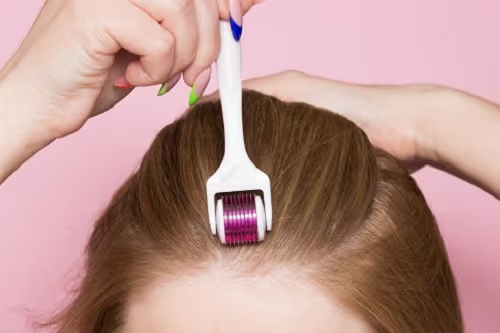
Microneedling is also called dermarolling or collagen induction therapy. With a dermaroller, a dermapen or a needle stamp you make hundreds of tiny holes in the scalp. The skin responds by repairing itself, and a topical treatment applied afterwards penetrates more easily. You can have it done at a clinic or do it yourself. How safe it is depends on needle length, how often you do it and how clean the equipment is.
The most convincing finding concerns microneedling combined with something else. In a 2013 randomised trial of 100 men, those who combined weekly needling with 5 % minoxidil had more hairs after 12 weeks than those who used minoxidil without needling. A meta-analysis of randomised trials published in 2025 reached the same conclusion, but the trials vary widely. For microneedling used entirely on its own, the evidence is much thinner. No protocol is standard, and a follicle that is gone doesn't come back. Both sides of the story get space here.
What is microneedling, and what happens during a session?
With microneedling you cover the scalp in tiny holes using a needle roller, needle pen or stamp, giving the skin a controlled injury that it repairs itself. In the hair loss studies the needles were 0.25 to 2.5 mm long. You can have it done at a clinic or do it at home, and it has nothing to do with hair transplant surgery.
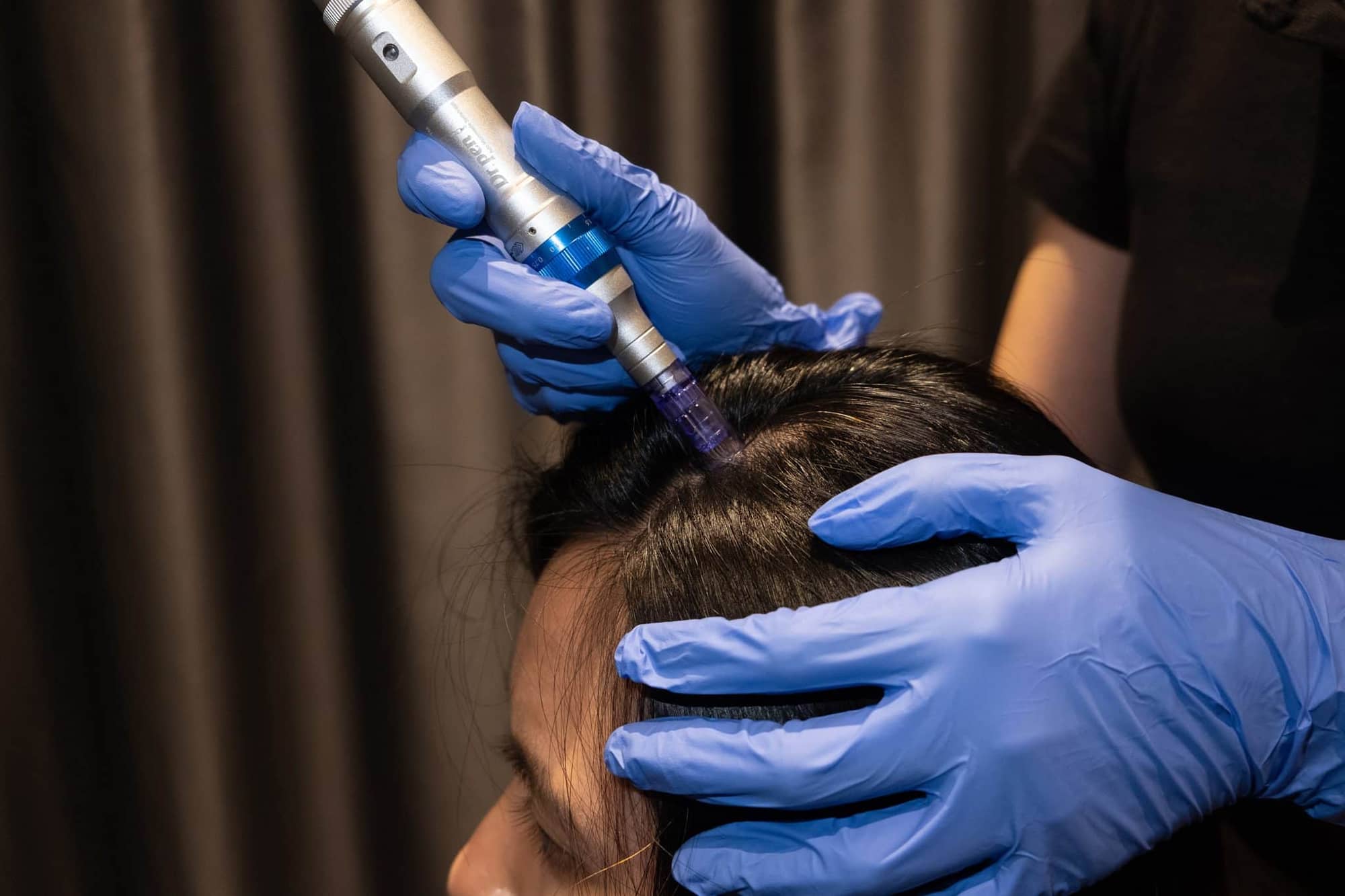
Researchers have used three types of tool: the manual dermaroller, the automated dermapen and the stamp. Rollers and pens dominated the trials in a systematic review published in 2021.
The point is to irritate the skin a little, not to create a surgical wound. The treatment targets hair follicles that are still alive, and it doesn't add a single new hair. If you have an area that is completely smooth, a transplant is what you should read about, not needles.
Why would tiny punctures in the scalp help hair?
There are two explanations. The punctures trigger wound healing in which the skin releases growth factors and signalling molecules that may wake up the follicles, and the tiny channels help minoxidil and other topical treatments penetrate better. The second explanation is the more solid, while the first rests mostly on animal and laboratory cell studies.
The idea behind wound healing is that repair releases growth factors, including platelet-derived and vascular endothelial growth factors, and switches on signalling pathways, among them Wnt/β-catenin, which helps control the hair growth cycle. Most of this has been shown in animal models. For needling on its own against hereditary hair loss in humans, the 2021 review calls the mechanism speculative.
The absorption explanation is far easier to grasp. If you apply a medicine to skin with open punctures, it is reasonable that more of it reaches the follicle. That is a big reason why the best data concern needling with minoxidil rather than needling by itself. But there is a downside. When more gets in, the skin can also become more irritated. Many routines therefore skip minoxidil on the day you needle.
What happens when you add microneedling to minoxidil?
Weekly needling on top of 5 % minoxidil produced more hair than minoxidil without needles in a 2013 randomised trial of 100 men. After 12 weeks, hair count had risen by an average of 91.4 hairs/cm², versus 22.2 in the comparison group (Dhurat and colleagues). A 2025 meta-analysis of randomised trials also found a clear gain for the combination, but the trials were very different. All are small and short, so read this as a promising sign, not an established standard.
The best-known result comes from Dhurat and colleagues, published in 2013 in the International Journal of Trichology:
- How the study was set up. Participants were 100 men aged 20 to 35 with mild to moderate hair loss, Norwood-Hamilton III vertex or IV. All used 5 % minoxidil morning and evening. Half also had one session a week with a 1.5 mm dermaroller, until the skin turned slightly red. On needling day they paused minoxidil and waited 24 hours before applying it again. Men who had taken finasteride or another antiandrogen in the previous six months were excluded, and 94 completed all 12 weeks.
- Hair count. In a marked area, hair count at week 12 had risen by an average of 91.4 hairs/cm² in the needling group, versus 22.2 in the group using only minoxidil (p = 0.039).
- Photos and self-assessment. An assessor who didn't know who was in which group gave 40 men in the needling group +2 or +3 on a seven-point photo scale. Nobody in the minoxidil group got there. In their own view, 82 % of the needling group (41 people) felt their hair had improved by more than 50 %, versus 4.5 % (2 people) in the other group.
The researchers found no significant side effects. They described the work as a pilot study and wrote that the right needle size, frequency, duration and when to stop had yet to be established.
Later reviews point the same way. Ahmed and colleagues published a meta-analysis in 2025 in Archives of Dermatological Research, with a literature search up to September 2024. They found 12 randomised studies with 631 patients in total, 11 of which were included in the hair count analysis. The combination increased hair count more than minoxidil without needling, with a standardised mean difference of 1.32 (95 % confidence interval 0.73 to 1.92). The studies varied sharply (I² = 88 %). Six pooled studies also showed thicker hair shafts. In 2021, English and colleagues reviewed 22 studies with 1,127 participants in Dermatology and Therapy. Seven of them tested needling on top of 5 % minoxidil, and in six of the seven the combination beat minoxidil without needles, with needle depths from 0.6 to 2.5 mm. The seventh used a 0.25 mm stamp twice a week and found no effect. The review itself rates the quality of the data as relatively low.
If your hair loss has only just started, a procedure may not be the right step yet. The medical team at the clinic at the top of our ranking can look at your photos and tell you honestly whether to wait, start with treatment or consider more.
Goes to the clinic at the top of our ranking.
Does microneedling help if you use it on its own?
A little, and not every time. The 2021 review included six groups that had needling only: two found more hair overall, one found thicker and denser hair, and three found nothing. The data suggest needles may boost a treatment you already benefit from, but they are not something you can swap minoxidil or finasteride for.
According to the review, data on needling alone for hereditary hair loss are limited, and the mechanism is still speculative. Of all 22 studies, only one compared needling with an untreated patch on the same head, and that was in patchy hair loss (alopecia areata), not hereditary hair loss.
In hereditary hair loss, needles don't take over the job of finasteride, and where the scalp is completely smooth, no hair grows back. Microneedling is at its strongest when the aim is to help minoxidil do more.
Which needle length, how often and with which tool?
Nobody knows yet. The 2021 review couldn't identify a best practice, because the studies used such different tools, needle lengths, intervals and end points. The 2025 meta-analysis also saw no clear difference in hair count by depth, duration or tool. Needles measured 0.25 to 2.5 mm, and sessions ranged from twice a week to once a month.
- How long the needles are. Studies ranged from 0.25 all the way to 2.5 mm, averaging 1.39 mm. Longer needles aren't obviously better. In one study using a pen every other week plus 5 % minoxidil, 0.6 mm did better than 1.2 mm. The 2025 meta-analysis also found no clear difference between 1 mm or shorter and longer than 1 mm, but here too the studies varied a lot. Go too deep and you risk scarring.
- How often. Everything from two sessions a week to one a month was tried, and a treatment course lasted about 20 weeks on average. The Dhurat study stuck to once a week for 12 weeks. If you needle every day, the skin never gets time to heal.
- Which tool. Rollers, automated pens, stamps and radiofrequency pens were all included. The 2021 review couldn't name a winner, and the 2025 analysis saw no clear difference between rollers and electric pens.
- When you stop. Some studies stopped when the skin turned slightly red, others when it started to bleed or after a set number of passes. Four studies didn't say.
Talk to a professional about needle length and interval before you start. That is where people most often go wrong.
Is it safe to microneedle at home, and what can go wrong?
Among the 657 participants who had microneedling in the 2021 review, no serious side effects were reported. The usual effects were tenderness, an irritated scalp and redness that faded. What can go wrong comes down to technique and hygiene, and the risk is highest at home with nobody watching: a dirty or borrowed tool can carry bacteria into the punctures, and sessions that go too deep or come too close together can cause scarring.
- Hygiene. Each session creates many open punctures, and each one is a door for bacteria. Disinfect the tool before and after use, never lend it out, and replace it regularly. Blunt needles tear the skin rather than making clean little channels.
- Depth and interval. Too deep or too often causes persistent irritation and redness. At worst you get scarring, which can damage the very follicles you wanted to help.
- At home or at a clinic. The researchers behind the 2013 trial needled at 1.5 mm, and that was in a hospital dermatology department. For home use we recommend the short end, usually 0.5 to 1.0 mm, and leaving longer needles to professionals. Note that the data for short needles are mixed.
- When you use minoxidil. Freshly punctured skin absorbs more and gets irritated more easily. In the 2013 trial the scalp had a day without minoxidil after each needling, and many routines keep the two treatments apart.
- Who should avoid it. Anyone with an active infection or inflammation of the scalp, eczema or psoriasis in the area to be needled, or a tendency to keloids.
A little tenderness, redness and a few drops of blood are normal, and the amount follows needle length. In the 2025 meta-analysis, side effects were more common when both treatments were used than with minoxidil alone, but they were usually mild and cleared up on their own.
Can you use microneedling before or after a hair transplant?
Never where grafts have just been placed. Needling skin where grafts can still come loose or haven't fully healed does harm. It can only be considered once the skin has healed completely and the surgeon has explicitly said yes. Grafts need plenty of time to take root, usually many months, and needling is meant for the thinning hair you have left, not for fresh grafts.
A transplant moves hair follicles. The hair around them keeps falling out as before, and it is this ongoing loss that a treatment such as needling with minoxidil might address later. Transplanted hairs shed in weeks 2 to 3, new hairs appear from month 3 to 4, and you see almost the full result after about 12 months. During the first part of that time, healing skin and grafts should be left alone. When anything can touch the recipient area again is for the surgeon to decide, not a fixed rule.
Participants in the studies on this page had hair loss, not a recent transplant. Any use around surgery is therefore guesswork based on other data. If you want to combine them, tell the clinic that operated on you, agree the timing in advance and do as they say.
Where does microneedling fit alongside minoxidil, finasteride and PRP?
Microneedling sits on top of a foundation and doesn't replace it. Minoxidil is the partner the data concern, finasteride suppresses the hormone driving hereditary hair loss, which needles don't touch, and PRP is a separate injection treatment with weaker evidence. The most logical order is to start with finasteride and minoxidil, add cheap extras like microneedling afterwards and leave the expensive ones until last.
- Minoxidil. This is the combination with the most data behind it. Think of needling as a way to get more out of the minoxidil you already apply, and remember that the studies used topical 5 % minoxidil.
- Finasteride. A prescription tablet that lowers DHT and so slows the hormone behind hereditary hair loss. Needling doesn't take over that job. The Dhurat trial excluded anyone who had recently taken finasteride, so it says nothing about what needles add if you are already on it.
- PRP. Platelet-rich plasma is injected into the scalp, and some clinics combine it with needling. It is more expensive, protocols vary a lot from place to place, and the data are promising but less clear than for the two established treatments.
Microneedling makes most sense if you are on minoxidil and want an affordable add-on. If you haven't had the cause checked, or the area is completely bare, it is less relevant.
What do we still not know about microneedling?
We know little about long-term effect, the best protocol and use without minoxidil. Of the 22 studies in the 2021 review, 21 followed participants for less than a year, no needle length or schedule has been established, the studies averaged about 50 participants, and the authors rate the quality as relatively low.
Four weaknesses determine how much you should read into the results:
- Short duration. The 2013 study lasted 12 weeks. With less than a year of follow-up it is often impossible to separate the effect of treatment from the hair's natural fluctuations through the year. Nobody knows whether the gain lasts, or whether you need to keep up sessions to hold on to it.
- No shared protocol. Tool, needle length, interval and end point varied so much that the review could neither run a meta-analysis nor recommend a best practice.
- No true placebo. Participants obviously notice when they are being needled. Self-assessments, such as the 82 % figure from 2013, therefore come from participants who knew their own group. The review authors call for placebo-controlled studies, for example with a roller without needles, and follow-up of at least 12 months.
- Narrow group. The 2013 trial included only men aged 20 to 35 with mild to moderate loss, from a single centre, and excluded anyone who had recently used finasteride.
This doesn't mean needling is a waste. It means the studies make an added effect likely, without being able to say which routine produces it, who benefits from it or how long it lasts.
What should you ask the clinic before you say yes?
Find out which tool, needle length and interval the clinic uses, and how equipment and needles are cleaned or replaced. Ask for the price per session, including outside packages, and which established treatments should run alongside. Agree how the result will be measured, and when you'll review it together.
Here are six questions to take with you:
- Which tool and needle length do you use, how often, and what is that routine based on?
- How do you clean or replace equipment and needles between patients? And if I do it at home, how often should I replace my own?
- Which established treatments have I been offered first, and why add needling?
- What does one session cost, and what does the whole course cost, without it being hidden in a package?
- How will we find out whether it has helped, and when do we review it? Take photos before you start, in the same lighting and from the same angle, so you have something to compare with.
- If I've had a transplant, has the surgeon approved this, and from what date?
If a clinic sells you needling as a replacement for minoxidil or finasteride, it is selling, not treating.
What people ask about microneedling
What exactly is microneedling for hair loss?
A roller, pen or stamp with fine needles makes many tiny punctures in the scalp. The aim is for the skin to start a controlled repair, and for topical treatments such as minoxidil to penetrate better. You can have it done at a clinic or do it at home.
Can microneedling make hair grow back?
In most of the reviewed studies, needling on top of minoxidil produced more hair than minoxidil without needles. Without minoxidil the data are weak and inconsistent, and follicles that are already gone don't come back.
Do microneedling and minoxidil together work better than minoxidil alone?
In a 2013 randomised trial of 100 men, hair count after 12 weeks rose by an average of 91.4 hairs/cm² with both and 22.2 with minoxidil only. The 2025 meta-analysis also found clearly more hair when both were used, but the trials were very different. The figures are averages from small, short studies, and nobody can promise you the same.
What needle length should I use, and how often?
Studies have used needles of 0.25 to 2.5 mm and anything from two sessions a week to one a month. No best protocol has been found. Dhurat and colleagues used a 1.5 mm roller once a week, at a hospital clinic. Let a professional help you with length and interval, and never needle every day.
Is it a good idea to microneedle at home?
Many people do, but the risk lies in technique and hygiene. A dirty or borrowed tool can carry bacteria into the punctures, and sessions that go too deep or come too often can cause scarring. The data for short needles are mixed, so you can't assume results from clinic studies apply to a roller you've bought yourself.
Does microneedling hurt, and is it dangerous?
Expect a little tenderness, redness and a few drops of blood, more with longer needles. In the 2021 review there were no serious side effects among the 657 who had needling, and the 2025 meta-analysis found more mild complaints when both treatments were used than with minoxidil on its own. The biggest risks are infection from poor hygiene and scarring if you go too deep or needle too often.
Who shouldn't use microneedling?
Anyone with an inflamed or infected scalp, an eczema or psoriasis flare in the area to be treated, or a tendency to develop keloids. Also keep needles away from recently transplanted areas.
When can I microneedle after a hair transplant?
Not where grafts have recently been placed. It usually takes many months before grafts are firmly anchored and the skin has healed. Later it should only be done on fully healed skin, and only when your surgeon has explicitly given the go-ahead.
Can I drop finasteride or minoxidil and just microneedle?
No. In hereditary hair loss, needles don't do the job of finasteride, and on completely bald areas no hair grows back. Microneedling is best documented as an add-on to minoxidil.
When can I expect to see a result?
Hair grows slowly, and treatment for hereditary hair loss is usually assessed after 6 to 12 months. The Dhurat trial measured as early as 12 weeks. Decide in advance when you'll look at the photos again, and what the plan is if your hair stays the same.
Start with what has the best evidence. Microneedling is affordable, and it is strongest as a helper for minoxidil. It doesn't replace the established hair loss medicines, and needles can't bring back hair follicles that have already died. A free hair analysis shows what is really driving your hair loss, and whether an add-on belongs in the plan at all, before you spend money on equipment or a course.
Goes to the clinic at the top of our ranking.
Sist oppdatert: October 2026 · Redaksjonelle standarder