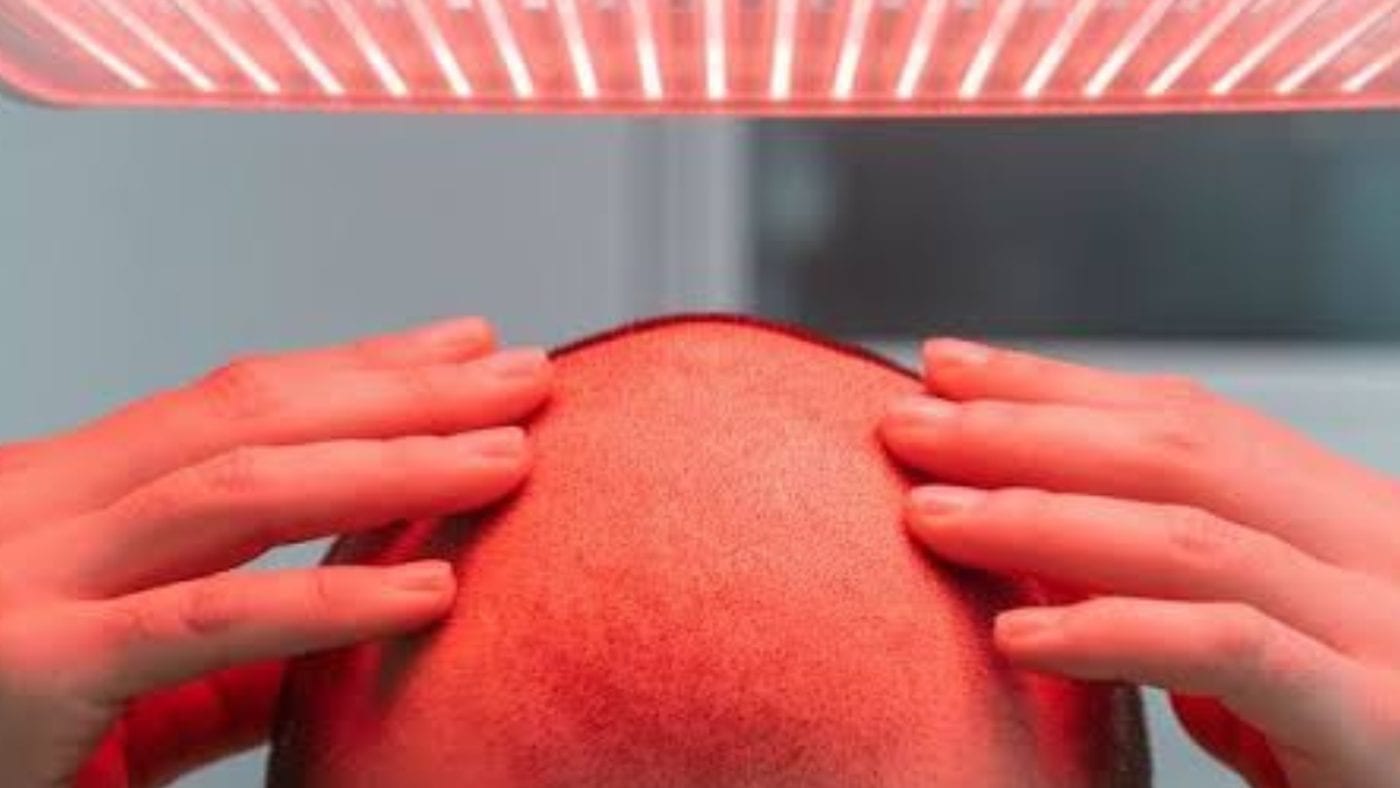
LLLP stands for Low-Level Laser/Light Therapy. The scalp is treated with low-level light, usually red, to give hair growth better conditions. You may also come across the names low-intensity laser therapy, red light therapy and photobiomodulation. In research, LLLT (Low-Level Laser Therapy) is the term most often used for the same principle.
The light comes from a light helmet, a laser comb or a light panel. It doesn't hurt, and you get almost no side effects. Among treatments that are neither medicine nor surgery, this one holds up fairly well, and several devices are approved.
Still, we won't dress it up: the effect is usually modest. Light therapy is best documented as an add-on to other treatment. On its own it's no cure. The rest of this page builds on that assessment, just like the guide on how to slow hair loss without surgery.
What is LLLP?
With LLLP you shine low-level red light on your scalp, produced by either laser diodes or ordinary LEDs. The light doesn't heat or cut the way a surgical laser does. You use a light helmet, a laser comb or a light panel, in short sessions repeated over a long period. It doesn't hurt, and side effects are very few.
The word laser makes many people think of something that burns or cuts. That's not the case here. The key word is low-level. The light is so weak that the skin neither heats up nor gets damaged. That's why specialists also use the term photobiomodulation: the light is meant to change how cells work, not to destroy tissue.
Are LLLP and LLLT the same thing?
In practice, yes. In studies and scientific papers you'll most often see LLLT, which stands for Low-Level Laser Therapy. LLLP covers the same treatment area but includes both lasers and ordinary light sources. That's useful, because most newer devices use LEDs rather than true laser diodes. If you see both abbreviations, it's usually the same type of treatment being discussed.
What devices are there?
- Helmets and caps. These light the whole scalp at once and are usually used at home.
- Combs and handheld devices. You move them over your head section by section and have to keep track of the time and make sure the whole area is covered.
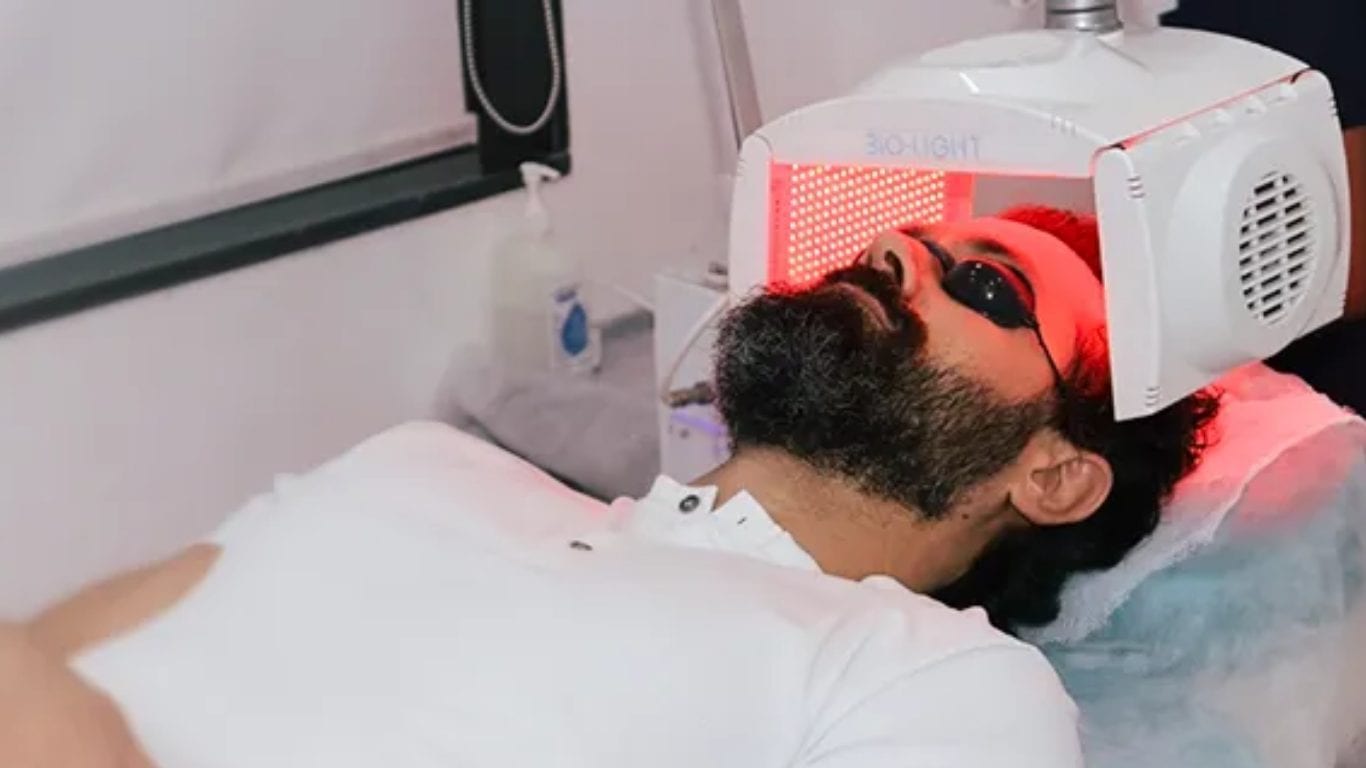
- Panels. Usually found at clinics, and you sit under a fixed unit.
The principle is the same whatever the form. But the form affects how faithfully you use the device, and that matters a lot, because LLLP only delivers anything if you keep going for a long time.
How could red light affect hair growth?
Researchers believe the light gives hair follicles more energy and improves blood circulation in the smallest vessels of the scalp. In theory this may support growth and lengthen the growth phase. But it's a hypothesis about how it works, not something that's proven, and you should keep that in mind when you weigh up the effect.
The most common explanation is about energy. According to the theory, certain wavelengths of red light are absorbed by the mitochondria, the cells' power stations, and make them work harder. A growing hair follicle has a high metabolism and needs a lot of energy. The idea is that more mitochondrial activity may help it.
Two other explanations also come up. The light may improve blood flow in the tiny vessels around the follicle, and it may calm inflammation in the scalp.
What doesn't the light do?
It doesn't affect DHT, the hormone that drives hereditary hair loss. That's where light differs most from the medicines. Light can give your hair a little help, but it can't stop hereditary loss. You can read how hereditary hair loss works under causes of hair loss.
How strong is the evidence, really?
We call it mild, and that word is chosen with care. Several studies have measured an effect, and several devices are approved. That's more than many other alternative treatments can point to. But the effect is small compared with finasteride and minoxidil. That's why we place LLLP among the add-ons, not in the foundation.
Who might benefit from LLLP?
It's most relevant for early or moderate thinning, as long as you have hair left to help. It also suits people who want an add-on without side effects in the rest of the body, or who for various reasons say no to medicines. If the scalp is already completely bare, there's little to gain. Light can't wake follicles that no longer exist.
When can it make sense?
- With early or moderate thinning. There have to be follicles left. The earlier you start, the more the light has to work with.
- Alongside medicines. This is where the evidence counts most.
- When medicines aren't an option. Some people can't or won't use finasteride or minoxidil. Then light is one of the few remaining choices that doesn't affect the rest of the body, even though the effect is smaller.
- With diffuse thinning in women. The options are often different for women than for men. Read more about hair loss in women.
- After a hair transplant. More on that further down.
When is it the wrong choice?
- On completely bare areas. Once the follicles are gone, light won't bring them back. Then a transplant is the only way to get hair back.
- As the only treatment for advanced hereditary hair loss. The effect is too small to do the job alone.
- Before the cause has been found. If the loss is caused by a deficiency or an illness, that should be treated first.
Wondering when surgery becomes the realistic choice? Read the guide on who can have a hair transplant.
If your hair loss has only just started, a procedure may not be the right step yet. The medical team at the clinic at the top of our ranking can look at your photos and tell you honestly whether to wait, start with treatment or consider more.
Goes to the clinic at the top of our ranking.
What are the pros and cons of LLLP?
It doesn't hurt, side effects are very few, the rest of the body isn't affected, and you can do it at home. On the downside, the effect is mild, you have to keep at it for a long time, and a good device can cost a lot.
- No pain. The light doesn't heat, and most people feel almost nothing.
- Hardly any side effects. That's the main reason the treatment is interesting at all, even with a modest effect.
- Local effect only. Unlike tablets, the light doesn't affect the body as a whole.
- Can be used at home. With a helmet or cap you don't need to go anywhere.
- Combines well with other treatment. Light doesn't rule out medicines, other supportive treatments or surgery.
What should you expect on the downside?
The effect is small and comes slowly. You have to use the device regularly for months before there's anything to assess, and if you stop, whatever you've gained disappears. A home-use device also costs a fair amount. Compare that sum with what the best-documented treatments cost before you buy.
What does LLLP treatment involve?
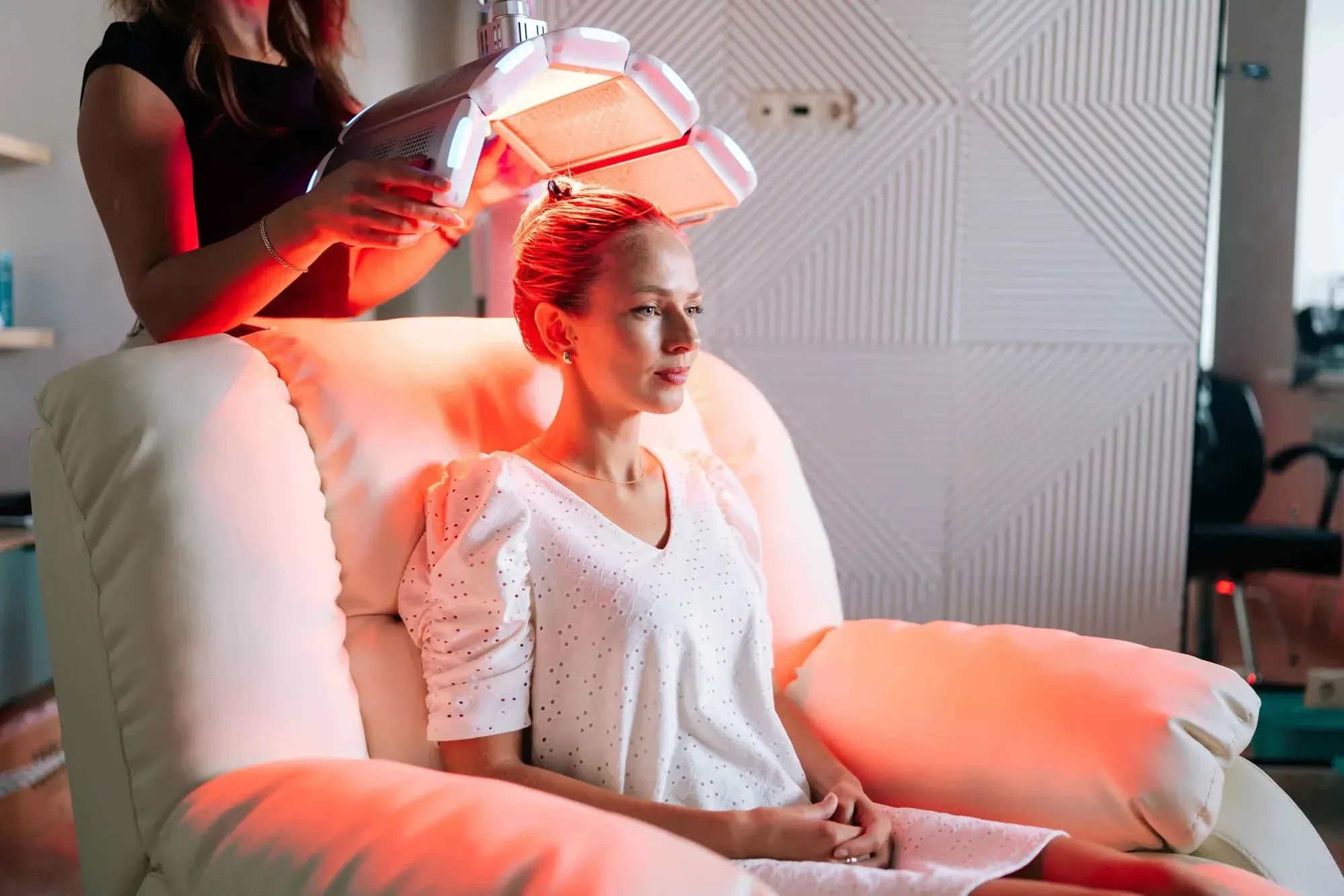
First, someone should look at your scalp and work out what's driving your hair loss. Then a plan is made for where light fits in alongside other treatment. The treatment itself is short sessions repeated over months, with check-ups along the way. How long and how often depends on the device.
- Consultation. You go through the pattern of your hair loss, how it has developed, and whether others in your family have lost hair.
- Scalp examination. Ideally with trichoscopy, so you can see how much hair there actually is to help.
- Why is the hair falling out? If you have a deficiency or an illness, light won't help. That has to be uncovered before anything else.
- Plan. Not least about where light therapy belongs alongside everything else you're doing.
- Treatment. Short sessions following the device's instructions.
- Follow-up. With photos taken in the same light and from the same angles each time, so that even a small change becomes visible.
When the effect is this small, good photos become extra important. Without them you can hardly tell whether anything has changed.
How often do you need to use LLLP?
Usually several times a week, in short sessions, over a long period. Exactly how long and how often is set out in the instructions for your device, and it varies from device to device, so we don't give you a fixed schedule. The most important thing is to keep going: the effect only lasts as long as you use it.
There are two things you should be clear about before you start.
You're never finished. LLLP has no end date. If you stop, the effect you've gained disappears. The same is true of the medicines for hereditary hair loss, and it's one of the most important things to understand before you begin.
Willpower sets the limit. Something you have to remember several evenings a week, year after year, only works if you actually do it. That's where most people drop off, not because of technical details of the device. So choose something you think you'll actually use.
Always follow the manufacturer's instructions, or the clinic's advice if you're treated there. We don't create a schedule meant to fit devices with completely different wavelengths and power levels.
When will you see results from LLLP?
After several months at the earliest, because hair grows slowly. How much you get out of it varies from person to person. It depends on how far the loss has progressed and what else you're doing. The effect is mild, so it's more often about the loss slowing down or stopping than about visible new hair. Sometimes nothing happens at all.
We won't promise you a timeline. What we can say is that the hair growth cycle sets the pace. Whatever you do, it takes months before anything shows. If you hear about a treatment that works in a couple of weeks, be sceptical.
What does it mean that LLLP "works"?
With a mild treatment, new visible hair is rarely the most important result. The most important thing is that the thinning slows down or stops. That's a real gain, but it looks different from the advertising photos, and it's hard to spot without photos taken the same way over time.
What do you do if nothing happens?
It happens. Not everyone benefits from a mild treatment. Set a date for when you'll take stock, and decide now what the next step will be if the photos show no change. How to assess results over time is covered in the article on long-term results.
How does LLLP compare with other hair loss treatments?
Finasteride and minoxidil have the strongest evidence and are the foundation for hereditary hair loss. Microneedling, PRP and LLLP are add-ons. A hair transplant solves a different problem, namely areas where the follicles are gone. SMP only changes how things look. They have different jobs, and none of them is best for everyone.
| Treatment | Type | Evidence | Place in the plan |
|---|---|---|---|
| Finasteride | Medical | Strong | Foundation |
| Minoxidil | Medical | Strong | Foundation |
| PRP | Medical | Promising | Add-on |
| Microneedling | Non-medical | Moderate | Add-on |
| LLLP, red light | Non-medical | Mild | Add-on |
| SVP, nutrients in the scalp | Non-medical | Weak | Possible add-on |
| Hair transplant | Surgical | Established | When the follicles are gone |
| SMP | Cosmetic | Not relevant, doesn't produce hair | Gives the impression of density |
It's the order that counts, not the position in the table. Start from the foundation. An add-on on top of the foundation makes sense. An add-on instead of the foundation rarely does. You'll find the full review of the evidence in the guide on how to slow hair loss without surgery.
Can you use LLLP alongside a hair transplant?
Yes, they can be combined. In theory, red light may help the wound heal and the new hair grow after surgery, and it may also help preserve your hair outside the transplanted area. When you can start must be agreed with the clinic that operated on you, because the scalp needs rest while it heals.
There are two different reasons to use light around a transplant. Keep them apart.
Does red light help after a hair transplant?
Among the alternative treatments used after a transplant, red light has relatively good evidence. The hope is that it helps the skin heal and the hair come through. Here too the effect is modest, and the light doesn't decide whether the surgery succeeds. What matters most then is following the clinic's aftercare advice. Read more in the guide on aftercare.
The hair that wasn't moved
Many people forget this. A transplant fills in where hair is missing, but it doesn't stop the loss of your own hair around it. If that keeps thinning, the result can eventually look patchy. A plan for the hair you have left therefore belongs in any serious treatment plan, and LLLP can be one of the add-ons there.
When can you start LLLP after surgery?
Don't use light on a freshly operated area before you've spoken to the clinic. The new grafts need to settle undisturbed, and it's the clinic that decides what you can add, and when.
Is LLLP safe?
Among hair loss treatments, LLLP is one of the gentlest. Very few side effects have been reported, and the light is too weak to damage tissue. Even so, it isn't entirely risk-free. Protect your eyes from direct light, have any active skin condition on the scalp assessed first, and be aware that some medicines make you more sensitive to light.
Light doesn't hurt and causes hardly any side effects. That's true. But "hardly" doesn't mean "never". Here's what you should know:
- Your eyes. Don't look straight into the light. Good equipment is designed so that this doesn't happen when you use it correctly.
- Light sensitivity. Some medicines and skin conditions make the skin more sensitive to light. If you take regular medication, ask your doctor.
- Scalp skin conditions. If you have active eczema, psoriasis or an infection, it should be assessed before you start.
- Short-lived irritation. A slightly red or dry scalp can occur.
- Device quality. Safety depends on the device staying within the power it was designed for.
If you're pregnant, breastfeeding, have a chronic illness or know you tolerate light poorly, talk to your GP before you start.
Does your scalp need care after LLLP?
Not really. There are no wounds to heal, no recovery and no restrictions afterwards. What matters is that your scalp is in good condition and that you actually use the device regularly. A clean scalp without leftover hair products also lets the light through better.
Nothing is cut or punctured, so there's nothing to heal. A few practical things still decide whether the treatment makes sense:
- Clean scalp. Lots of wax or gel between the light and the skin isn't a good idea.
- Regular use. This matters more than anything else. A helmet sitting in the cupboard does nothing.
- Cleaning the device. Follow the manufacturer's advice.
- The rest of the basics. Light on top of smoking, too little sleep and an untreated deficiency gives little back. Sort out the foundation first.
If you want to combine light with something that affects the skin, such as microneedling or other treatments that penetrate the skin, agree on the order with whoever carries out the treatments.
What should you ask before buying a device or a course?
Find out what wavelength and power the device has, what evidence the manufacturer can point to, what it costs in total and whether you can return it. For a clinic course: how many treatments are included, what everything costs and what happens afterwards. Most important of all: ask for an explanation of where light therapy fits alongside everything else you're doing.
- What wavelength and power does the device have?
- What specific research does the manufacturer or clinic point to?
- What's the total price, and can I return it if it doesn't work for me?
- How many minutes, and how many times a week, should I realistically expect?
- What kind of effect can I expect, and when will we take stock?
- What do we do if nothing has happened by then?
- Where does it fit alongside the better-documented treatments?
The last question is the most important. If an add-on is presented as an alternative to the treatments with the strongest evidence, that's selling, not advice. Also read the guide to red flags and how to choose a clinic.
Common questions about LLLP
What does LLLP stand for?
It stands for Low-Level Laser/Light Therapy. You shine low-level, usually red, light on your scalp that neither heats nor damages the skin. It's done in short, repeated sessions with a light helmet, laser comb or light panel.
Is there a difference between LLLP and LLLT?
In practice, no. Researchers most often use LLLT, which stands for Low-Level Laser Therapy. LLLP covers both lasers and other light sources, which fits well because most newer devices use LEDs rather than true laser diodes.
How does LLLP work?
The theory is that the light gives hair follicles more energy and improves circulation in the scalp, giving growth a helping hand. It's a hypothesis, not proven. DHT, the hormone behind hereditary hair loss, isn't affected.
Does LLLP help with hair loss?
It can contribute, but the effect is usually small. The evidence is best for light as an add-on to other treatment, not as the only treatment. There also has to be hair left. If the follicles in an area are completely gone, light won't bring them back.
How many times a week should I use LLLP?
Usually several times a week, in short sessions, over a long period. The exact schedule is in the instructions and varies between devices, so we don't give one for all. The most important thing is to keep going.
When can I expect to see results?
Several months, because hair grows slowly. Responses vary from person to person. Often the gain is that the loss slows down or stops, not that you get new hair you can see. You need photos taken the same way over time to judge it.
Does LLLP hurt?
No. The light doesn't heat, and most people notice almost nothing while it's on. The scalp may get slightly red or dry, but that passes.
Is LLLP suitable for men?
Yes, especially with early or moderate thinning, while there are still follicles to help. For hereditary hair loss it should be an add-on to the treatment with the strongest evidence, not a replacement for it.
Is LLLP suitable for women?
Yes. Women with even thinning over the top use it too. Their options are often different, partly because finasteride usually isn't used the same way as in men. Get the cause of your hair loss clarified before you start.
Can I use LLLP after a hair transplant?
Yes, they combine fine. In theory, red light may help the skin heal after surgery, and light can be part of the plan for the hair that wasn't moved. But don't use it on a freshly operated area until you've agreed it with the clinic.
How long is each session?
Short, but how short depends on the device. We don't give one time for all devices, since they differ in wavelength and power. Follow the instructions or the clinic's advice.
Is LLLP dangerous?
No, it's one of the gentlest hair loss treatments, and very few side effects have been reported. Even so, it isn't entirely risk-free. Don't look straight into the light, have any active skin condition on the scalp assessed first, and remember that some medicines make you more sensitive to light.
Does the effect disappear if I stop?
Yes. LLLP has no end date. If you stop, the effect you've gained disappears. The same applies to the medicines for hereditary hair loss, and it's worth knowing before you start.
How much does LLLP cost?
It depends on whether you buy a home-use device or have the treatment at a clinic, so we don't give fixed prices. Home-use devices cost a fair amount. Compare with the price of the best-documented treatments, and always ask about the right to return.
As an add-on, LLLP can be a reasonable choice. As the foundation, it won't hold up. Find out what's making your hair fall out, and what your plan should be built on, before you buy a helmet or sign up for a clinic course.
Goes to the clinic at the top of our ranking.
Updated: October 2026 · How our editorial team works