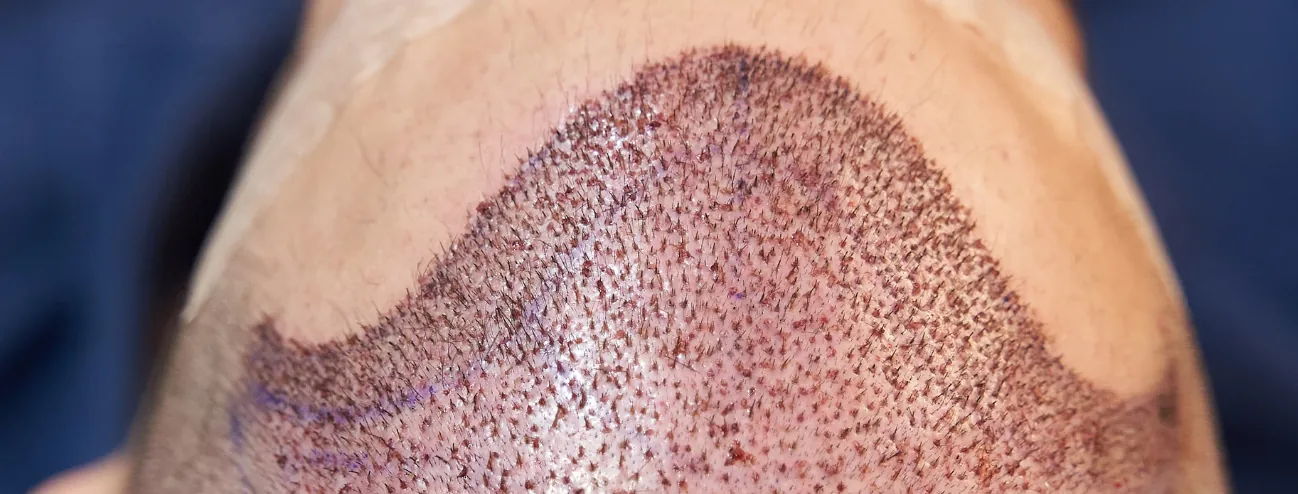
Can a hair transplant that went wrong be rescued? In most cases, yes. A repair usually has three parts: misplaced grafts are removed or moved, old work is hidden behind new single-hair grafts, and density is built up with a new session. But it is a harder operation than the first one. The surgeon has to work in scar tissue, with a donor area that has already been partly used, and around mistakes someone else made. That's why repairs should be done by high-volume clinics with documented experience. The clinic that created the problem is rarely the right place to fix it.
Below we explain why repairs are so common, go through the seven errors surgeons most often have to clean up, show how the work is done and help you find the right surgeon. If you haven't had your first procedure yet, start instead with the warning signs of a bad clinic. The repair you avoid is always the cheapest one.
Why do so many hair transplants need repairing?
For decades the technique was crude, and many clinics still haven't changed: small, low-volume clinics with outdated equipment and too little time and experience per patient. The old plugs produced rows of doll hair, and today's weak clinics produce hair that doesn't grow, wrong angles and coarse hairlines. The country a clinic is in tells you little. What counts is experience and volume, modern equipment, plenty of time for each patient and the right person holding the instruments.
Looking back, a great many hair transplants were done badly. From the 1960s until the 1980s the standard was so-called punch grafts. Each plug held around 15 to 20 hairs and was moved as one piece. The result was stiff rows that looked like a doll's hair, and that image still lingers for many people. The methods have improved enormously since then. Even so, the problem didn't go away. It just found a new home.
Today, most failed procedures come from clinics that never modernised. They are small, see few patients, use old equipment and older methods, and give each patient too little time. As a result, they never build up enough experience per procedure. The best centres in the world invest in new tools, set aside plenty of time for each patient and put a named surgeon in charge. The weak ones do the opposite. Technicians take over the critical steps, several patients are operated on at once, and planning shrinks to a sales conversation. Behind a failed transplant you will almost always find the same pattern: too little time, little experience, old tools and nobody with enough expertise to check the work.
So if you have a result you're unhappy with, you're far from alone. The article on repairing a failed hair transplant goes through several examples of what can be saved.
Which errors does a repair usually need to correct?
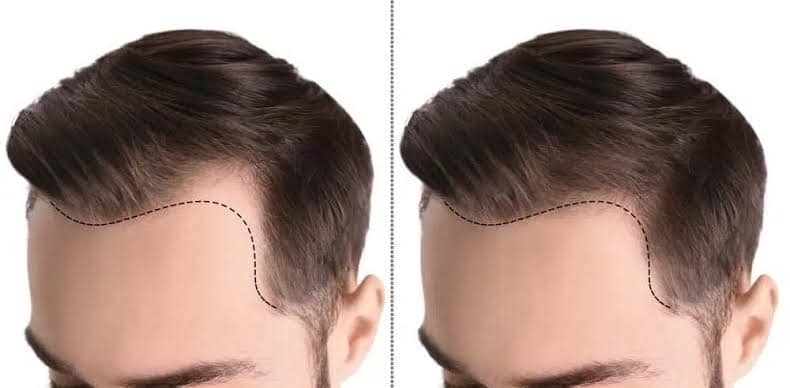
Seven errors come up in almost every repair case. Grafts that never grew, patchy growth, hair pointing the wrong way, coarse grafts right at the front, a badly designed hairline, thin coverage and too few grafts for the area.
- No growth. The grafts never took root. The usual cause is rough handling, incorrect storage or drying out because too much time passed between extraction and implantation.
- Uneven growth. Some grafts survived and some died. The result looks sparse and patchy, like a moth-eaten rug.
- Wrong angle. The hairs grow in directions that don't look natural, because the channels were made without following the way the hair falls. It shows most in the hairline and in the whorl on the crown.
- Multi-hair grafts right at the front. In a natural hairline, single hairs sit at the leading edge. If grafts with two to four hairs are placed there, the edge looks coarse even at conversation distance. That is the opposite of what makes a transplanted hairline look natural.
- A badly designed hairline. Too low, too straight or too rounded, or drawn without thinking about how the face changes with age. No amount of density can hide a design error like that.
- Too little density. The grafts grew, but coverage was thin. This is typical of clinics with too few patients and too little routine. They lack the volume needed to afford the right equipment, enough staff and enough time per patient.
- Sessions that were too small. The procedure was too small for the area, and coverage was left half-finished. The fix here is a session that completes the job. In practice, that is the planning that should have been done the first time.
How is a repair done in practice?
The surgeon uses three techniques, often together. Misplaced grafts are removed one by one with FUE and reinserted where they fit, visible old work is hidden behind fine single-hair grafts, and missing density is built up with a new session. Scar tissue and how much donor hair you have left set the limits of what is possible.
Misplaced grafts can be extracted individually with an FUE punch and placed again where they do some good. Old plugs can also be extracted, split into smaller units and reused. If the old work is visible, the surgeon can place fine single-hair grafts in front of and between the coarse ones. The transition becomes softer, and the eye no longer stops at the plugs. Areas that are too thin are filled with a new session.
Two things limit every repair. The first is scar tissue in the area receiving new grafts. Grafts survive somewhat less well in scar tissue, so a repair often has to be done carefully and in several rounds. The second is donor hair. It doesn't regenerate, and grafts wasted the first time are gone for good. An honest plan therefore starts with a count: how much donor hair do you have left, and where does it give you the most value?
If the donor hair on the scalp is nearly used up, beard or body hair can sometimes fill the gaps. It is a solution for selected cases, and you can read more about it in the article on body hair as a donor source.
It depends on how much donor hair is left. Send three photos and the medical team at the clinic at the top of our ranking will assess what's realistic.
Goes to the clinic at the top of our ranking.
Who should repair your hair transplant?
Choose a surgeon who has corrected hundreds of failed procedures and looks at every single graft with the same question: should it be removed, hidden or reinforced? The clinics that create the problems are rarely the same ones that solve them.
Repair is the hardest discipline in hair surgery. The surgeon has to work out what someone else did wrong, plan with limited donor hair and work precisely in scar tissue. This is exactly the profile we look for in our list of the world's best hair transplant clinics. The clinics at the top of the list handle repairs and corrections as part of their everyday work.
Wondering whether your result can be improved? Request a free hair analysis and have your donor hair and repair options assessed before anyone touches your scalp again. Whoever you choose, check them against the red flags checklist. It would have exposed the first clinic too.
How long does a repair take?
The grafts behave as they did after the first procedure: the hairs shed in weeks 2 to 3, growth starts between months 3 and 4, and the result can be assessed once 12 months have passed. Two extra rules apply. Wait at least 12 months after the failed procedure, and expect several months between rounds if the repair is done in stages.
The curve is the same as for any transplant. After 2 to 3 weeks you lose the hairs that were implanted. Around months 3 to 4 they start to come back, and at 12 months it's time to judge the result. With a repair, two further rules apply.
The first is to wait at least 12 months after the procedure that went wrong. After six months the grafts may still be on their way. Go back in too early and you are repairing something that hasn't finished developing. The second is that staged repairs, where grafts are removed first and density is built up later, deliberately leave months between rounds. The skin needs to heal, and the surgeon needs to see what the previous stage achieved before planning the next.
So expect a full repair to take more than a year from the first consultation until you see the finished result. It takes patience. But a rushed new attempt is what most often makes things worse.
Frequently asked questions
I had a transplant in the 1980s or 1990s. Can it still be improved?
Yes. Old plugs respond well to modern repair. The surgeon extracts them with FUE, splits them into smaller units and redistributes them, and single-hair grafts give the front edge a softer transition. The age of the work sets no limit. What decides it is how much donor hair you have left.
Does removing grafts leave scars?
When grafts are removed with FUE, they leave the same small dot scars as a normal FUE extraction. They usually aren't visible at normal hair length. If the surgeon removes large, old plugs, the marks can be slightly bigger. New grafts are then placed around them so they don't show.
How many grafts does a repair need?
Anything from a few hundred, when a stiff hairline just needs softening, to several thousand, when density has to be rebuilt after a session that failed across the whole head. The donor hair you have left sets the limit. A price list doesn't.
What if I have almost no donor hair left?
Does a repair cost more than a standard hair transplant?
Often a little more per graft, because removing and moving grafts takes longer than implanting new ones. Ask for the plan to be itemised. Removing, hiding and building density are different jobs that take different amounts of time.
A transplant that went wrong can feel like a final verdict. It rarely is. But the next round should be the last, so choose a clinic where repairs are routine. See which clinics meet that standard in the global clinic ranking, or book a free hair analysis and the clinic we rank number 1 will assess what can be corrected.
Goes to the clinic at the top of our ranking.
Updated: October 2026 · How our editorial team works