Can a failed hair transplant be fixed? What can and can't be saved
Did the hairline end up wrong, the scar visible or the result thin? A lot can be improved, but not everything. Here's an honest look at the options and the limits.
Can a bad hair transplant result be improved?
Yes, more often than many people think. A poor result can in many cases be made considerably better. But repair is among the hardest jobs a hair surgeon can take on, and some damage can't be reversed.
People who seek help after a failed procedure rarely come with just a technical problem. They're disappointed, often embarrassed, and afraid nothing can be done. Many have also lost faith in the whole field, which is easy to understand when you've been let down once.
This article is written with two readers in mind. One already has a result they're unhappy with and needs to know what's realistic. The other hasn't had the procedure yet and should see what's at stake before choosing a clinic.
Which mistakes most often need repairing?
Most failed results fall into a few categories, and many patients have more than one of them.
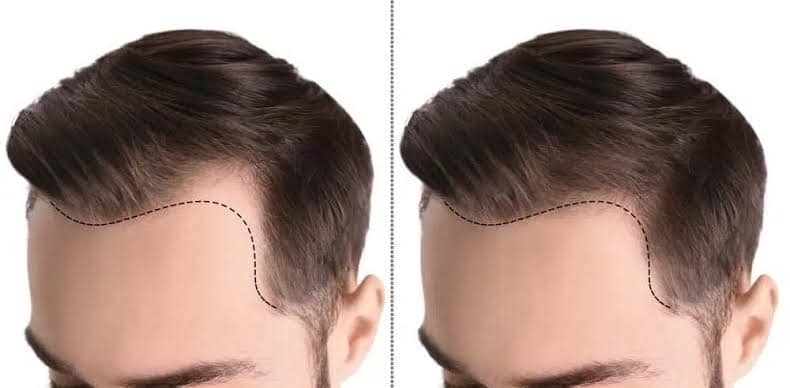
The hairline looks artificial. This is the most common. It has been placed too low, is too straight or too dense, or large grafts have been put right at the front. The result is the stiff “doll hair” look that gives the procedure away from a distance.
The scar shows. It may be the wide strip left by a FUT operation, or small white dots scattered about after heavy-handed FUE harvesting.
The donor area has been depleted. Here a clinic has harvested so hard that the back of the head looks sparse and moth-eaten. That's unsightly in itself and limits everything that can be done later.
Too few grafts grew. Many were placed, but only a fraction took root. The number on paper was high, the result in the mirror is thin and disappointing. Read more about what decides this in the article on graft survival.
When several of these problems occur together, the job gets harder. Before anyone can say what's possible, the hairline and scars need careful examination, and above all the surgeon has to work out how much donor hair you have left.
What can actually be improved?
Quite a lot, provided there's donor hair left to work with.
An artificial hairline can often be redesigned. The surgeon can remove or thin out the coarse grafts at the front, and implant single-hair grafts to soften the edge. A hairline that sits too low is harder, but can in some cases be disguised or partly corrected.
A FUT scar can usually be made less visible. The surgeon can plant hair directly into the scar tissue, operate on the scar again, or cover it with scalp micropigmentation (SMP).
A thin result after poor growth can often be filled in with a new session, done properly this time. If the scalp has already been heavily harvested, a skilled surgeon can supplement with beard hair.
All of this hinges on one thing: that there's donor hair left. Without it there's little to build with. See also the overview of hair transplant repair.
Where is the limit to what can be saved?
The limit is a donor area that has been permanently ruined. If a previous clinic took out so much that the back of the head is permanently damaged, nobody can create new donor hair. The resource is used up, and that sets a fixed limit on what any surgeon can do afterwards.
The same goes for scar tissue where the hair follicles have been completely destroyed. Hair won't come back there on its own. The area can only be covered by transplanting, and only if there's donor hair to take from. More on this in the article on the donor area as a limited resource.
This is what lies behind something you'll often hear from reputable surgeons: you really only get one attempt at getting a hair transplant right. If the first attempt goes wrong, you can lose options that no surgeon can give you back later. The best repair is therefore the one you never need.
What should you expect from a repair surgeon?
Honesty over promises. A patient who is already disappointed is hurt even more by false hope. So a good surgeon tells you straight how much better it can get, where the limit is, and how many sessions and how much money it will take. That holds even on the day the news is that your donor area doesn't have enough left for everything you want.
You should also expect thoroughness. The surgeon should examine your hairline, scars and donor area before saying anything about a plan or price. If you get a quote over the phone before anyone has looked at the back of your head, that's a bad sign.
And you should look for experience with repairs specifically. It's a specialist field of its own within hair surgery. A second opinion from another specialist is sensible before you decide.
Why do so many people end up needing a repair?
The pattern is almost always the same. The clinic was chosen because it was the cheapest. The operation was done as conveyor-belt work, with technicians doing the job the doctor should have done in the crucial parts. Or the patient was promised a low hairline and a large graft count that were never realistic.
The criteria in the guide on how to choose a clinic lower the risk sharply: a doctor present for the critical parts of the procedure, documented results, few patients per day, and a focus on graft survival and wise management of the donor area.
The maths is worth knowing too. Repair often costs more than the first operation did, and the job is harder. Paying for quality the first time almost always costs less than saving money and repairing afterwards. And the price isn't just financial. The disappointment and embarrassment after a poor result often last longer than the bill.
What people ask before a repair
Can a wrong hairline be fixed? It often gets much better. Coarse grafts can be thinned, and single hairs implanted for a softer look. If it sits too low, it's harder, but it can sometimes be camouflaged.
Will the FUT scar disappear? Not completely. But the scar can often be made much less visible with hair planted into it, a new operation on the scar, or SMP.
What if my donor area is ruined? Then that's the biggest limitation you have. New donor hair can't be created, but beard hair can sometimes help. That's the main reason the first procedure has to be done right.
Does a repair cost more than the first operation? Often, yes, and it's technically harder. See more about what the price should cover in the article on what a hair transplant costs.
What should you do now?
If you already have a result you're unhappy with: take photos of your hairline, crown and the back of your head in good light, dig out your records or the operation report from the clinic, and book an assessment with a surgeon who has specific experience of repairs. Bring the photos and ask how much donor hair they think you have left.
If you haven't had surgery yet, spend the time on choosing your clinic instead. That time is the best insurance you can buy.
This article is general information. It does not replace an examination of you.
It depends on your donor area, your hair type and where the loss is. Send three photos and the medical team at the clinic at the top of our ranking will suggest a method and number of grafts.
Goes to the clinic at the top of our ranking.