Hair transplant donor area: why can you only use it once?
At the back of your head sits a supply of hair that never refills. Here's how it should be planned, and what to ask the clinic before anyone removes a single graft.
Why does the donor area matter more than the graft count in the quote?
Because every graft in your quote is taken from there, and what's removed never comes back. Clinic quotes tend to be about one number: how many grafts you'll get. What's rarely on the sheet is how much you have to work with in total, and how much should be saved for later.
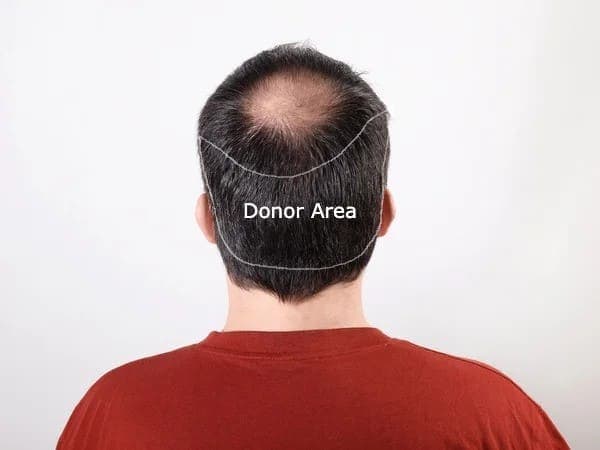
The donor area is the band of hair at the back of your head and above your ears. For genetic reasons, the hair follicles there are far less sensitive to DHT, the hormone behind hereditary hair loss. They aren't completely immune, but they're affected so little that they keep growing when moved to a thin area. The whole hair transplant rests on that.
The supply is finite. You have a certain number of hairs in the safe zone, and no new ones grow once some have been harvested. Think of it as a savings account that has to last a lifetime. You wouldn't empty it on a whim.
How many grafts do you have to work with?
It varies from person to person, but a common rule of thumb is 5,000 to 8,000 grafts in total over a lifetime without the donor area being damaged. Some people are above that, others below. What you have depends on how densely your hair grows, how thick each hair is, your hair colour and how elastic your scalp is.
That may sound generous. But the same grafts often have to keep pace with thinning that continues for decades.
In a single operation, part of the supply can be removed without it showing, as long as the extraction is spread evenly and done gently. That's all there is. No machine or method can create donor hair you don't have, whatever the advertising says. Read more about how capacity is assessed in the article on donor capacity and in the guide do I have enough donor hair?
What happens when a clinic takes too much?
You get damage that in practice can't be repaired. If harvesting is too aggressive, the back of the head becomes thin, patchy or “moth-eaten”. That shows clearly if you cut your hair short. Worse still, your reserves are used up on the day your hair loss progresses and you need them.
The temptation is real. A clinic can push up the graft count by extracting more densely and more aggressively. It looks great in the quote and in the before-and-after photo, but the bill comes later, both at the back of your head and in everything you can no longer do. An experienced surgeon stays on the right side of the line. Clinics that run patients through on a conveyor belt often don't.
Patients who seek help after a procedure like this often have two problems at once: a thin donor area and too few grafts left to keep up as the loss progresses. No surgeon can recreate a ruined donor area. That's why many in the field say you really only get one chance to get it right. If the first attempt goes wrong, you lose more than one result. You lose choices you could otherwise have made later in life. Read more about what can and can't be fixed in the article on repair after a failed transplant.
Why must the hair loss you haven't had yet be part of the plan?
Because hereditary hair loss rarely stops by itself. A 30-year-old man with early hair loss will probably have less hair at 45, and even less at 60. A plan made only for how you look today can be wrong in ten years.
Picture a young man who spends almost his entire donor supply on a dense, low hairline. If the loss continues behind the new front, he ends up with a full hairline in front of an ever-thinner area, and nothing left to fill it with. It looks unnatural, and it can't be fixed.
A surgeon who thinks long term does a few important things differently. She deliberately holds back part of the donor supply. She draws a hairline that suits your age, often a little more conservative than the patient wants. And she often recommends medication to slow the loss to come, see how to slow hair loss without surgery. That isn't excessive caution. It's what makes the result still look right in twenty years.
Can beard or body hair be used instead?
As a supplement, yes. Beard hair is the best alternative. The hair is strong and grows steadily. It works well for filling in the crown, or for making a limited scalp donor supply go further. Body hair, for example from the chest, can be a last resort in some cases. It's thinner, has a shorter growth cycle and behaves less predictably.
Even so, the back of the head is the main donor area and the best one you have. The other sources come on top of it, they don't replace it. With extensive loss, or when a previous procedure needs repairing, a smart mix of sources can make a real difference. Pulling that off takes experience, and this is where you see the difference between a specialist and someone who just operates on routine. More on this in the articles on beard hair as a donor and body hair as a donor.
What should happen with your donor area at the consultation?
It should be examined and discussed, without you having to ask. A reputable surgeon looks at your donor capacity, weighs it against the loss you have and the loss you can expect, and explains how the plan protects your reserves. If what you want goes beyond what your donor area can handle, you should be told.
The warning sign is the opposite. If the clinic only talks about graft count, and never about the limits or how your hair will look in ten years, the focus is on the sale. Ask these questions directly:
- How does the plan allow for hair loss I may get later?
- What share of my donor area are we using now, and how much stays in reserve?
- What will the back of my head look like with short hair afterwards?
The answers, or the lack of them, say a lot about the clinic. You'll find more signs of quality in the guide on how to choose a clinic.
Questions we often get about donor hair
Does donor hair grow back after extraction? No. A graft that has been removed is gone from the donor area for good. That's why the supply has to be used with care.
How big is my supply? Many people have around 5,000 to 8,000 grafts in total over a lifetime. The exact number for you has to be estimated by a surgeon after examining the back of your head.
What does overharvesting mean? That the extraction is too large or too dense, so the back of the head becomes visibly thin or moth-eaten. The damage is permanent and limits what can be done later.
Are there alternatives to hair from the back of the head? The beard is a good supplement, and body hair is an option in some cases. Even so, the back of the head remains the most important source.
What should you do before saying yes to a quote?
Take a photo of the back of your head today, with short or wet hair, so you know what your starting point looks like. Then ask the clinic to write down how many grafts they'll remove now, and how many they think you'll have left afterwards. If you can't get a number for the second, you've learnt something important.
This article is general information. It does not replace an examination of you.
It depends on your donor area, your hair type and where the loss is. Send three photos and the medical team at the clinic at the top of our ranking will suggest a method and number of grafts.
Goes to the clinic at the top of our ranking.