Natural hairline after a hair transplant: how to spot the difference
The hairline is the first thing other people notice. Here's what separates a line that looks born from one that looks drawn, and why the height it's placed at matters most.
Why does the hairline give away a transplant faster than anything else?
Because it's the first thing people's eyes land on. A successful hairline can carry an otherwise modest result, while a poor one gives the procedure away even when everything else has been done right.
People look you in the face. The hairline frames your forehead, so it's the place where a procedure is most often noticed. No one looks at the density on your crown when they say hello. Everyone sees the front edge.
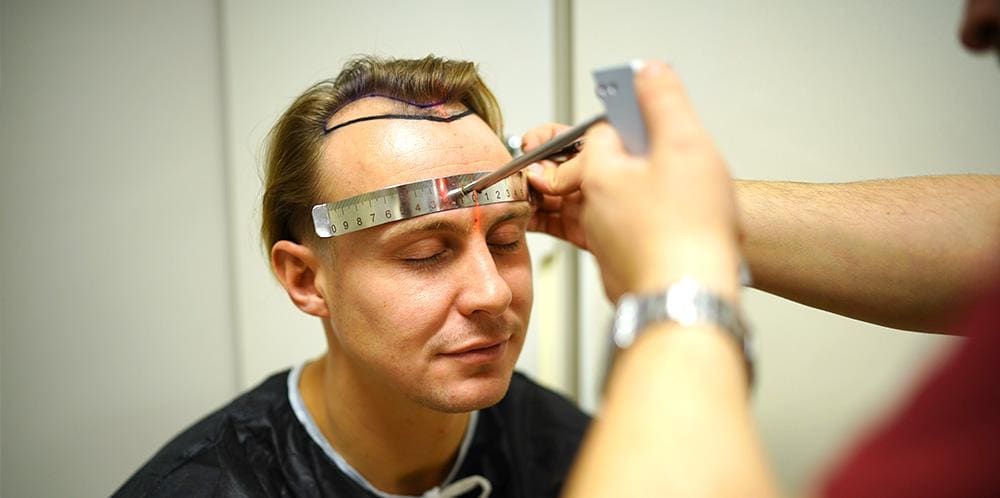
Designing the hairline is therefore one of the hardest things in all of hair surgery. No surgeon can settle for drawing an outline and filling it in. The surgeon needs to know the anatomy, have an eye for aesthetics and enough experience to see how your face looks now and how it will have changed twenty years later. This is exactly where the difference between a practised technician and a surgeon with an artistic eye shows most clearly.
If you know the principles, you can use them yourself. The hairlines in a clinic's before and after photos tell you more about quality than almost anything else.
How high should the new hairline be?
This is the most important decision, and the one most often taken too lightly. The temptation is strong, both for you and for a clinic that wants to impress: put the line low, where it was when you were twenty. The result looks great for the first year. Later, it becomes a problem.
Even men who keep their hair get a line that recedes a little and matures over the years. A youthful, low line on a fifty-year-old face looks wrong, and the mismatch grows as the face ages and the hair further back gets thinner. A low line also swallows a lot of grafts. They come from a donor reserve that is limited, and which you may need later if the loss continues.
A responsible surgeon therefore draws a moderate, age-appropriate hairline, one that suits you now, still suits you twenty years from now, and spares the donor area. Sometimes that means saying no when you ask to get your old line back. That no is one of the surest signs you're sitting with a serious surgeon and not one who sells you whatever you ask for.
What makes a hairline look natural?
Forget the line. A real hairline isn't an edge. Look closely at someone who has kept their hair and the transition between forehead and hair is a zone: at the very front there are a few fine hairs, scattered without any obvious pattern, and density gradually increases further back.
That's what a skilled surgeon tries to recreate. Right at the front go single-hair grafts, the smallest units with one hair each, which give the soft, almost feathery transition. Behind them come grafts with two and three hairs that build density. The whole line gets small, deliberate irregularities, with tiny peaks and notches, so it never looks drawn on.
The irregularity is the whole point. A clean, symmetrical line looks artificial precisely because no human has one.
Why does the angle of each hair matter so much?
At the forehead, hair doesn't spring straight out of the skin. It lies at a low, forward-slanting angle, and its direction changes across the forehead, turning gradually as you get closer to the temples and the crown.
The surgeon has to open each channel so that the implanted hair follows exactly the slope and direction nature would have given it. We're talking several hundred, often several thousand, tiny openings, each with its own direction. If the angles are off, the hair stands up or sticks out every which way, and then a nice shape to the line doesn't help much.
Opening the channels therefore belongs with an experienced specialist. It's precision handwork where concentration and experience decide how the hair falls, and it can't be rushed without it showing.
Which mistakes give away a poor hairline?
- It sits too low. A twenty-year-old's line on an adult face. The most common mistake, and the most visible.
- It's too straight and sharp. Without the natural irregularities, it looks drawn with a ruler.
- Multi-hair grafts right at the front. This gives the familiar doll's hair or toothbrush effect where the transition should have been soft.
- The angles are wrong. Hairs that stand up or stick out with no pattern.
- It doesn't allow for the future. The line is planned as if the hair behind it will never thin any further.
Doll's hair is especially bad because it's almost impossible to hide and very hard to correct. Next time you look at before and after photos, look at the line first. Is it soft, irregular and right for the person's age? Or is it straight, dense and suspiciously low?
Who should design and open your hairline?
An experienced doctor. The design and the opening of the channels decide how natural the result looks, and they shouldn't be handed to a changing team of technicians.
Placing grafts can be learned. Building a line that looks real, suits your age, has the right angles and can cope with future loss takes something more: experience, aesthetic judgement and an eye for the actual person sitting in the chair.
The mistakes that can't be put right happen precisely here. If a clinic is vague about who designs and opens your hairline, that tells you something about how much priority they give that part. Read more about who actually performs the operation.
Ask to see hairlines from several patients, not just one hand-picked photo. A surgeon who delivers soft, natural, age-appropriate lines time after time is showing the most important skill in the field. That says more than any advertising campaign.
Can you get the hairline of your youth back?
Often the answer is that you shouldn't. A line that's too low looks unnatural as the face matures and becomes more noticeable over the years. It also uses up grafts you can't get back. A good surgeon will suggest a line that stays attractive over time instead.
Can a failed hairline be fixed?
Partly. A line that sits too low or looks artificial can often be improved with a new design and by thinning out the worst grafts. It's demanding repair work, and the result is rarely as good as if it had been done right from the start. That's why it pays to spend time choosing a clinic before the first operation.
What should you do before the consultation?
Dig out photos of yourself from different years and take them to the consultation. Ask the clinic to show you hairlines from patients your age at least a year after surgery, and ask straight out who will design the line and open the channels. Ask too where they would place your line, and why. A good answer is about your age, your face and your donor reserve, not about what will look best in a photo next summer.
This article is general information and does not replace a medical assessment of you.
It depends on your donor area, your hair type and where the loss is. Send three photos and the medical team at the clinic at the top of our ranking will suggest a method and number of grafts.
Goes to the clinic at the top of our ranking.