Hairline design: how to draw a hairline that ages well
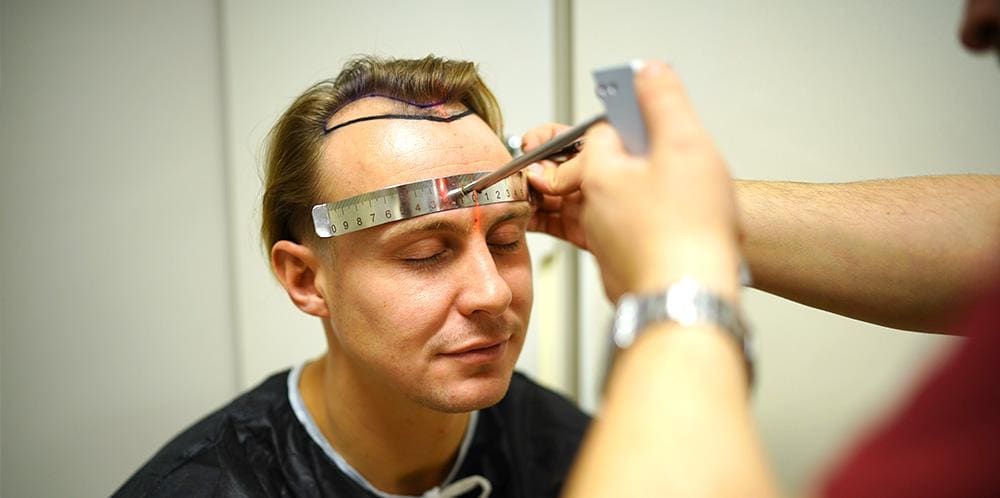
A natural-looking hairline is irregular, soft at the edge and suited to the face. Most importantly, it is drawn with the person you will be in twenty years in mind.
A natural-looking hairline is irregular, soft at the edge and suits the face. Most importantly, it is drawn with how you will look in twenty years in mind. No single decision does more to determine whether people can tell you have had a transplant.
What makes a hairline look natural?
Five things come up again and again: the line is irregular rather than straight, it has a zone where density increases gradually from single hairs at the very front, the leading edge consists only of single-hair grafts, the height suits the proportions of the face, and the shape matches the face, including around the temples and any widow's peak.
- Irregularity. A real hairline has small clusters and gaps. A straight line gives itself away instantly.
- A gradual transition. Right at the front, single hairs are sparse, and density builds up further back. Nature has no sharp edge.
- Only one hair per graft at the leading edge. Multi-hair grafts in the front row give a tufted, pluggy look.
- Height to suit the face. Placement is guided by the proportions of the face, not by where the hair once was.
- The shape, with the transition to the temples and any widow's peak included in the design.
Why should a hairline be designed for the future?
A hairline that is too low can look great in your thirties. Twenty years later, the hair loss behind it has continued, the donor hair that should have supported it has been used, and the line looks increasingly out of place. A more conservative line needs fewer grafts, saves reserves for later and looks believable for a long time.
This is the point on which patient and surgeon most often disagree.
What warning signs should you look for in a proposal?
Be wary if the proposal has a straight, sharp edge, sits lower than your original hairline, or does not address future hair loss and donor capacity. The same goes for promises to give an older patient the hairline of their youth, and a clinic that won't draw the line and let you see it in the mirror before you are shaved.
- The line is straight with a sharp edge
- It is placed lower than your original hairline
- The hair loss still ahead of you is not mentioned
- There is no discussion of donor capacity
- As an older patient, you are promised the hairline you had when you were young
- The clinic won't draw the line and show it to you in the mirror before shaving
What should you ask for when your hairline is being planned?
Ask the surgeon to draw the line and show it to you in the mirror, both straight on and in profile, and ask directly how it will look if you end up at Norwood stage 6. If the surgeon cannot answer that, the design has not been thought through well enough.
Sources
- Shapiro R. Principles and techniques used to create a natural hairline in surgical hair restoration. Facial Plastic Surgery Clinics of North America, 2004;12(2):201-217. pubmed.ncbi.nlm.nih.gov/15135130
- Shapiro R, Shapiro P. Hairline design and frontal hairline restoration. Facial Plastic Surgery Clinics of North America, 2013;21(3):351-362. pubmed.ncbi.nlm.nih.gov/24017977
- Garg AK, Garg S. Decoding Facial Esthetics to Recreate an Esthetic Hairline: A Method Which Includes Forehead Curvature. Journal of Cutaneous and Aesthetic Surgery, 2017;10(4):195-199. pubmed.ncbi.nlm.nih.gov/29491654
- Gómez-Zubiaur A, Mir-Bonafé JM, Muñoz Moreno-Arrones O, et al.. FUE for the repair of unnaturally designed or low hairlines in men with androgenetic alopecia: a retrospective, multicenter observational study. Frontiers in Medicine, 2026;13:1735251. pubmed.ncbi.nlm.nih.gov/41907238
- Goldin J, Zito PM, Raggio BS. Hair Transplantation. StatPearls (NCBI Bookshelf), 2025 (updated 2 August 2025). pubmed.ncbi.nlm.nih.gov/31613520
This article is based on published research and standard clinical practice in the field. It offers general information and is not medical advice. The instructions from the team that operates on you always come first, including where they differ from what is written here.
Wondering what's possible for your hair?
Send three sharp photos of your hair, from the front, the top and the back. You'll get an honest answer on what can be done, roughly how many grafts it would take and what it costs.
- Free and with no obligation
- Photos are assessed by the clinic's medical team
- Replies usually within an hour in the daytime


A study tells you something about groups. Only a doctor who has seen your photos can say what applies to your hair. The medical team at the clinic at the top of our ranking offers a free assessment.
Goes to the clinic at the top of our ranking.