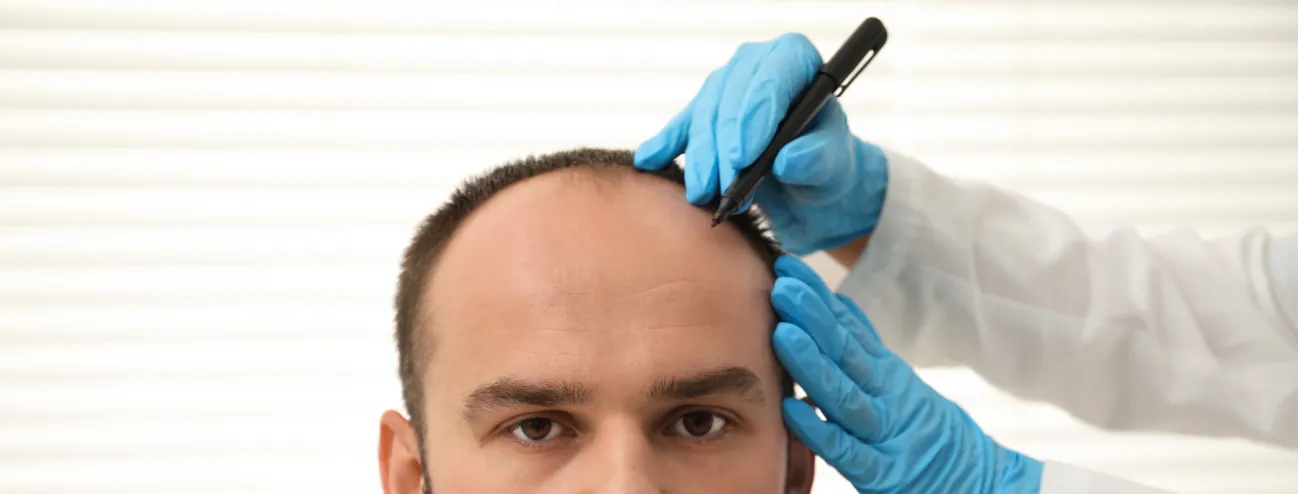
For many men the answer is yes. The condition is that your hair loss has settled into a fixed pattern that no longer changes from month to month, and that the hair at the back and above the ears has been examined and found healthy. If you're still losing hair quickly, you usually start with medication and hold off on surgery until things have stabilised. The medical name for male pattern hair loss is androgenetic alopecia, and doctors grade it on the Norwood scale. Your stage and how much donor hair you have determine, in practice, how many grafts you need and what an operation can achieve.
Below we take the decisions in the order they usually come up. Is surgery right for you now? What does your Norwood stage mean for the number of grafts? Should the hairline or the crown get the grafts first? Then we look at the medications finasteride and minoxidil, which are usually started before or alongside the operation, the choice between FUE, DHI and FUT, how long growth takes, what it costs and how to find out whether you're suitable. The broader candidate guide covers all types of hair loss. Here we stick to men and Norwood. If the question is about a woman, the loss is more often spread across the whole head and measured on the Ludwig scale. In that case the page on hair loss in women is a better fit.
- Surgery gives the best result when the pattern has settled and the donor area is healthy. If the loss is still moving fast, it's treated with medication first and reassessed later.
- Nothing drives graft needs more than the Norwood stage. Around 500 to 1,400 grafts is often enough at stage II, while stages VI and VII can easily need well over 6,000.
- Donor hair is a limited resource, so the hairline and crown compete for the same grafts. Usually the hairline and mid-scalp come first, and the crown is treated cautiously.
- Finasteride or minoxidil is often started before or around the operation. The point is to protect your own hair that isn't moved. The transplanted grafts don't need it.
- Whatever the method, the new hairs shed after 2 to 3 weeks, growth picks up from months 3 to 4, and you judge the result after around 12 months.
When is surgery the right answer to male pattern hair loss?

When the loss has settled into a fixed pattern and the donor hair at the back and sides is healthy. While the loss is still progressing, most people start with medication and are reassessed once photos taken over 6 to 12 months show it has slowed. If both are in place and the pattern is clear on the Norwood scale, there's a good chance you're suitable.
It's the pattern itself that makes transplants possible in men. The follicles at the hairline, the temples and the crown have an inherited sensitivity to DHT (dihydrotestosterone) and shrink a little with each growth cycle. The follicles further back and down by the ears have a different inheritance and tolerate the hormone far better. If you move them, they take that quality with them. That's why the difference needs to be visible as a fixed pattern before anyone starts moving hair. As long as the whole head is changing, nobody knows where the boundary will end up.
What needs to be in place before surgery makes sense?
Three things. The pattern has stayed still, or clearly slowed, over a long time and not just a couple of months. The donor area is dense and healthy enough for the plan. And you know what the operation actually does: it moves hair you already have to places where it shows better. The number of hairs you get over your lifetime doesn't increase. Most men at Norwood III to VI with good donor hair tick all three boxes.
When does a good surgeon say "wait a bit"?
When the loss is recent and still moving fast. When nobody has checked that scarring alopecia or another condition isn't behind it. Or when the donor area itself is starting to thin. We see the last of these in a smaller group of men who thin evenly across the whole head rather than in a classic pattern. Then there's no safe zone to harvest from, and surgery is rarely a good answer. It's rarely a final no, just a postponement. If surgery is done before the pattern has found its shape, the hairline may look right today and be left stranded like an island in a few years, because the untreated hair around it keeps receding. Many who are told to wait are good candidates a year or two later.
General health, the condition of the scalp and hair type are covered thoroughly in the candidate guide, which applies to all forms of hair loss. Here we carry on with what's specific to men.
How many grafts do you need at your Norwood stage?
Your stage decides how many grafts you need more than anything else. Temples that have only just receded (Norwood II) often need 500 to 1,400 grafts, while Norwood VII, where only a horseshoe of hair is left around the head, comes in at 7,100 to 8,600. The stage also tells you how much of your donor hair you can use now and how much should be saved.
The scale runs from I, where the hairline has barely moved, to VII, where only a horseshoe-shaped band is left around the nape and above the ears. The surgeon plans around the area that actually needs covering. "More hair" isn't a plan. Spend a little time placing yourself on the scale before you look at graft numbers, and ideally use photos from the last 6 to 12 months, not just today's reflection in the mirror.
Many people fall between two stages, and that's completely normal. The scale is a tool for speaking the same language as the surgeon, not an exact measurement. Take the photos from directly above, straight from the front and from both sides with wet or combed-flat hair, so you see the hairline and crown as they really are. Dry, styled hair hides a lot.
What are the graft needs stage by stage?
| Stage | What it looks like | Approximate number of grafts* |
|---|---|---|
| II | The temples have receded evenly on both sides | 500 to 1,400 |
| III | Deep recession at the temples, crown intact | 1,500 to 2,800 |
| III vertex | Recession at the temples and early thinning on the crown | 2,900 to 3,800 |
| IV | Hair loss at the front and on the crown, with a strip of hair in between | 3,900 to 4,900 |
| V | The strip narrows and the two areas move closer together | 5,000 to 6,200 |
| VI | The front and crown have merged | 6,300 to 7,000 |
| VII | Only a horseshoe of hair is left around the head | 7,100 to 8,600 |
*The figures come from our own graft calculator, added up for the hairline, mid-scalp, crown and temples. They're a starting point, not a promise. How thick your hair shafts are, how much they curl and how dense your donor area is can move the figure either way, and your hair type alone can make a noticeable difference. If you want to see the sums behind it, read graft needs for each stage, step by step.
Why is the graft count a question of budget?
Every graft that ends up at the front or on the crown is taken from a donor area that has to last for decades, while your own hair around it may keep disappearing. Norwood VII is the clearest example. A man at that stage who wants full coverage everywhere often needs more grafts than a typical donor area can safely give. At advanced stages, good planning is therefore about order and priority, not one big session where everything is harvested. That's the subject of the next section.
Should the hairline or the crown get the grafts first?
If the donor hair won't stretch to everything at once, most surgeons start with the hairline and mid-scalp. The hairline shapes how your face is perceived, and the crown copes better with waiting for a later round. The crown also has to be filled more densely before it looks full, so it uses up donor hair faster for the same visible effect.
There's no fixed rule. It's a trade-off that comes up as soon as the graft needs for your stage approach what the donor area can give in one go.
Why does the hairline usually win?
The hairline is the frame around your face. A moderate, well-designed hairline changes the whole impression of the head. A half-covered crown, on the other hand, looks unfinished whatever you do. At the very front the surgeon places single hairs in a soft, slightly irregular line, and that often takes fewer grafts than a dense whorl on the crown. On a tight budget, the hairline gives the most return per graft. What separates a natural hairline from one that looks "operated on" is explained in the guide to designing the hairline.
Why is the surgeon careful with the crown?
Hair on the crown grows in a whorl, and from above every gap shows. The grafts therefore need to sit more densely there. Around the crown there's also a lot of your own hair that may keep thinning for many years. If you use a lot of grafts there early, before the surrounding hair has stopped changing, you can be left with a dense patch that becomes more and more visible as the rest disappears. That's why many surgeons give the crown a light treatment the first time, or save it for round two.
Is it wise to split the plan?
Often. At advanced Norwood stages, doing the front first and the crown in a later round is a sign that someone has thought long-term, not a half-finished result. You save donor hair for another round rather than spending it all on a pattern that is still shifting. When such a staged plan pays off is covered in the article on one or two sessions.
It depends on your donor area, your hair type and where the loss is. Send three photos and the medical team at the clinic at the top of our ranking will suggest a method and number of grafts.
Goes to the clinic at the top of our ranking.
Does your hair loss have to stop before you have surgery?
In almost all cases, yes. If you move hair into an area where the loss is still ongoing, the result may look good now and be left isolated in a few years, when the hair around it keeps disappearing. Finasteride and minoxidil are the usual ways to slow the loss before the operation or alongside it, so that the hair that isn't moved is protected.
A transplant relies on a difference that already exists on your head. In men with the inherited tendency, DHT (dihydrotestosterone) makes the follicles at the hairline, the temples and the crown shrink. The donor follicles further back and low on the sides largely resist the hormone, and they mostly keep that resistance in their new location. They're not completely immune, which is why no honest source calls the result permanent. But the difference is real, and it explains why the donor hair keeps growing where your own hair gave up. Read how this fits together in the guide to DHT and genetics, or in the broader overview of what causes hair loss.
What happens if you have surgery while the loss is ongoing?
The grafts end up on a scalp where the loss hasn't stopped. Your own hair around and behind them gets no protection from the procedure and may keep shrinking for years. The result was well placed when it was created, but gradually becomes surrounded by thinner and thinner hair. That's exactly why surgeons look for stability before they ask how old you are.
How do you stabilise the loss in practice?
If you're still losing hair at a fast rate, which is common in your early twenties, the usual approach is to start finasteride, minoxidil or a combination and then photograph your head at six to twelve month intervals. The operation can wait. Around 25 is a common guideline for when a transplant becomes an option, provided the loss has settled. It's a rule of thumb and not a limit. Some people in their early twenties who are losing hair slowly and in a clear pattern are sensible candidates, while some over 25 are told they should give it more time. Where you stand is covered in the article on age and when hair loss has settled.
Why do many continue medication after the operation?
DHT keeps acting on your own hair after the grafts are in place. That's why many surgeons recommend starting or continuing finasteride or minoxidil around the procedure. The aim is to preserve the hair surrounding the grafts. The grafts themselves don't need the help. Doses, how long it takes and what the research actually shows are in the guide to slowing hair loss without surgery.
FUE, DHI or FUT: which method suits your head?
Most men end up with FUE, where follicles are removed one at a time through small punches, without a long scar. DHI harvests the grafts in the same way but places them with an implanter pen that gives good control of angle and density, which is useful at the hairline. FUT (strip method) is still an option at advanced Norwood stages that need a very large number of grafts in one session, but it leaves a linear scar in the donor area.
The name of the method doesn't decide the result. What counts is whether the technique suits your stage, donor density and hairline plan, and how much experience the team has with that particular method. Here's the short version. The full comparison, including sapphire FUE, is in the guide to hair transplant methods.
Why is FUE the default choice?
In FUE (follicular unit extraction) the surgeon removes the follicles one by one with a small punch. What's left are small, scattered dots that rarely show, not a line. The method suits most cases of male pattern hair loss, and it's the safest choice if you want to be able to cut the back and sides very short.
What does DHI do differently?
DHI (direct hair implantation) harvests the grafts exactly as FUE does. The difference lies in the placement. An implanter pen places each graft directly, without the channels being made beforehand, and the surgeon gets fine control of angle and depth. That helps when the hairline needs to be dense and natural. It doesn't give you more grafts per session, though, and the operation can take longer.
When is FUT still relevant?
In FUT the surgeon removes a strip of scalp from the donor area and divides it into grafts under magnification. This makes it possible to harvest a very large number of grafts in one go, which can suit a man at Norwood VI or VII who wants as much coverage as possible straight away. The price is a linear scar at the back of the head, and that matters more if you like your hair very short. Read about when FUT is still a good choice.
Whatever the technique, it's the surgeon who makes the difference. Ask for a name and documented experience with the method you're being offered.
How long does it take before you see the result?
The transplanted hairs usually shed after 2 to 3 weeks, and that's completely normal. New growth comes in months 3 to 4. You judge the final result after around 12 months. You get a natural hairline and denser coverage where it's been treated, but the density you had as a teenager won't come back.
The course is the same for FUE, DHI and FUT. The method affects how the grafts are harvested and placed, not how they grow. Know this before you have surgery. Most disappointments come from someone promising more than a transplant can deliver.
Months 2 and 3 are the hardest for many. The hairs from the operation have shed, the new ones haven't arrived, and the mirror shows roughly the same as before the procedure. That's expected. Take photos in the same light every month, so you can see the progress when it comes.
What happens month by month?
- Weeks 2 to 3: the hairs in the grafts shed. The follicle stays under the skin, so this doesn't mean the graft is lost.
- Months 3 to 4: new, fine hairs start to grow.
- Months 6 to 12: the hairs get thicker and gain more fullness. Around 12 months most people see something close to the final result. The crown is often the last to come through.
What's a realistic result?
The surgeon aims for a natural hairline and more even, thicker coverage in the treated area. The density you had at 18 isn't the goal. The grafts are spread out deliberately, both so the donor area doesn't look thin and because you only have a certain number to use over your lifetime. Well-placed, correctly angled hair looks full even at a lower density than in your youth. Some clinics offer PRP and similar supportive treatments to help healing in the first months. There you can read what has good evidence behind it, and what doesn't.
How do you look after the result?
The transplanted hair tolerates DHT well and keeps growing. Your own hair around and behind the grafts has no such protection and may keep thinning, which is why many continue with medication. Washing, sleeping position and exercise in the first weeks are covered in the aftercare guide. What happens to the result after 10, 20 years and more is covered in the article on how long the result lasts.
What should a man expect to pay?
The price follows the number of grafts first and foremost. Norwood III with roughly 1,500 to 2,800 grafts costs clearly less than Norwood VI or VII with roughly 6,300 to 8,600, before country or method is taken into account. In Turkey a standard procedure averages around 3,500 euros (roughly 37,000 NOK), against 85,000 to 150,000 NOK for the same in Norway, based on a full session of around 4,000 to 4,500 grafts.
What affects the price most is neither the country nor the marketing. It's how many grafts your stage and plan actually require. If you get a price before anyone knows your stage and graft count, you haven't had a quote yet.
It works the other way too. A low figure in an advert may cover far fewer grafts than you need, and then you end up with two bills instead of one. Always ask how many grafts the price covers, and divide by the number of grafts before you compare.
What else pushes the price up or down?
The method plays a part, since FUT is sometimes priced differently from FUE and DHI. So does the number of sessions the plan requires, and what the package covers beyond the operation itself, such as hotel, transport, an interpreter and a proper aftercare plan. The per-graft sums are in price per graft, explained.
Why is Turkey the benchmark?
In Turkey a standard procedure averages around 3,500 euros, and most prices fall between 2,500 and 5,500 euros. That works out at under one euro per graft, and hotel, transport and aftercare are often included. In Norway the same procedure, a full session of around 4,000 to 4,500 grafts, usually costs 85,000 to 150,000 NOK. You don't get less for your money, either in number of grafts or in quality. The difference comes mainly from a lower cost level and the fact that the leading clinics in Istanbul carry out a very large number of procedures, not from anyone cutting corners in the operation.
How do you find your own figure?
Because the price is so closely tied to the number of grafts, a rough graft count for your particular stage and goals is the best place to start. A country price tells you little. The graft calculator gives you a rough range in a few minutes. You can only get a written quote once a proper consultation has measured your donor density and drawn up a plan. All the countries side by side are on the prices page.
If you're planning two sessions, budget for both from the start. The second round is often smaller, but it still costs money, and sometimes another trip.
How do you get confirmation that you're a candidate?
Let a proper assessment establish your Norwood stage, donor density and how stable your loss is, rather than guessing from what you've read. Only then do graft count, method and timing become a real plan. A free hair analysis gives you the first assessment from home, and you're not committing to anything.
Everything you've read here, from stage and the priority between hairline and crown to medication, method and price, depends on a few facts about your own head: how clear the pattern is, what's available in the donor area, how long the pattern has stayed still and what your health is like. Only an examination, in person or from good photos, gives you a real plan rather than just an estimate.
For an analysis from home, sharp photos of the hairline, the crown, both sides and the back of the head are usually enough, ideally taken by someone else in good daylight. If you have older photos showing how your hair looked a couple of years ago, include them. They say a lot about how fast the loss is moving.
What should be checked first?
- Your stage and direction. Both where you are now and which way it's heading. Your photos from the last twelve months show whether the pattern has settled or is still moving.
- Density and thickness in the donor area. Density is usually between 65 and 85 follicular units per cm², but it's your own measured figure that counts. The page do I have enough donor hair? shows how the figure is measured and what limits it sets.
- Age considered together with stability. There's no fixed age limit, either lower or upper. The page on age explains what's assessed when you're 20, 30 or over 50.
- Your health. Diabetes, thyroid disease, blood-thinning medication and the like are assessed individually and don't automatically rule you out. Read hair transplants with diabetes and other conditions if you have one of these.
Where do you go from here?
This page is written for men with pattern hair loss. The candidate guide brings together all the factors above, plus scalp and hair type, for all forms of hair loss. Once you have an idea of where you stand, you can read how to choose a clinic, compare in the clinic ranking and go through the best clinics. Don't book anything before then.
Frequently asked questions
What's the best age for a hair transplant in men?
There's no single right answer and no absolute limit. Around 25, and once the loss has clearly settled, is a common guideline, because a pattern that's still moving can leave the grafts stranded after a few years. Some men in their early twenties with slow loss in a clear pattern are well suited. Others are past 30 and are still advised to give it time, because the pattern has only just settled.
Can a transplant cure male pattern hair loss?
No. The procedure moves hair you already have. It's taken from where DHT does little damage and placed where the hair is thinning. Androgenetic alopecia doesn't stop because of it, and you don't get more hairs in total. Your own hair that wasn't moved, including the hair around the grafts, can thin over the years, which is why many men combine the operation with medication.
Do I have to use finasteride or minoxidil after the operation?
It isn't a requirement, but it's often recommended. The operation doesn't protect your own hair around the grafts from further DHT-driven loss. That's why many continue with finasteride or minoxidil, so the overall look stays even over time. Both medications have their own considerations, so make the decision together with a doctor.
How many grafts do you need at Norwood 5 or 6?
At Norwood VI many people need 6,300 to 7,000 grafts, and at V the figure is 5,000 to 6,200. Both ranges are added up for the hairline, mid-scalp, crown and temples. The figures are estimates from a graft calculator, not a quote. Your own needs depend on how dense your donor area is, how coarse your hairs are, and whether you treat the crown now or let it wait.
Which method is best for men: FUE, DHI or FUT?
None of them is best for everyone. FUE suits most people and doesn't leave a long scar. DHI gives extra control during placement, which helps at the hairline. FUT can move a very large number of grafts at once in extensive hair loss, but leaves a linear scar. What suits you depends on your stage, your donor area and how experienced the surgeon is with the technique.
What if my donor area won't cover my whole stage?
Then a responsible surgeon plans soberly and doesn't over-harvest just to achieve full coverage. Usually the hairline and mid-scalp are prioritised, while the crown gets a light treatment or waits for a later session. You'll also get an honest answer that maximum density across the whole head isn't realistic. This is where the personal assessment earns its keep: a donor area that looks limited on paper can stretch further once density and thickness are measured.
Where you are on the scale and what your donor hair can supply apply only to you, and no article can assess that. It takes someone looking at your head. Ask for a free hair analysis and you'll hear back from the clinic at number 1 in our ranking: an honest reading of your pattern, whether the timing is right and how many grafts actually make sense. You're not committing to anything.
This is general information and not medical advice. Only a qualified surgeon can decide whether and when the procedure suits you, after a personal assessment.
Goes to the clinic at the top of our ranking.
Updated: October 2026 · How our editorial team works