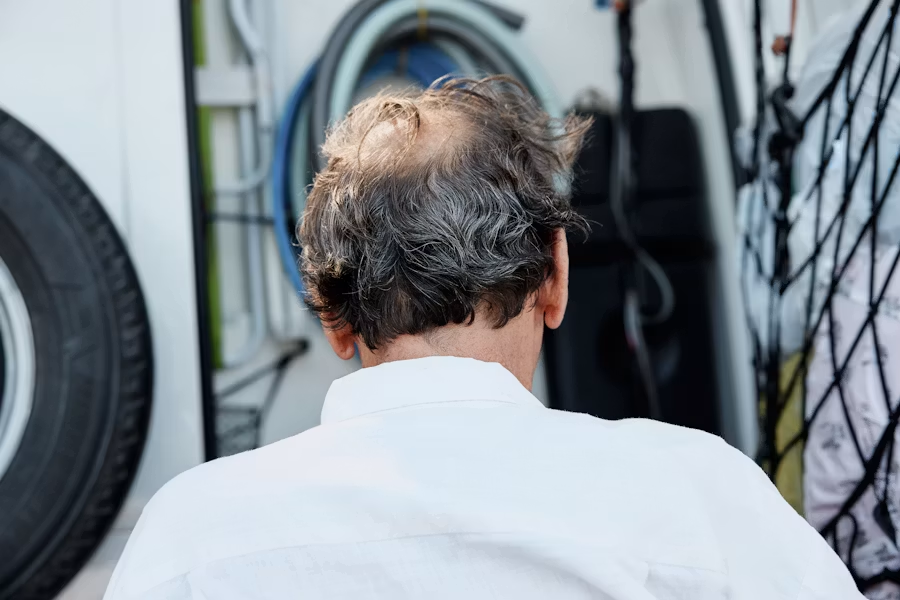
How many grafts per Norwood stage? A realistic number for you
Graft needs rise sharply between Norwood 2 and Norwood 7. Here are the guide figures, what pushes them up or down, and why your donor area has the final say.
How many grafts do you need at your Norwood stage?
Roughly, from around 1,500 grafts for a receding hairline to over 6,000 when large parts of the top are bare. The figures below are a guide, not a definitive answer. The size of your head, the type of hair you have, how dense your donor area is and what you want all move the number in either direction. The Norwood scale (Norwood, 1975) divides hereditary hair loss in men into stages, from a hairline that has barely receded to advanced loss where only the horseshoe remains. It describes a pattern and is not a treatment recipe. Its value is that you and your doctor can talk about how far the loss has gone using the same words. Not sure which stage you're at? See the overview of the Norwood scale and causes of hair loss.
| Norwood stage | Approximate need |
|---|---|
| II to III (hairline and temples) | around 1,500 to 2,500 |
| III vertex or IV (front and early thinning at the crown) | around 2,500 to 3,500 |
| V (front and crown) | around 3,500 to 4,500 |
| VI (one large, continuous area) | around 4,500 to 6,000+, often split over two sessions |
| VII (the most extensive loss) | Very large, often more than the donor area can fully cover |
What is a graft, and why isn't it the same as a hair?
A graft is a follicular unit, a small natural group of 1 to 4 hairs that are moved together. How many you need depends mostly on how large the area is and how dense the result should be.
The difference between a graft and a hair matters when you compare offers. Since each graft holds several hairs, 2,500 grafts often equal 5,000 to 6,000 individual hairs. Some clinics advertise an impressive "hair count" and are counting individual hairs. Make sure you're comparing the same unit, or an offer will look twice as big as it really is.
With a rough grasp of the numbers, it's easier to judge whether a clinic's recommendation and price fit together, and to spot promises that miss in one direction or the other.
Why might your number differ from the table?
Because two men at the same Norwood stage can start from completely different places. A large head has more area to cover. Thick hairs cover more per graft than fine ones. Curly hair and low contrast between hair colour and skin colour give a fuller look with fewer grafts. And a dense donor area gives you more to work with than a sparse one.
What you want also plays a part. If you want a dense, sharp hairline, you'll need more grafts than if you're happy with a softer transition. The number a clinic gives you should therefore always come with an explanation that's about you specifically.
Why does the donor area set the limit?
Because there's only a limited number of hairs you can safely take. What you need is only half the calculation. The other half is what you have to give. The hair at the back and sides of the head is largely resistant to DHT, but the supply is finite. Ideally it has to last a lifetime, while the original hair loss may continue.
The tables only tell you how much you need, never how much you have. The reserve is determined by the density measured in the safe zone, where roughly 65 to 85 follicular units per cm² is normal (Jimenez and Ruifernández, 1999), and it also has to cover future loss. If you're far along the scale and have little donor hair, you therefore can't get the numbers in the table. The published graft ranges are averages from heads of different sizes (see for example Chouhan et al., 2019, and Goldin et al., 2025). A typical donor area yields 5,000 to 8,000 grafts in total over a lifetime. Some have more, others less. At high Norwood stages the sums therefore don't always add up, however much you want them to. A responsible surgeon thinks about you at fifty and doesn't use up the supply in the first round. Read more about this perspective under long-term durability.
Are more grafts always better?
No. What matters is the proportion that take root and grow, and whether they're placed naturally. If a clinic promises a very high number at a low price, it may mean it harvests aggressively without regard to how many survive, or to the reserve you'll need later. That can damage both the result and the donor area for good.
Be as sceptical of an inflated number as of a strikingly low one. The right number gives you a natural result while keeping your reserve intact for later.
When are two sessions smarter than one?
Often at Norwood V and above. Full coverage in a single session is rarely possible then, and not always wise. Many surgeons split the work: hairline and front in the first session, crown in the next. This usually gives a more natural and lasting result, and the second session can be adapted to how your own hair loss has developed in the meantime.
If a surgeon suggests a staged plan like this, it's a sign that someone is thinking long term. A skilled surgeon will often choose a slightly more cautious approach rather than packing in as many grafts as possible at once. That protects both the result and your donor supply, which has to last for decades.
How do you check whether a clinic's number holds up?
Ask for the reasoning. Ask why they've arrived at exactly this number, how they've accounted for hair loss you may have later, and what share of the grafts they expect to survive. If the clinic answers concretely and thoughtfully, that's promising. Check whether the number is based on a measurement. If you're given a figure based on photos you've sent, with no measurement of donor density, it's an estimate from a photo. Ask what your density has been measured at, how much of your reserve the planned day will use, and how much is saved for later. If the answers are vague, or the number seems suspiciously low or inflated, get a second opinion.
If you want a starting point before the conversation, try the graft calculator and bring the number to your consultation. You'll find the full checklist for choosing a safe clinic under choosing a clinic.
This article is general information and doesn't replace an assessment of your own head.
That depends on your donor area, your hair loss and your health, and a doctor needs to look at it. Send three photos and get an honest answer from the medical team at the clinic at the top of our ranking.
Goes to the clinic at the top of our ranking.