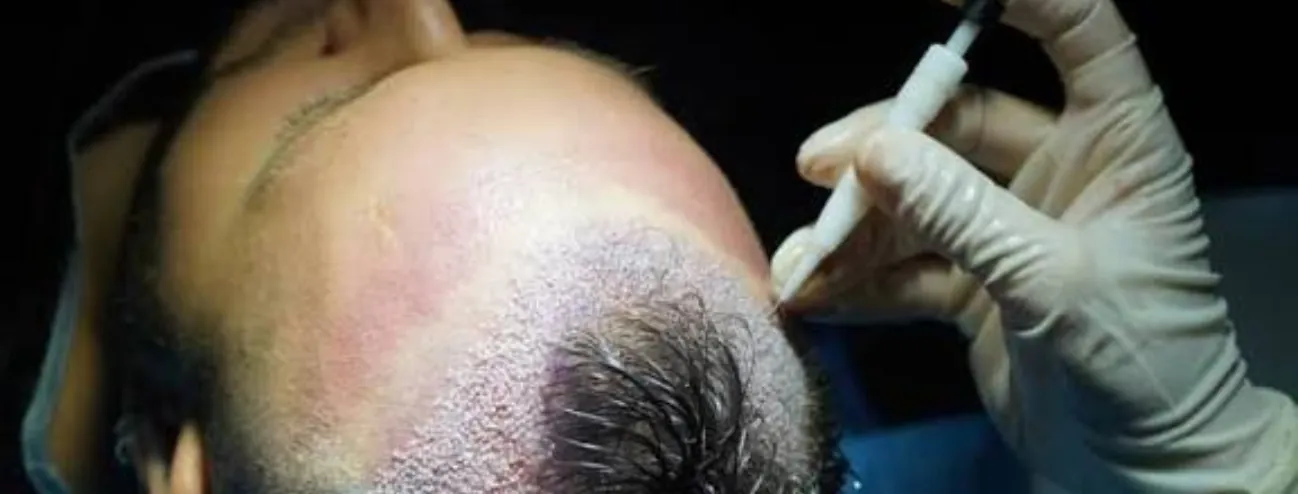
DHI, Direct Hair Implantation, is a way of placing grafts. It is not a separate way of harvesting them. Extraction still happens with FUE, one follicle at a time. What DHI changes is the second half of the operation: instead of the surgeon first making a channel and then laying the graft into it, a handheld implanter pen does both in one movement. The pen is most often called a Choi pen. Every real difference between DHI and standard FUE comes from this one mechanical change.
Below we explain what is actually different, without the gloss some clinics put on the name. You'll see how the pen gives the surgeon control over angle and depth, and where that brings a practical advantage, for example in the hairline, in small areas and in procedures where you keep your hair. You'll also see where the advantage disappears: in very large sessions, on price and when the team lacks routine with the pen. Whether you're a suitable candidate for a transplant in the first place is covered in the candidate guide. Your hair type and donor hair matter at least as much for the result as the technique the surgeon chooses.
- DHI is a placement technique used together with FUE, and occasionally FUT. The follicles are harvested the same way either way.
- The difference is concrete. The Choi pen opens the skin and places the follicle in the same move. In standard FUE all the channels are made first, and the grafts are placed afterwards.
- Its strengths are precise control of angle and depth, dense placement between hair you already have, and the option of avoiding a full shave in smaller areas.
- No solid research shows that grafts survive or grow better with DHI than with well-performed FUE. The surgeon and team matter far more than the name of the technique.
- DHI often costs more per graft than standard FUE, but not always. The main reason is that the work is slower and the team needs specific training with the pen.
What is DHI?
In DHI, or Direct Hair Implantation, the surgeon uses a handheld implanter pen, usually called a Choi pen, which makes the opening in the skin and places the follicle in one and the same movement. Extraction is the same as in FUE. Only the placement is new. Think of it as one particular way of doing the placement step of FUE, not as an alternative to FUE.
What two steps does every hair transplant have?
Whatever the clinic calls the procedure, it has two parts. First, follicles are harvested from the donor area. Then they're placed where the hair is thin or gone. DHI concerns only the second part. Extraction is standard FUE, where small groups of follicles are removed one by one with the same fine punch used in every FUE procedure. If a clinic sells you DHI, the hair is harvested exactly as before.
What does the pen actually do?
The pen is named after the surgeon Choi, who is regarded as the first to describe it. That happened at Kyungpook National University in Daegu, South Korea, in the early 1990s, and the name has stuck for over three decades. The tool itself is a thin, hollow needle with a plunger behind it. Pens come in different needle sizes, and the team chooses according to graft size, so a single-hair graft in the hairline and a three-hair graft each get their own size. Someone on the team loads one follicular unit into the needle. The surgeon places the tip against the scalp where the hair is to sit and presses the plunger. The needle makes a tiny opening, and the follicle is pushed in during the same movement. In standard FUE these are two separate jobs. The whole area gets its channels first, cut with a blade or needle, and the grafts are placed afterwards, often by a different person on the team.
Why are the names so confusing?
Because DHI only replaces the placement, it's often mixed with other tools in the same session. Many clinics extract with standard FUE, place the hairline with a Choi pen and put grafts in a larger area further back into pre-made channels, sometimes cut with a sapphire blade. So when a clinic sells "DHI", it is describing how the grafts are placed, not a completely different operation. Keep that in mind when a price list shows DHI as a separate product next to FUE.
What does the implanter pen change about placement?
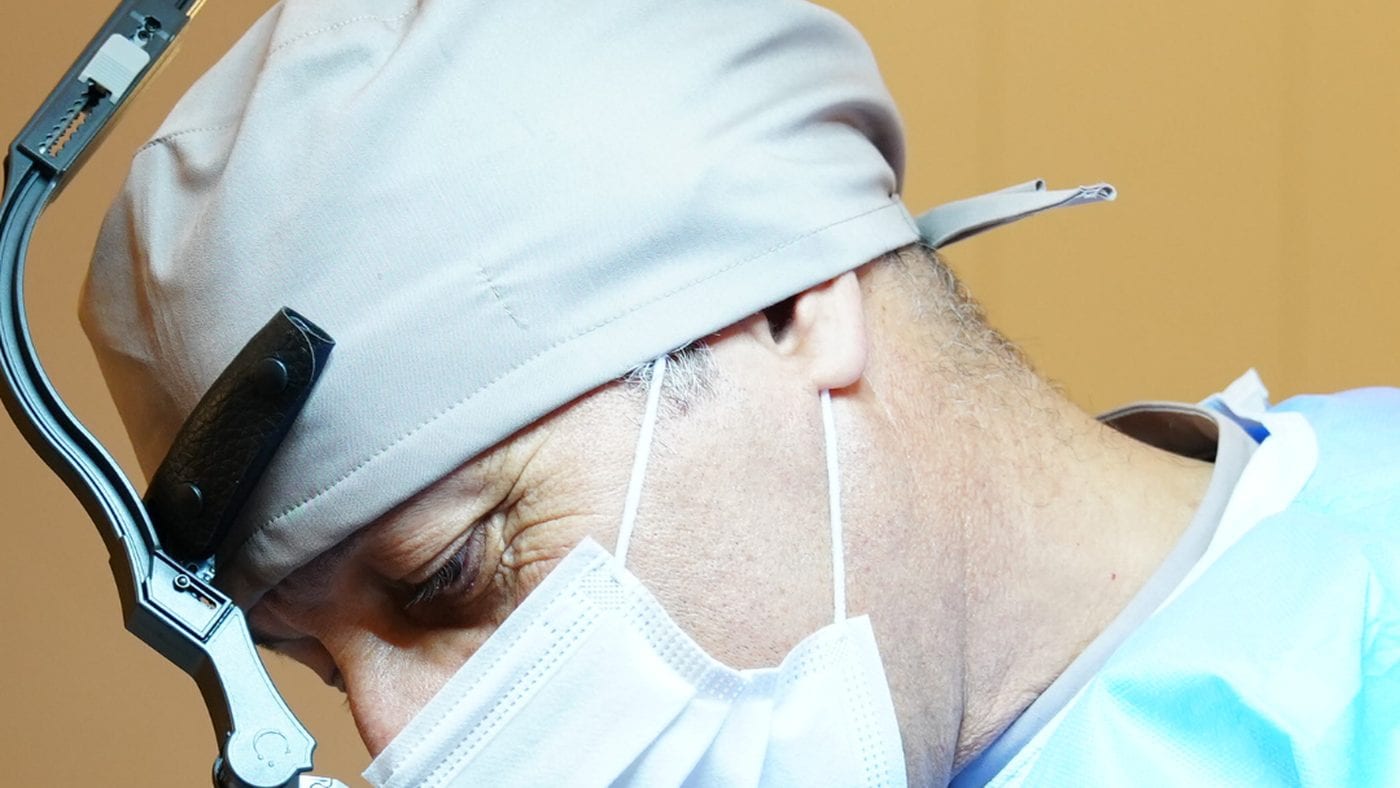
With the pen, the surgeon decides the angle, direction and depth of each follicle as it enters the skin. In standard FUE that choice was made when the channel was cut. That's why DHI is associated with precise hairline work, where the person placing the hair controls the direction graft by graft. How the grafts heal and how quickly the hair comes back are the same whichever method is used.
Why does it matter that one person makes all the choices?
With a pre-made channel, the angle is set when the channel is cut, sometimes by someone other than the person who later places the graft. With the pen, the same person decides angle, direction and depth while each hair is being placed. That's useful where the direction of a few hairs is very visible, and most of all in the front hairline. There the hairs must lie low and point forwards to look natural.
Do the grafts spend less time outside the body?
Often, in theory. The pen is loaded and used in quick succession, so grafts can spend less time in the storage solution than when a whole area first has to be channelled. That this could improve survival is biologically plausible. Good studies have still not shown that it gives noticeably higher survival than standard FUE done carefully. What counts with both methods is that the follicles are kept cool and moist and get back into the skin quickly. That's down to the team's discipline, and the pen can't replace it.
Does hair grow differently with DHI?
No. The transplanted hairs shed after about 2 to 3 weeks, and that's expected. New growth arrives in months 3 to 4. You see the mature result after roughly 12 months. That course is governed by the hair growth cycle, not by the instrument that put the graft in place. Aftercare in the first weeks matters just as much whatever the technique. Everything about it is in the aftercare guide.
How big is the difference between DHI and standard FUE really?
The differences are practical and fairly small. DHI skips the channel step. That makes it good for dense work on small areas and can spare you some shaving, but each graft takes longer and the price is often higher. You can't count on a better result than FUE in skilled hands, because no solid research shows that grafts survive or grow better with one placement method than the other.
Where do the two ways of placing grafts differ?
| What we compare | DHI (implanter pen) | Standard FUE (pre-made channels) |
|---|---|---|
| Placement | The pen opens the skin and places the follicle in one move | Channels are made first, grafts are placed in a separate step |
| Control of angle and depth | Set for each hair as it is placed | Set earlier, when the channel is cut |
| Dense placement in small areas | Very precise, well suited when hairs need to sit close together | Possible, but less precise at very high density |
| Shaving | Sometimes possible to keep all or part of your hair | The recipient area is usually shaved, and often the donor area |
| Speed per graft | Slower, one graft at a time by design | Faster once all channels are ready |
| Typical price | Often higher | Often lower |
| Best suited to | Fine hairline work, small areas, density between your own hair | Large areas and many grafts in one day |
Notice what the table doesn't say. No row shows that DHI heals or grows better, because there's no reliable evidence for that.
Where does the marketing exaggerate?
Some clinics make it sound as if DHI is a completely different and better operation. The professional community sees it differently. ISHRS (International Society of Hair Restoration Surgery), the largest professional organisation for hair surgeons, describes DHI as graft placement with an implanter pen, not as a separate hair transplant method. The organisation also asks patients to be wary when a clinic gives standard FUE a new name that sounds like a patent. Both approaches harvest the same follicular units in the same way. The only thing that separates them is how the graft gets into place.
Does the result last longer with DHI?
No, the placement method doesn't affect durability. Donor hair is largely resistant to DHT, the hormone behind most hereditary hair loss, and so keeps growing after being moved, whether it was placed with a pen or a blade. No follicle is completely immune, so "lasting" is a better word than "guaranteed". DHI doesn't change this. It only affects the angle of each hair and how much of the head needs shaving.
It depends on your donor area, your hair type and where the loss is. Send three photos and the medical team at the clinic at the top of our ranking will suggest a method and number of grafts.
Goes to the clinic at the top of our ranking.
Who benefits most from DHI?
DHI suits smaller, defined areas best, where precision matters more than speed, such as adjusting the hairline, adding density between hair you already have and procedures where you want to keep as much of your hair as possible. The method is also common for women, because women usually need density added between their own hair and rarely want to shave their head or donor area.
Why does the pen suit the hairline so well?
When one person controls the angle and depth of each graft, it pays off most in the front hairline and at the temples. There a difference of a few degrees can decide whether the edge looks natural and forward-facing, or looks planted. The same precision helps when an existing hairline is to be refreshed or filled in rather than built from scratch.
What about adding density where you still have hair?
Here DHI has a real practical advantage. The aim is to thicken an area where you still have some of your own hair, not to cover a completely bare patch. The pen places the graft precisely between the hairs without a separate channel step that could hit a follicle already there. That suits early or moderate thinning. For large, completely bald areas, speed and coverage usually matter more than finely tuned placement.
Can you avoid shaving your head?
Sometimes. Keeping your hair, fully or partly, is among the most often mentioned advantages of DHI, and it can be done in the right case. Usually that means a small area or density work, not a large session. That's why DHI often comes up with hair transplants for women. In women hair loss is more often diffuse, showing as a wider parting or a receding hairline, and the grafts have to be woven in between existing hairs. Many women are also reluctant to remove a large part of their hair for the procedure. Whether it can actually be done unshaven in your case is decided by the size of the area and the surgeon's assessment. Asking for DHI by name doesn't change that.
What does keeping your hair mean for healing?
Long hair over a treated area hides scabs and redness in the first weeks, and many people appreciate being able to go to work without anyone noticing. The downside is that the surgeon sees less clearly between the hairs during the procedure, and you have to be extra careful when washing and combing in the first days. Ask the clinic how they want you to care for your hair when it hasn't been shaved.
Who should choose something else?
Liking the idea of precision isn't a reason on its own to choose DHI. If you have large, completely bald areas and need many thousands of grafts in one working day, standard FUE or sapphire FUE is usually a better choice. When the channels are made all at once, placement goes faster. Both alternatives are covered further down.
What are the limits of DHI?
The limitations are practical. DHI is slower per graft, so a very large number of grafts in one day becomes hard to fit in. The grafts still have to be handled gently and can't sit in solution for too long, and the technique takes time to learn, so the result depends heavily on a team that uses the pen every week rather than now and then. That doesn't mean you should avoid DHI where it fits. It means you need to ask about the team's experience with the pen itself.
What happens with large sessions?
Each graft is loaded and placed individually, so DHI scales less well to a very large number of grafts in one day than FUE where the channels are made first. If you need many thousands of grafts, the clinic may have to extend the day, split the work across several sessions or use standard FUE or sapphire FUE for parts of the area. If someone promises thousands of grafts with DHI alone in just a few hours, you should ask how that will add up.
Does the pen protect the grafts better?
Not automatically. Whether a graft survives still depends on how it's handled between extraction and placement: cool, moist and as short a time outside the body as possible. The pen can't make up for carelessness elsewhere in the chain. A rushed team can damage grafts with the best instruments, and a careful team gets good results with simpler tools.
Does DHI use more of your donor hair?
No. Extraction is the same, so the donor area takes as much or as little strain as with standard FUE. How many grafts you can harvest depends on the density at the back and sides, not on how they're placed. Read more in the candidate guide about how the donor area is assessed.
Why does the team matter so much?
The pen takes practice. In experienced hands it's very precise. Used by someone with little training, follicles can be crushed or placed crookedly during loading, and you only notice when the graft doesn't grow months later. Standard FUE placement is far more widespread, simply because more teams have done it for longer. That doesn't make it better, but it does mean the team's own routine with the pen weighs more heavily with DHI than with techniques most teams have already mastered. That's why documented team experience counts in our Nordic clinic ranking. A technique is never better than the hands using it.
What's the difference between DHI and sapphire FUE?
They aren't opposites, because each solves a different part of the procedure. DHI answers how the graft gets into place, with a pen and without channels made in advance. Sapphire FUE answers what the channels are made with, namely sapphire rather than steel. Both are often used on the same day, with sapphire channels further back and a Choi pen in the hairline, so it's better to ask what each tool is meant to do.
Why are these two different questions?
DHI removes the whole channel-first, graft-afterwards sequence and does everything in one press of the pen. There's no separate incision. Sapphire FUE keeps the two steps, but the channels are made with a blade of synthetic sapphire, which is sharper and smoother than steel. That can give smaller, more precise openings and make it easier to create dense channels at natural angles. The two techniques belong at different points in the same process. Comparing them as if you have to pick one and reject the other is therefore a bit misleading.
How do they look side by side?
| What we compare | DHI | Sapphire FUE |
|---|---|---|
| The recipient site | Opened and filled in the same movement by the pen | Opened with a sapphire blade and filled in a separate step |
| Tools | Choi pen (implanter pen) | Sapphire-tipped blade and forceps |
| Control of angle | Set during placement by the person placing | Set when the channel is cut |
| Shaving | Small areas can often be done while you keep most of your hair | The area usually has to be shaved for the channel work |
| Strongest point | Hairline precision, dense placement between your own hair | Fast, even channels over large areas |
| Scarring and healing | As with FUE: small, scattered dots | As with FUE: small, scattered dots |
Why do clinics combine them?
Since each handles its own part of the job, the same day can easily include both. The pen takes the hairline, where angle is everything, while sapphire channels cover the mid-scalp and crown, where speed and evenness count for more. If a clinic says you must choose between DHI and sapphire FUE, it's simplifying what is really a toolkit the surgeon puts together around your plan. We compare all the methods, FUT included, in the guide to hair transplant methods.
How much more does DHI cost, and how many grafts do you need?
At the same clinic, DHI is often more expensive than standard FUE, but not always. Each graft takes more time, and the team needs pen training that many lack at scale. How many grafts you need depends on how far your hair loss has progressed and which area is to be treated, not on the placement method, so start with a graft estimate and discuss the method afterwards.
Why is DHI often more expensive?
Where there's a price difference, it comes down to time and training. Each graft is loaded and placed individually, which is slower than making all the channels at once and filling them afterwards. A team also needs many hours with the pen behind it before it can be used safely in large sessions. Some clinics add a fixed surcharge for DHI. Others charge the same per graft whatever the method and charge for the longer operating day. Ask directly which model your quote is based on. Indicative prices in each country, with explanations, are in the price guide.
Why is the number of grafts a separate question?
How many grafts you need is determined by your Norwood or Ludwig stage and which areas are to be treated, whether that's the hairline, mid-scalp, crown or several of them. Whether the surgeon uses a pen or pre-made channels doesn't change the number. Work out a rough range for your own head with the graft calculator before you compare quotes. Then you'll know which graft count the headline price actually applies to, instead of taking it at face value.
What should you look for in a DHI quote?
DHI is slower, so get confirmation that the team can cover the whole area within the hours the price covers. Also ask whether many grafts with DHI will require an extra day, more people on the team or that parts of the area are done with standard FUE or sapphire FUE. None of this is wrong in itself. It just needs to be agreed in writing before you book, so you don't get a surprise once you've travelled there.
What should you ask when a clinic offers DHI?
Find out how much DHI experience the person who will place your grafts has, not the clinic as a whole. Ask for results from cases similar to yours, and ask how they decide when the pen is used and when pre-made channels are used in the same session. If you don't get concrete answers, or DHI is sold as an upgrade everyone should take, you have reason to be cautious.
Which questions are specific to the pen?
The pen requires its own training, and long experience with hair transplants isn't the same as long experience with DHI. How many times has the exact person who will hold the pen used it before? Is the same person loading the pen and pressing it in? And ask to see recent results from someone with roughly the same area and graft count as you. If the answers are vague, or you hear about the clinic's good reputation instead of the team's own DHI experience, take note.
What should you ask about the plan?
Ask the clinic to explain why some areas get the pen and others get pre-made channels. Pure DHI isn't automatically the best plan for everyone. A competent team should be able to explain the choice based on your hairline, your area and your graft count, not reel off sales arguments. What's the plan if they find during the procedure that more grafts are needed than estimated? Since DHI is slower, that can affect the day's schedule more than with channel-based placement.
Do the usual checks still apply?
Yes, in full. The warning signs are the same for a DHI clinic as for any other. You should know the surgeon's name, and he or she should be in the room and taking part. The clinic should have medical approval you can check, a written price with no hidden items and a written plan for follow-up afterwards. The full list is in the red flags guide, and the complete checklist for choosing a clinic is in choosing the right clinic.
Questions we're often asked
Does DHI give better results than FUE?
Not as a rule. DHI places the grafts differently, but nobody has shown that it produces more or healthier hairs. No solid research shows that more grafts survive than with well-performed standard FUE. The method may suit particular goals better, such as hairline precision, dense work between your own hair or avoiding a full shave. For very large sessions, standard FUE or sapphire FUE is usually more efficient.
Is DHI a separate method or a variant of FUE?
It's a variant of FUE. The hair extraction itself is the same, one follicle at a time as in a standard FUE procedure. The difference lies in the placement, which is done with a pen rather than into channels made in advance. Professional organisations such as ISHRS describe DHI as a variant of graft placement, not as a separate transplant method.
Can I have DHI without shaving my head?
Sometimes, especially when the area is small or when density is being added between hair you still have. Nobody can promise it in every case, and it gets harder the larger the area and graft count, because unshaven work makes an already slow method even slower. Mention it in your first consultation, and you'll get an honest answer on whether your plan allows it.
Why is DHI often more expensive than standard FUE?
Mostly because the work is slower graft by graft, and because the team needs a lot of practice with the implanter pen. Both make it more expensive for the clinic. How large the surcharge is varies a lot between clinics and countries, and it doesn't guarantee a better result. Compare what the quote actually covers and who does the work, and don't choose on the name of the technique alone.
Is DHI suitable for women?
DHI often comes up in discussions about women. In women the grafts more often need to be spread between existing hairs rather than cover a bare patch. Many women are also keener to avoid shaving. Whether DHI is right for you still depends on your own case, not on your sex. Read more on the page about hair transplants for women.
Does DHI leave scars, and does healing take longer?
The scars are the same as with any FUE extraction: small, scattered dots that are barely visible even with a clipper cut, and no long line. Healing follows the same course as with other methods. After 2 to 3 weeks the new hairs shed, in months 3 to 4 they start growing again, and only after around 12 months is the result mature. DHI makes the process neither faster nor slower.
Whether DHI, standard FUE or a mix suits you best depends on where you've lost hair, what your donor area can handle and how much documented experience the team has with the pen. The fanciest name on the price list decides nothing. Request a free hair analysis and you'll get an answer from the clinic ranked first in our ranking, plus an honest view of which placement method actually suits you. You're not committing to anything.
This is general information and not medical advice. Only a qualified surgeon can decide whether DHI is right for you, after a personal assessment.
Goes to the clinic at the top of our ranking.
Updated: October 2026 · How our editorial team works