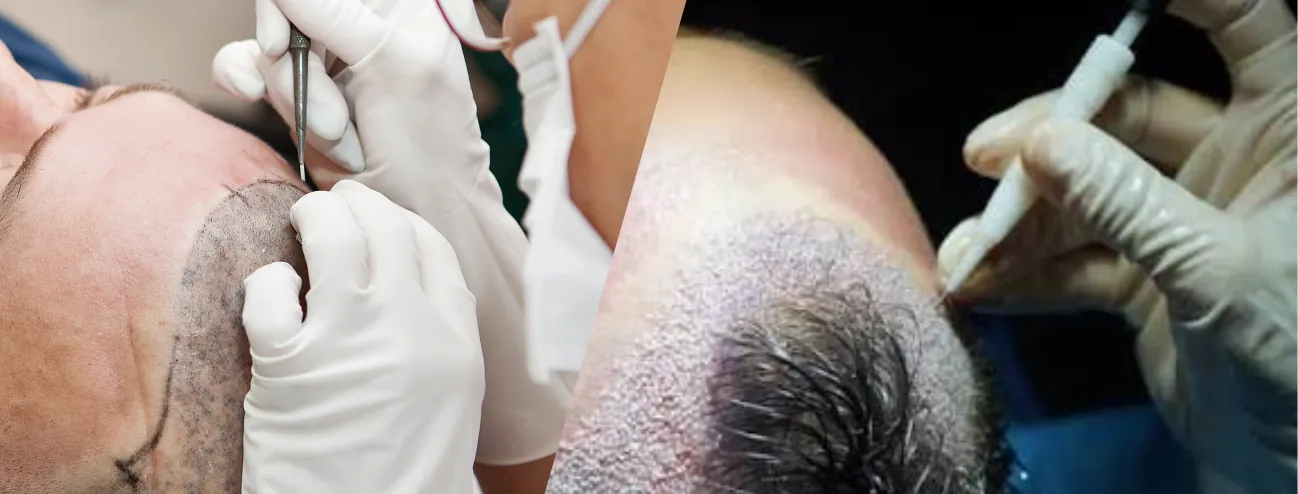
In a combined FUE and DHI transplant, every single graft is harvested with FUE. The difference comes when they go back in. Where hitting the angle and density matters most, usually in the hairline and front, the team uses an implanter pen. Where many grafts need to go in quickly, usually in the mid-scalp and crown, they're placed into channels opened in advance with a sapphire or steel blade. This is a choice about placement. It isn't a fourth surgical method, and far from every clinic using the word plans this carefully.
The individual methods, including FUT and sapphire FUE, are each explained in the guide to hair transplant methods. Here we look only at why and how clinics mix placement tools on the same operating day, who actually gains from it, and how to tell a real zone plan from a sales label. Whether you're suitable for a transplant is a separate question, answered in the candidate guide. Combining tools changes the technique, not who is suited to the procedure.
- All grafts are harvested with FUE. Only placement is split: an implanter pen where precision counts, as in the hairline, and blade channels where volume counts, as in the mid-scalp and crown.
- The reason is mechanical. The pen makes the channel and places the graft in one controlled move, while a blade channel is a separate, faster step better suited to covering large areas.
- The extra coordination pays off most when a large part of the head needs covering and the hairline also has to be drawn finely. In small single-zone sessions it adds little.
- "Combined" or "hybrid" can mean a real zone plan. It can also be a completely ordinary session with a new name. The word alone proves nothing.
- What reveals the difference is whether, before you book, the clinic can point out the zones, give a rough graft split and say who will place the hairline.
What does combining FUE and DHI mean?
Each graft is harvested individually with FUE, and placement is then split between two tools according to where on the head the grafts go. The pen takes the hairline and front, where angle and density show most, while channels opened with a sapphire or steel blade take the mid-scalp and crown, where many grafts need to go in quickly. So you get one operation with two placement techniques, not a new method.
The name makes it sound like two procedures. It isn't. You have one session and one harvest. All the grafts are taken from the donor area with FUE, unit by unit, wherever they're going to end up. Only the second half of the operation, the placement, is split, and the split concerns which tool is used on which part of the head.
How can one harvest lead to two ways of placing?
The answer lies in how the two terms relate. DHI isn't a way of harvesting hair. It describes how the grafts are placed once they're out. An implanter pen, often called a Choi pen, has a hollow needle loaded with one follicle. The needle opens the channel and places the graft in one press, and the surgeon decides the angle, direction and depth for that particular hair. The rest of the head gets the classic two-step approach: a steel or sapphire blade makes the opening first, and the graft is placed afterwards, usually by a different person.
Why is the work split by zone?
The tools are good at different things. The pen is precise but slow. Blade and forceps bring speed, because the openings can be made ahead of the people placing, but angle and depth are controlled a little less tightly than in one continuous movement. A good zone plan puts the pen where precision is worth the slower pace: the hairline and the very front, where every degree shows. The blade channels get the mid-scalp and crown. There, filling the area counts for more.
How does the day itself go?
Extraction comes first and looks like any other FUE session. The grafts are then sorted, usually by number of hairs, and the single-hair grafts are set aside for the hairline. The front gets the pen, ideally in the hands of the most experienced person in the room. The mid-scalp and crown get blade channels and are filled separately, often by someone else on the team working in parallel. Otherwise the day is like any other hair transplant, with the same anaesthesia, roughly the same time and the same aftercare.
Why use two placement methods in the same session?
Because no single method is best across the whole head. The pen gives precision but costs time, while pre-made channels give speed, with somewhat less tight control of angle and depth. Combining them gives each zone the trade-off that suits it: slow and precise where the eye falls first, fast and efficient where the job is covering ground.
What do you lose with one method everywhere?
If the team uses the pen for every graft in a large session, you get the precision everywhere, but also the slow pace everywhere. That's why DHI alone is described as slower and often more expensive when many grafts need placing, including in our own methods guide. If the team uses blade channels everywhere, you keep the speed, but fine control of angle and depth moves to a separate step after the channel is made. That matters most in the one place where small errors show most, namely the hairline.
What does each zone need?
The hairline and front are built with single-hair grafts. The edge should be soft and slightly irregular, and the hairs should lie low and point forwards, so it looks right up close and at a distance for many years. That's exactly the job the pen's single, controlled move is suited to. The mid-scalp and crown are larger areas. They can take denser, multi-hair grafts, and the hair grows in a whorl in several directions. There, even and efficient coverage matters more than every single hair sitting at exactly the right degree. That's where the blade channels earn their keep.
Is this actually anything new?
No. It's the same choice the methods guide describes for the whole head, simply made afresh for each part of the head on the same day. Many experienced teams have worked this way for years.
Who benefits from a combined session?
You benefit most if large parts of the head need covering while the hairline also has to be drawn carefully, for example with advanced hair loss affecting the front and crown at the same time. Then the clinic can spend pen time where it shows and cover the larger, less visible zones efficiently. If only the hairline needs adjusting or only the crown needs filling, the combination rarely brings any real gain.
Why is it best suited when both front and crown are treated?
When the front and crown are treated in more advanced loss, many people end up at 4,000 grafts or more, sometimes spread over two sessions. The hairline and front alone are often 2,000 to 3,000 grafts. With that many grafts, a pen-only session becomes very long, while a blade-only session may give the hairline less care than it deserves. With a combined plan, the team keeps the pace up further back and gives the hairline the slow, controlled placement it needs.
When is one method enough?
If you only need to refresh the hairline or only fill the crown, you rarely need two tools. If the whole session is in one zone, split placement adds coordination without a gain you can see. The pen alone is fine for a small hairline where precision is everything, and blade channels alone are fine for a moderate crown where volume is the goal. The combination is the answer when you need both on the same day. It isn't a general upgrade.
Does combining change how much hair you have to use?
No. The amount of hair you can move is decided by the donor area, not by the placement. A normal donor density is between 65 and 85 follicular units per cm², and it's the density, not the technique, that determines how much you can safely move. How the donor area is measured is covered in the guide to donor hair. With the graft calculator you can get a rough estimate for your own area of loss before a personal assessment gives the final figure.
It depends on your donor area, your hair type and where the loss is. Send three photos and the medical team at the clinic at the top of our ranking will suggest a method and number of grafts.
Goes to the clinic at the top of our ranking.
What does combining change for duration, team and logistics?
How long you sit in the chair is still governed mostly by how many grafts you get, not by how placement is split. A combined session does need more coordination, though. Usually one person works with the pen in the hairline while another handles the blade channels further back, ideally in parallel. If the clinic has only one experienced person who has to switch between tasks, the time saving disappears and the day may get longer.
Where does the time saving come from?
A combined session can keep the time down, or even shorten it, because in principle the team can work on two parts of the head at once. One person works with the pen in the hairline while another opens and fills channels in the mid-scalp or crown. That only works with two skilled people working at the same time. If one surgeon works alone and switches from pen to blade and back, the gain is that each zone gets the right tool. You don't save time.
What should you ask when several pairs of hands are involved?
Several people sharing the work isn't a problem in itself. But you should ask the same questions as for any hair transplant. Who places the hairline? Does the same experienced person handle every graft there? And does a less experienced person ever work there, or only where mistakes show less? In the guide to choosing a clinic we explain why the doctor's involvement in exactly these steps is the most important thing you can ask about, whether the session is combined or not.
What changes, and what stays the same?
The instrument tray is different, with both pen and blade. Sorting is also different: single-hair grafts go to the pen, multi-hair grafts to the channels, and at each zone boundary the team has to hand over clearly. Other things stay the same. The anaesthesia is the same, and with a fixed graft count the day usually lasts 6 to 8 hours. Healing follows the same course too: the new hairs shed after 2 to 3 weeks, growth starts in months 3 to 4, and around 12 months after the procedure you can see how it turned out. The tool plays no part in that course. The aftercare guide goes through the whole period.
Is "combined" a real protocol or just a sales word?
It depends on the clinic. Choosing tools by part of the head is professionally well founded, but the words "combined" and "hybrid" also end up in adverts for sessions where nobody has thought about zones. Ask whether the clinic can tell you before the operation where the pen will be used, where the blade will be used and why.
What does the real version look like?
The reasoning rests on what the tools do mechanically, not on brands. The pen makes the channel and places the graft in one controlled move, so it suits the hairline. A blade channel is a separate, faster step that covers large areas better. A clinic working this way can draw the boundary on your head and explain why the pen stops exactly there.
And the sales version?
Some clinics give the completely ordinary combination of FUE extraction and split placement its own trademark and a higher price. Behind the name there's often no zone plan, and nothing else has changed. A special name doesn't make the protocol special. Whatever the clinic calls its version, you're left with the same question: which tool will be used where?
How do you tell them apart?
A real zone plan can be described before the operation. You're told where the pen will be used and where the channels will be made, a rough graft count for each area and the name of the person placing the hairline. If the session has only been renamed, the answer tends to be "we use a combination technique" and not much more. There's no plan to point to, just a pen and a blade on the same tray. Ask for the details, not the name.
What might a good answer sound like?
Something like this: "The hairline and temples, the front couple of centimetres, get single-hair grafts with the pen, and the surgeon does that personally. Behind that, up to and including the crown, we make channels with a sapphire blade and place two- and three-hair grafts. Since your crown is still thinning, we hold back there and save donor hair for later." The answer doesn't have to be long. It just has to show that someone has looked at your particular head and made choices based on it.
How does the combination compare with FUE alone, DHI alone and FUT?
FUE with blade channels across the whole head is fastest and usually costs least per graft, but the hairline gets the same fast treatment as the rest. DHI everywhere gives precision everywhere, but takes a long time and gets expensive when many grafts are needed. FUT harvests grafts in a completely different way, gives the most grafts per session and a linear scar, and the combination sits between FUE and DHI, with a pen where it's needed and FUE pace the rest of the way.
The table sets out the four approaches in the same way, with extraction, placement, scarring and what each is suited to, without picking a winner.
| Approach | How grafts are harvested | How they are placed | Scarring | Best suited to |
|---|---|---|---|---|
| FUE with blade channels | Individually with a fine punch | The blade makes the channels first, grafts are placed afterwards | Small, scattered dots that are barely visible | Most sessions, fast work over large areas |
| DHI with a pen throughout | Individually with a fine punch, as in FUE | The pen makes the opening and fills it in one move | Small, scattered dots that are barely visible | Sessions where the whole area needs hairline-level precision |
| FUT | A strip of skin from the donor area is divided into grafts | Channels are made first, then the grafts are placed | One thin, linear scar | A very large number of grafts in one session, or when the donor area is poorly suited to FUE |
| Combined FUE and DHI | Individually with a fine punch, always the same | By zone: pen in the hairline and front, blade channels in the mid-scalp and crown | Small, scattered dots that are barely visible | Large whole-head sessions where the hairline also has to be drawn carefully |
What if the clinic only uses one of the methods?
That isn't a warning sign in itself. Many skilled teams place all grafts with blade channels and achieve natural hairlines, because they're highly practised with forceps. Others use a pen across the whole head and plan for two days instead. What counts is whether the team can explain why their choice suits your head, and whether their results show it works. No method replaces experience.
Is combined the same as DHI with an extra step?
No, and it pays to be precise here, because the terms easily blur into each other. DHI can be used across the whole head and not just in the hairline, and it often is. That's a pen-only session. "Combined" means the tool changes from zone to zone on the same day. So it isn't an upgraded DHI, just a different way of dividing up pen and blade.
If you want to read more about each technique and the distinction between extraction and placement, you'll find it all in the guide to hair transplant methods.
How much does a combined session cost?
A combined session is usually priced closer to, or slightly above, pure DHI rather than pure FUE with blade channels, because pen placement is the part that demands the most time and skill, even when it's only used on parts of the head. The surcharge follows the share of grafts placed with the pen. The word "combined" on the invoice tells you nothing about that.
What determines the price?
Blade and pen carry different price tags. The pen is slower and needs highly trained people, which is why DHI tends to cost a little more. When the session is combined, only the grafts placed with the pen push the price up. A session made up mostly of hairline and pen work ends up close to a pure DHI price. A session that's mostly volume work with blade channels and just a small hairline with the pen ends up close to a pure FUE price. The name "combined" doesn't tell you where you are on that scale.
Is it worth the surcharge?
That depends on how much the hairline matters in your plan. In a large front and crown session, the hairline is the part everyone sees, and a little extra for the pen right there may be money well spent. If you're offered a pen across the whole head or an expensive "hybrid" surcharge on a small crown session, there's reason to ask what you're actually getting for your money.
How do you compare quotes?
Whatever the mix, the same rule applies. Divide the total price by the number of grafts, and get the number of grafts the quote covers confirmed by email. In the price guide we show why the price per graft reveals more than a package price, and the graft calculator gives you a starting point for how many grafts your area of loss may need.
Can you ask for the split?
Yes, and you should. Ask for a rough figure for the grafts going to the pen and the grafts going into channels. Expect the split to match a real price difference, not just a higher figure attached to a word that sounds more advanced.
Which questions reveal whether a clinic has a real zone plan?
Ask the clinic to show you where the pen and the blade will be used, give a rough graft count for each area and say who will place the hairline. A clinic with a real plan answers concretely. If you only get reassuring words and no boundaries drawn before the operation, "combined" is just a word.
Which five questions should you ask?
- Which zones get the pen and which get channels, and why exactly that split for me? A real plan can show you the boundary. A sales label can't.
- What share of my grafts will be placed with the pen? A rough figure says more than a long explanation of the technique.
- Who places the grafts in the hairline, and is it the same person throughout? No pair of hands in the room matters more, whatever the method.
- Do two people work in parallel, or does one person switch tools? The answer shows whether you're paying for real coordination.
- Can you show results from exactly this zone split, and not just a general selection? Documented, consistent results matter more than the abbreviation on the price list.
Why do the answers matter more than the name?
None of this applies only to combined sessions. It's the standard every hair transplant should be measured against, and you'll find the full list in the guide to clinic red flags. A word on the price list isn't a plan. If you get zones, figures and the name of the person placing the hairline, you've seen a plan. If you only get comforting words or a trademark, you haven't.
How do you compare clinics from there?
Once you've had proper answers, set them alongside the criteria we use for each clinic. You'll find them in the clinic ranking and in the overview of the best clinics. Owning both a pen and a blade is easy. Choose the clinic that can show you the map of your head and results proving they follow it.
Questions we're often asked
Is combined FUE and DHI a separate surgical method?
No. Extraction is always FUE, follicle by follicle from the donor area. The combination is a placement choice divided by zone in the same session, with a pen in the hairline and front and blade channels in the mid-scalp and crown. It isn't a fourth surgical method.
Do I need two operations or two visits?
No. Everything is done on the same day, with the same local anaesthetic and the same healing as with other hair transplants. Only the placement is split between two tools.
Is combined FUE and DHI more expensive than either method alone?
The price is usually closer to, or slightly above, pure DHI, because pen placement is the most time-consuming step where it's used. What really drives the price is the share of grafts placed with the pen. Get that share stated before you look at prices.
Which part of the head usually gets the pen?
Most often the hairline and front. There, angle and depth decide whether the edge looks soft and natural. The mid-scalp and crown more often get blade-cut channels, because there it's more important to cover a large area efficiently than to get every single hair at exactly the right degree.
Can a clinic call a session "combined" without planning zone by zone?
Yes, and that's the pitfall you should know about. The words "combined" and "hybrid" are sometimes put on an ordinary session with no graft plan for each part of the head. Get the zone boundaries and a rough graft count for each by email before you book, and you'll see whether the plan exists.
Does healing take longer when two tools are used?
No. The hairs shed after 2 to 3 weeks, new hair starts growing in months 3 to 4, and after roughly 12 months you see the final result. That applies to all the grafts. Healing depends on how the grafts are handled and on aftercare, not on which placement method was used where.
Is a combined session worth it when only one zone is being treated?
Usually not. The extra coordination pays off most when large parts of the head need covering and the hairline also needs fine work. If you're only treating the hairline or only the crown, one placement method is usually enough.
Whether you need a zone plan, or whether one placement method is enough, depends on your own hair loss pattern and what your donor area can handle. An article can't decide that. Request a free hair analysis and you'll get an answer from the clinic ranked first in our ranking, plus an honest view of what your head needs. You're not committing to anything.
This is general information and not medical advice. Only a qualified surgeon can decide whether a combined session is right for you, after a personal assessment.
Goes to the clinic at the top of our ranking.
Updated: October 2026 · How our editorial team works