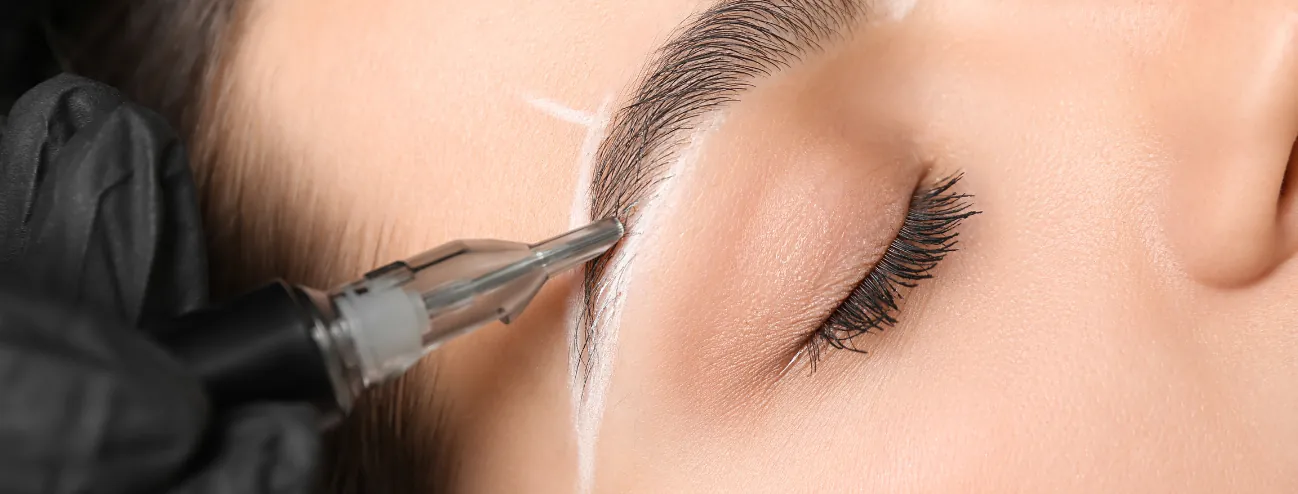
Maybe you plucked your brows thin when you were young, and they never came back. Maybe the years have thinned them, or alopecia, an accident or a scar has taken a piece. When the hair doesn't grow back by itself, an eyebrow transplant can give you brows made from your own hair. The surgeon moves hair follicles one by one from your head and places them following a shape you've drawn together beforehand.
What happens during an eyebrow transplant?
The surgeon takes individual hair follicles from the scalp using FUE and places them in the eyebrow, so thin, over-plucked or scarred brows are filled in with hair you already have. The surgeon handles one hair at a time, both during extraction and placement. That's what lets the new hairs blend into the brow instead of looking stuck on.
The technique is FUE (follicular unit excision), the same as for transplants to the scalp and beard. The demand for precision is much higher, though. The surgeon extracts hair follicles one at a time from the donor area at the back of the head and places them one at a time in the brow. Almost all the grafts should contain a single hair. On the scalp, grafts with two or three hairs are often used, but in an eyebrow those small clusters look like tufts when you stand close to the mirror. The time it takes to separate out single hairs is therefore absolutely necessary. It's the difference between a brow and a dotted line.
Most people have tried other solutions before they end up here. Brow pencil, tint, microblading and growth serums can make a thin brow look fuller. None of them gives you new hair follicles. A transplant is the only method that gives you living hair that stays. The grafts are living hair follicles that keep growing at their own pace where they're placed. They aren't pigment or a product sitting on top of the skin.
The procedure is closely related to a beard transplant. The hair is taken from the same donor area with the same tools. Placement in the brow is still slower and needs a finer hand, because a single hair pointing the wrong way shows in an eyebrow. In a beard or on the scalp it often gets lost in the crowd. Both brows are usually treated in the same session, and they're planned together so they become a matching pair, not two separate projects.
Who can benefit from an eyebrow transplant?
You may be a good candidate if your brows are thin from plucking, age or genetics, are patchy or missing because of alopecia, are scarred after surgery, a burn or an accident, or have always been sparse. What needs to be in place is enough donor hair on your head and brow skin that isn't affected by an active scarring condition.
People who get new eyebrows usually recognise themselves in one of these points:
- Brows that were plucked too hard when younger and never grew back. Many were shaped to trends that have since changed.
- Brows that have thinned with age, in the same way scalp hair can.
- Alopecia areata or totalis, where the brow hair has disappeared along with hair on the head or body.
- Scars in the brow line after surgery, a burn, a piercing or an accident.
- Brows that have always been thin or uneven, right from birth.
- Trans people who want a more defined or differently shaped brow.
The most important requirement is that you have enough single-hair grafts to spare from the donor area on your head. That's assessed the same way as before any other transplant. The brows need only a small fraction of what a scalp or beard requires, so donor hair is rarely the limiting factor. It should still be checked, especially if you might want a scalp or beard transplant later and want your donor hair used with that in mind.
If you have an active scarring condition in the brow itself, such as frontal fibrosing alopecia, it usually has to have settled and been stable before the surgeon places grafts. That applies to all scarring conditions that affect hair, because grafts in active inflammation are often lost. Uneven brows are also a common and entirely treatable reason to get in touch, whether the difference is congenital or comes from uneven loss. The plan can give one brow more grafts than the other so they match. Read more about who is suitable for a transplant in the candidate guide.
Where is the hair taken from, and how many grafts are needed?
The grafts are taken from the donor area on the head, often at the nape of the neck or just above the ear, where the individual hairs are finer and can easily be separated as single hairs. Each brow usually needs 100 to 350 grafts, depending on how much hair is already there and how dense you want it.
The hair comes from the same genetically resistant band at the back and sides of the head as in all other hair transplants. How this area is assessed is explained in the guide do I have enough donor hair?. For brows, surgeons often choose hair from the nape of the neck or from the area just above and behind the ear. The hairs there are often finer and easier to separate into pure single hairs. A coarse scalp hair in the middle of an eyebrow can look noticeably thicker than the hairs around it.
Compared with the scalp and beard, the need is small, usually 100 to 350 grafts per brow. If you only need to fill a few thin patches or build up the outer part of the brow, you'll be at the lower end of the range. If the brow has to be built almost from scratch, after major loss or a scar running right across it, you'll be at the top. The number depends on your current density, the width and shape you want and how different your two brows are. You can't work it out precisely in front of the mirror.
The number is so small that it rarely affects any later need for grafts for your scalp or beard. More important than the count is how carefully each graft is selected for thickness, so it matches your natural brow hair. That's part of the plan made when the surgeon assesses you, not a standard number given to everyone.
Send photos from the front and the side and you'll get a graft estimate from the medical team at the clinic at the top of our ranking. It costs nothing and doesn't commit you to anything.
Goes to the clinic at the top of our ranking.
Why are angle and direction so crucial in an eyebrow?
Brow hairs lie flat against the skin and change direction along the brow: upwards at the bridge of the nose, diagonally through the middle and down and out towards the temple at the tail. When each hair follows that pattern, the brow looks natural. When it doesn't, it looks spiky, artificial or drawn on.
Nowhere else in hair surgery does direction matter as much. On the scalp, hairs sit at a fairly similar angle over large areas. A beard follows the jaw in broad zones that tolerate a little variation. Brow hair is different. The hairs lie almost flat against the skin and change direction several times within a small area. At the bridge of the nose the hairs point up and slightly out. Through the middle of the brow they run diagonally downwards. At the outer end they curve down and out towards the temple.
A graft at the wrong angle doesn't just look a bit odd. It stands out immediately. A hair sitting at 90 degrees to its neighbours becomes a spike rather than a strand. That's why the work is done under magnification, hair by hair, with the surgeon constantly comparing the emerging pattern with the direction of your own brow hairs around it. A fixed template isn't good enough.
That's also why experience with brows counts for more than the total number of FUE procedures a surgeon performs. Many thousands of grafts on scalps each year don't automatically make anyone good at brows. They're two related crafts, not one. Ask the clinic directly how many eyebrows they've done, and ask for close-up photos of the results. A general gallery isn't enough. The candidate guide makes the same point about hair type more generally.
Do the new brow hairs keep growing, and do you need to trim them?
Yes. The grafts come from the scalp and keep the growth pattern of scalp hair, so they get much longer than normal brow hairs, which stop growing at a short length. You therefore need to trim them regularly, usually every week or every other week, to keep a natural shape.
This is among the most important things to understand before you decide, and not every clinic says it clearly. A hair follicle brings its growth programme with it from where it came from. The new location doesn't change that programme. Normal brow hairs have a short growth phase and stop after a few millimetres. Scalp hair doesn't. Left alone, it grows to the length the hair on your head usually reaches. When a follicle from the scalp is moved to the brow, it keeps behaving like scalp hair and gets far longer than the brow hairs around it.
In practice, regular grooming becomes part of the package. Every week or every other week, most people get out a small curved pair of scissors and trim their brows, a bit like keeping a beard line neat. That way the brow keeps its shape and doesn't get bushy. Some also notice that the hairs grow a little more up and out than normal brow hairs and need taming with a bit of brow gel or a small brush in the morning. That applies especially in the first year, while the hairs find their final direction.
The routine is manageable and no reason to hold back. But it lasts for the rest of your life, so count it as a permanent part of your grooming. If the clinic says nothing about this before the consultation, you're missing information you're entitled to. Ask what kind of maintenance to expect before you book.
Does an eyebrow transplant last a lifetime?
Donor hair withstands DHT well, the hormone behind most hair loss, so it keeps growing after the transplant and the result lasts for many years. No hair follicle is completely immune to DHT, so you should see the result as lasting rather than as an unconditional guarantee.
Online you'll read either that everything falls out again or that the result is 100% permanent. The truth lies in between. The grafts are taken from the donor area at the back of the head, which is genetically far more resistant to DHT (dihydrotestosterone) than hair at the hairline or on the crown. The follicle takes that quality with it to the brow. The same principle, called donor dominance, is what makes scalp and beard transplants last too. Hair from the same place behaves the same wherever it ends up.
A transplanted brow therefore isn't affected by the same thinning that may have taken the original hairs, whether it was caused by age, hormones or years of tweezers. In the brow, the hairs keep behaving like scalp hair, and they usually grow for life. The result still isn't indestructible. Injuries, certain scarring skin conditions or an autoimmune process in the area can still affect individual grafts. That's why an honest surgeon describes the result as lasting and stable and promises no more.
For most people with thin brows after plucking, ageing or a stable scar, the difference has little practical significance. The result holds year after year, and the only thing you need to keep doing is the trimming. It's still worth understanding why it lasts, so you don't simply take an advertising claim of a permanent result at face value.
How do the brows heal, and when will you see the result?
In the first few days, small scabs form around each graft, and they come off within one to two weeks. After 2 to 3 weeks you lose the new hairs, and that's supposed to happen. Growth returns between months 3 and 4. You'll see the full result after about 6 to 12 months.
The procedure is done under local anaesthetic and usually takes a few hours. The number of grafts is small compared with a scalp or beard session, but each hair is placed slowly and precisely. You go home the same day. A small scab forms where each graft sits, and it comes off by itself after one to two weeks. Don't touch, scratch or put make-up on the area until the clinic says it has healed. A little swelling or redness in the first few days is common and passes quickly for most people.
In weeks 2 to 3 you lose the new hairs. Almost everyone gets worried. Yet this is exactly what is supposed to happen. The graft hasn't failed. The follicle sits safely under the skin and is just taking a break before it starts producing hair again. Then come a couple of quiet months where you see little, before new hairs start to appear, most often from month 3 to 4.
From then on the brow gradually fills in. The final result, with the direction, density and length you'll trim to, is usually assessed after 6 to 12 months. For some, the shape is mostly in place after six months. Others have to wait almost a year for the last hairs. What most people underestimate is the patience needed while the hairs fall out. You should have it explained clearly before the procedure, so you don't discover it alone at home in front of the mirror.
What determines the price of new eyebrows, and which surgeon should you choose?

The price depends mostly on the number of grafts, usually 100 to 350 per brow, and on how skilled the surgeon is at angling brow hairs, which makes each graft more time-consuming than a graft on the scalp. Choose a surgeon who can show experience with eyebrows specifically, not just many FUE procedures.
The number of grafts is small, but each graft often costs at least as much as on the scalp. The work is slower and more demanding. A surgeon extracting and placing single hairs at constantly changing angles in a small area can't work at the same pace as on a scalp. It's the time, not the number of grafts, that accounts for most of the cost.
Alongside the number of grafts, the surgeon's experience with brows is what affects the price most. It's a narrower skill than FUE in general, and clinics that are good at it often charge for it. That's a reasonable price to pay. A brow done in a hurry with the wrong angles often has to be corrected later, and that usually costs more than getting it right the first time.
The need is individual, so both the number of grafts and the price should be confirmed after someone has looked at your brows. A figure given over the phone before they've seen you is worth little. If you're comparing clinics, ask to see brows they've done. Photos of scalps tell you little here. Also get confirmation of how many brows the surgeon who will operate on you has done. The clinic's overall figure is something else. If you want to take the first step, you can book a consultation. Then someone looks at your brows long before you have to make a choice.
Questions we often get
Do transplanted eyebrows look natural?
Yes, when the surgeon has experience with eyebrows specifically. Brow hairs lie flat and change direction from the bridge of the nose through the middle to the tail, so each single-hair graft has to be angled individually. Done well, nobody can tell the new hairs from the old ones, even up close. Done badly, the brow can look spiky or drawn on. That's why experience with brows matters more than the total number of procedures the surgeon has done.
How many grafts do I need for my eyebrows?
Usually between 100 and 350 per brow. It depends on how dense your brow is today, what shape you want and how much needs to be built up. A few thin patches are at the lower end of the range. A brow built almost from scratch after major loss or a scar is at the top. You get your own number through a personal assessment.
Do the new brow hairs keep growing?
Yes. They come from the scalp and grow like scalp hair, meaning much longer than normal brow hairs. You need to trim them regularly, usually every week or every other week, to keep the shape. Trimming is something you'll need to keep doing for good. It doesn't stop after a transition period.
Is the result permanent?
The hairs from the back of the head withstand DHT, the hormone behind most hair loss, and they don't lose that ability when they're moved. That's why the result lasts for many years. No hair follicle is completely immune to DHT, so think of it as lasting and stable, not as a guarantee without conditions.
How much does an eyebrow transplant cost?
It depends mostly on how many grafts you need, usually 100 to 350 per brow, and on the surgeon's experience with angling brow hairs. Each graft takes longer than on the scalp, and that shows in the price. Because the need varies from person to person, you only get an exact price after a personal assessment.
When will I see the final result?
After 2 to 3 weeks the new hairs usually fall out. That's exactly as it should be. From month 3 to 4 they come back. How dense the brow becomes, what shape it takes and how short you'll need to trim it, you'll usually see after 6 to 12 months.
Where on the body is the hair for new eyebrows taken from?
From the donor area on your own head, most often the nape of the neck or just above and behind the ear. That's where you find hair fine enough to use as single-hair grafts. Each follicle is extracted individually with FUE and placed one at a time, selected for thickness and angled to follow the natural direction of the brow.
A free hair analysis tells you how many grafts your brows need, whether you want to fill a few gaps or build a brow from scratch. You send the photos from home. You're not committing to anything, and you don't make any decision until you know what a natural, defined brow takes in your case. Ask for a free hair analysis and get started.
Goes to the clinic at the top of our ranking.
Updated: October 2026 · How our editorial team works