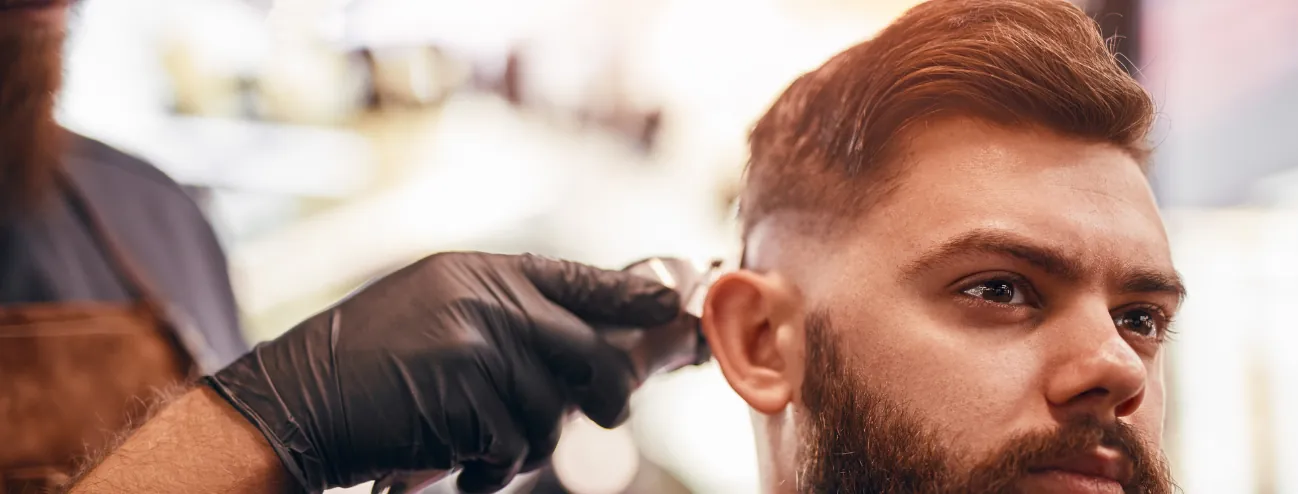
Yes, you can have a hair transplant without it being obvious that your head was shaved. Still, "no-shave" isn't the name of a single technique. Behind the label are at least three quite different methods. With partial shaving, a narrow strip is shaved and then covered by the hair above it. With unshaven donor extraction, only each individual follicle is trimmed short, and the tiny sites disappear under the rest of your hair. With true long-hair FUE, the hair is extracted at full length and never cut. ISHRS, the international society of hair restoration surgeons, explicitly distinguishes between these, precisely because "unshaven" is used so loosely in advertising and because practice behind the word varies widely from clinic to clinic.
Below we go through what each method involves in practice and who can realistically use it. You'll find out whether the result is affected and what you'll pay. Finally, we look at how to recognise a clinic that truly masters the technique. Skipping the shave is a planning choice. Whether you're suitable at all is assessed in the usual way, explained in the candidate guide.
- "No-shave" can mean partial shaving, unshaven extraction where only each follicle is trimmed, or true long-hair FUE. Each trades discretion against session size and difficulty in its own way.
- When grafts are extracted through standing hair, the surgeon sees less of what they're doing. The risk of damaging grafts (transection) rises unless the surgeon has trained extensively in this specific technique.
- No-shave sessions are usually smaller than standard ones. If you genuinely need a lot of grafts, at least partial shaving is almost always necessary.
- Your body heals at the same pace either way. Shedding, new growth and the final result arrive at the same time. The only thing that changes is what other people see along the way.
- The surest sign of a serious clinic is that it puts in writing which method you'll get before you book. "No-shave" without further detail is a sales term.
Can you have a hair transplant without shaving your head?
Yes, using one of three methods: partial shaving, where a narrow strip is shaved and covered by the hair above, unshaven extraction, where only the tiny extraction sites are trimmed beneath untouched hair, or true long-hair FUE, where nothing is cut and grafts are extracted at full length. The methods aren't interchangeable, and each balances session size, difficulty and price in its own way.
The starting point is this: in a standard hair transplant the donor area is shaved, and often the recipient area too, so the team can see everything and work quickly and precisely. Every no-shave method is a way round that. You gain discretion and pay for it with speed, session size or simplicity, or a mix. That's why the methods need to be kept apart rather than lumped together under one sales term.
Why does "no-shave" need a precise definition?
Because otherwise the word can mean almost anything. ISHRS formally recognises three categories. Fully shaved FUE is the standard. In partially shaved FUE the hair is lifted, a defined area is shaved, grafts are taken from there, and the hair is laid back down. In unshaven FUE the hair keeps its length throughout. The society has also asked clinics to state clearly on their websites what they mean by "unshaven", because the industry uses the term so inconsistently. The takeaway: ask the clinic which of the three methods below it actually uses, and wait for a concrete answer.
How do the methods differ?
| Method | What is shaved or cut | Typical session size | How demanding extraction is |
|---|---|---|---|
| Standard shaved FUE (baseline) | The whole donor area, often the recipient area too | All sizes, including the largest sessions | Least demanding, the team sees everything |
| Partial shaving | A narrow strip, covered by the hair above once it falls back | Medium | Medium |
| Unshaven extraction with trimmed sites | Only each tiny extraction site, hidden under uncut hair | Smaller | More demanding |
| True long-hair FUE | Nothing. Grafts are extracted at full length | Smallest, most limited | Most demanding |
What do the three methods have in common?
Under the surface, all of them are standard FUE. Follicles are still extracted one by one and placed in the recipient area. The biology is the same, both for how well grafts survive and for how long healing takes. The only difference is how much of the process other people can see in the weeks afterwards. Which is, of course, why people ask about this in the first place.
How do no-shave methods work, and what can others see afterwards?
With partial shaving, a shaved strip sits hidden under longer hair, with unshaven extraction only the follicle is trimmed so the surrounding hair falls over each tiny site, and with long-hair FUE nothing is cut. It's the surrounding hair that hides the procedure, not an absence of wounds. Up close you'll see small pink marks for the same period as after any FUE.
The methods work so differently that the label alone won't tell you what you'll look like in the mirror the next morning.
What happens with partial shaving?
The team lifts part of your hair, shaves a narrow strip underneath and extracts grafts from there. Afterwards, the long hair falls back down over the strip. The surgeon can work with several such narrow strips in the same session. The strips lie under full-length hair, so once your hair is combed into place, the donor area looks untouched to someone standing a metre away.
What happens with unshaven extraction?
No strip is shaved here. Instead, each follicular unit gets its own tiny trim just before extraction. The surrounding hair keeps its length, is moved aside during extraction and falls back over the tiny site afterwards. It's slower than partial shaving because everything is done unit by unit. In return, there isn't a single shaved area, however small.
What happens with true long-hair FUE?
Nothing is cut. The punch is guided down along the hair shaft itself, and the graft comes out with the hair at full length. Both the donor sites and the grafts in the recipient area keep their length. It's the only one of the methods where, on the same day, you can already see roughly how long the hair is and how densely it sits in the treated area.
Does the procedure become invisible?
No. It becomes hidden, which is something else. None of the methods makes the procedure impossible to see up close. Each extraction site is a real wound, however small, and it reddens, forms tiny scabs and heals exactly like a site after shaved FUE over the next one to two weeks. What you're paying for is that your boss, your neighbour or a video call won't give away a new haircut or a shaved patch. That's exactly what people ask for when they don't want to turn up at the office with a shaved head, or haven't told anyone at home or at work. The difference is in what others see. The wound itself heals the same way.
Who is actually suitable for a no-shave transplant?
Mainly people who need a small or medium number of grafts, for example for the hairline, the temples or a minor correction, and who have let their hair grow long enough to cover the extraction sites. The main limitation is large sessions, because working around and through standing hair is slower, so most clinics set a cap well below that of a shaved session.
The requirements for the procedure itself are the same. Your hair loss must have stabilised and your donor area must be healthy, as we describe in the candidate guide. Wanting to skip the shave simply adds an extra set of practical questions on top: is it feasible in your particular case?
Is your hair long enough?
That's the first requirement. All the methods assume there's hair long enough to lie over the treated sites. If you've just had a buzz cut or wear your hair very short, there's no hair to provide cover. Many clinics therefore require a minimum length, often a few centimetres, before they'll even offer a no-shave session. If you're planning this, it can pay to let your hair grow for a few weeks before the procedure.
How many grafts do you need?
This is where the biggest limitation lies. When the team has to work slowly around or through standing hair, the number of grafts they can safely and accurately extract in one session drops. A shaved session can deliver 3,000 to 4,000 grafts, or more, in a day. With the fully unshaven methods in particular, sessions often end up well below that. That's why these methods are best suited to rebuilding the hairline, filling the recessions at the temples or making a minor adjustment. Covering the whole crown or a far-advanced pattern in one go is a different matter.
What about the area where the hair will be placed?
Without shaving, grafts are placed between hairs you already have. That calls for extra care, because the surgeon has to create the channels without hitting the roots of the existing hairs. Some of those existing hairs may still fall out in the following weeks, known as shock loss. It's usually temporary, but it's worth knowing about in advance, especially if you still have quite a lot of your own hair in the area. Ask the clinic how they plan around it.
Why do large sessions almost always need some shaving?
A large session, often 3,000 to 4,000 grafts or more, requires the team to keep up the pace and see clearly over a working day of six to eight hours, often longer. Through uncut hair, every single graft goes more slowly. Doing that for thousands of grafts on the same day isn't possible without stretching the day enormously or letting quality slip. An experienced and honest clinic will therefore tell you plainly, if you need a great many grafts, that fully unshaven isn't realistic, and will suggest partial shaving instead as a compromise that works.
Who asks about this most often?
These methods are especially relevant for women considering a hair transplant, since many of them don't want anything shaved at all. They're also relevant if you work with clients or in front of a camera and need to get back to everyday life after a few days rather than several weeks.
It depends on your donor area, your hair type and where the loss is. Send three photos and the medical team at the clinic at the top of our ranking will suggest a method and number of grafts.
Goes to the clinic at the top of our ranking.
Is the result worse if you don't shave?
Not necessarily, but more is asked of the surgeon. When grafts are extracted through standing hair, the surgeon has a poorer view of the angle at which each follicle leaves the skin, and published research links this to a clearly higher share of damaged grafts than standard shaved FUE, especially with standard instruments. With punches designed for long hair and a surgeon who has trained extensively in the technique, the gap shrinks considerably.
This is the real trade-off, and it deserves to be taken seriously, without exaggerating it or brushing it aside.
Why does the risk increase?
A follicle doesn't run straight down into the skin. From a shaved area, the surgeon can clearly see where each hair emerges and angle the punch accordingly. When the hair is standing, some of that view is lost, and the punch is more often misaligned with the follicle. Studies of unshaven and long-hair extraction have shown a clearly higher rate of transection than standard shaved FUE when older standard instruments and conventional technique are used.
Can experience close the gap?
Largely, yes. Surgeons who train specifically in these techniques use punches made for the purpose, with a wide or adapted tip that guides the hair shaft in rather than cutting across it. They work more slowly per graft and rely more on feel and on gently parting the hair, not only on what they can see. In published work with purpose-built instruments for long hair, experienced teams have reported rates of damaged grafts close to what's usual for shaved FUE, occasionally within that range. The gap exists, but it can be closed. It's closed by experience with this exact technique, not by how much standard FUE the clinic performs.
What should you ask at the consultation?
Since the difficulty lies in the technique, "do you offer no-shave?" is a poor question. Ask instead: "How many no-shave or long-hair procedures has this surgeon personally performed, and can I see the results?" If the clinic offers the method as a box to tick on a menu, without a surgeon who has done it many times, they're asking you to accept a technique with a known higher risk, carried out by someone who lacks the training that reduces it. In the methods guide you can read more about how extraction technique affects how many grafts survive.
What is long-hair FUE, and what do you get from it?
With long-hair FUE nothing is cut, either before or after extraction: grafts are harvested and placed at the length they already have, so you see real hair length and approximate density straight away instead of tiny dots. It gives a useful preview of direction and density, but the method is the most demanding of the three, and relatively few surgeons have trained enough in it.
Long-hair FUE is sometimes sold as a "long-hair transplant", or simply folded into a general "no-shave" promise. It still deserves its own explanation, because it differs significantly from unshaven extraction with trimmed sites, even though the surrounding hair is left untouched in both.
What's the big advantage of long-hair FUE?
You get a rough idea of how it will look on the day of surgery. The grafts are full length, so the recipient area doesn't look like a field of tiny dots, as it does after a freshly shaved session. Both you and the surgeon can see how the hair lies, falls and covers. That's useful when assessing density and the shape of the hairline, long before the months of growth begin. If photos of standard transplants have put you off, with the weeks when the head looks odd before it looks good, that's exactly the period long-hair FUE tries to make easier.
What's the catch?
The hair falls out anyway. The preview doesn't let you skip the biology. Transplanted hair, long or short, follows the same cycle. It usually sheds in the normal period after the procedure, before the follicle starts producing new, permanent hair from around the third or fourth month. The final result has settled after roughly 12 months, just as with any other transplant. So a graft that looks full on day one loses its hairs before the permanent hair arrives. What you see on the day of surgery is a pointer to direction and density. It isn't the result you get to keep.
Why do so few clinics offer it?
Extracting a full-length graft without damaging the follicle is the hardest form of extraction. That's why relatively few surgeons do it, and only those who have trained specifically for it. The method also comes with the smallest realistic sessions of the three. If it's served up to you as a perfectly ordinary option, with no caveats and for any number of grafts, you have good reason to be sceptical.
Does a no-shave hair transplant cost more?
Usually, yes. The same clinic will normally charge more than for a standard shaved session, because the work is slower per graft and requires the most experienced staff. Some add a fixed surcharge or a higher price per graft, others give you fewer grafts for the same amount. Either way, get the total price, the number of grafts it covers and the method you'll receive in writing.
There's no single fixed surcharge, because clinics price this very differently. What drives the cost is the same everywhere, though: time.
Why does it cost more?
When the team has to work slowly around or through standing hair, fewer grafts are done per hour than in a shaved session. The surgeon or the most experienced technician also has to do more of the extraction personally, because the technique doesn't tolerate a beginner. More hours on the table and more input from senior staff cost the clinic more, and that bill ends up with you in the end.
What does it look like in a quote?
It varies. Some clinics add a fixed surcharge on top of the standard package when you want a no-shave or long-hair session. Others raise the price per graft for the whole session. And some keep the total price the same as a larger shaved session but give you fewer grafts. Then you're not paying more in kroner per session, but you're getting less for your money. All three approaches are fine. The problem arises when the quote is silent about which one you've been given.
What should you compare?
Treat the quote like any other. Get the total price in writing, and find out exactly how many grafts the price covers. Also ask for written confirmation of which method you're actually getting for your money: partial shaving, unshaven extraction or true long-hair FUE. The price guide shows what a standard shaved session costs by country and per graft, which is a good benchmark to hold the quote up against. With the graft calculator you can check whether the number of grafts you're offered is anywhere near what your recipient area realistically needs.
How do healing and concealment go, week by week?
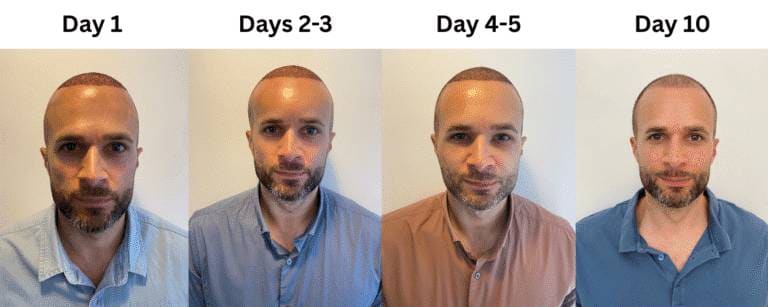
The biology is the same: transplanted hairs usually shed two to three weeks after the procedure, new ones start coming through after three to four months, and you see the final result after roughly 12 months, with or without shaving. The only difference without shaving is what others see in the meantime, because the surrounding hair covers the healing throughout.
Keep two things apart. One is the medical course of healing and growth, which is governed by biology. The other is how well the procedure is hidden from others, and that's where the methods make a difference.
Does the timeline change?
No. Whatever the method, transplanted hairs usually fall out two to three weeks after the procedure. That's a normal and expected part of the process, and it doesn't mean the grafts are lost. New, permanent hair starts growing from the third or fourth month, and the density and texture of the final result are usually assessed after a year. None of this happens faster because you skipped shaving. The methods affect what's visible, not how fast your body works.
What's different along the way?
In the first few days, both the donor sites and the recipient area heal, with some redness and tenderness, whichever method you chose. Without shaving, the surrounding hair covers this from day one, seen at normal distance. That's the whole point. If you're shaved, it shows until the hair has grown a bit. When the transplanted hairs shed in week 2 or 3, that period is also largely hidden under the surrounding hair, whereas a shaved scalp looks patchy during those same weeks. Once the new hairs come through, around month 3 or 4, the method you chose matters less and less. By then, a head that was shaved has grown back too.
Is aftercare the same?
Yes. The rules that protect the grafts while they establish a blood supply apply equally. Don't press or rub the area. Be careful with the first few hair washes. Hold off on hard exercise, sauna and alcohol for the first few weeks. The full week-by-week routine is in the aftercare guide. Without shaving, there's one extra thing to watch: the long hair shouldn't be rubbed or dragged hard over the grafts when you look after it in the first few days, so follow the clinic's advice on combing and drying.
How do you tell a clinic that can do this from one that just advertises it?
Ask the clinic to put in writing, before you book, which method it means, and check that it has photos of that exact technique, not just of standard shaved FUE. Be wary if you're promised both a large number of grafts and full discretion in a single session, because the two rarely go together, and agree in advance whether partial shaving becomes plan B if the surgeon can't see well enough on the day.
Wanting to skip the shave is a sensible wish, and also something that's easy to promise without being able to deliver. Here, a few direct questions will get you further than a long checklist.
Why should the method be in writing?
Because that's what ISHRS itself recommends. A serious clinic tells you clearly which one it will be, partial shaving, unshaven extraction with trimming or true long-hair extraction, and writes it into the treatment plan. It doesn't leave "no-shave" as a loose term in the quote. If the clinic can't or won't give a concrete answer when you ask directly, it's the same warning sign as any other vague claim. You'll find more on such signs in the guide to clinic red flags.
Which results should you ask to see?
Results from this exact technique. A gallery full of great results from shaved FUE says little about whether the team can extract grafts through standing hair without damaging many of them. Ask for photos of the donor area, ideally close-ups, from real patients who weren't shaved or who had long-hair FUE, and ask how many such procedures the surgeon has performed personally.
What is an unrealistic offer?
An offer where you get many thousands of grafts and also avoid all shaving, in a single day. The two pull in opposite directions. If the clinic promises both without caveats, it is either overstating the graft count, planning to shave more than it says, or both. Ask how large a session the clinic considers realistic for you without shaving, and compare the answer with your own estimate from the graft calculator.
What happens if the surgeon can't see well enough on the day?
It can happen, even in a well-planned session. Sometimes the surgeon has to shave a small patch to work safely. If the clinic tells you this before you arrive and explains how it will then be handled and hidden, it's being honest about something that can genuinely happen. A clinic that only mentions it once you're on the table is not. To assess the clinic on everything else that matters, read the guide to choosing a clinic, see our ranking and browse the clinic overview.
Frequently asked questions
Does your head have to be shaved for a hair transplant?
No, but there isn't one single technique for avoiding it. With partial shaving, a shaved strip is hidden under longer hair. With unshaven extraction, only each tiny site around the follicle is trimmed, beneath hair that's left untouched. With true long-hair FUE, the hair is extracted at full length without anything being cut. All three hide what's visible under the hair you already have. None of them removes the marks of healing.
What's the difference between no-shave FUE and long-hair FUE?
"No-shave" is the umbrella term. It also includes a variant where each donor unit is trimmed down just before extraction. The grafts are then short, while the surrounding hair keeps its length. Long-hair FUE is narrower. The hair is never cut, and both the extraction and the transplanted grafts keep their full length. That's also why it's the harder of the two.
How long does your hair need to be to avoid shaving?
Long enough for the surrounding hair to lie over each tiny extraction site. Clinics often state at least a few centimetres. If you've recently had a buzz cut or wear your hair very short, it usually won't be enough for the methods to be discreet. A good clinic will tell you clearly if your length isn't sufficient.
Is a no-shave hair transplant more expensive?
Usually, yes. Each graft takes longer, and the surgeon or an experienced technician has to spend more of their own time. Clinics therefore often add a fixed surcharge, raise the price per graft or give you fewer grafts for the same sum. Get the total price, the number of grafts and the method in writing before you compare it with a standard quote.
Are more grafts damaged when the hair isn't shaved?
It can happen. When grafts are harvested through standing hair, the surgeon has a poorer view of each follicle's angle. Studies have shown a clearly higher rate of transection, meaning damaged grafts, than with shaved FUE when standard instruments are used with little experience. Purpose-made punches for long hair and a surgeon trained in the technique shrink the gap considerably. That's why experience with this specific method matters more here than with standard FUE.
Will people notice anything in the first few days if I'm not shaved?
At normal distance most people see nothing, because the surrounding hair covers the treated areas. The wound is still there, though. If someone looks at you up close under a bright lamp, small pink marks and tiny scabs may be visible for the first one to two weeks, just as after any FUE. So skipping the shave hides the fact that your hairstyle has changed. It doesn't make the healing invisible to someone who's looking.
Which method is realistic for you, if any, depends on how long your hair is, how many grafts you need and how dense your donor area is. There's no rule that applies to everyone. Request a free hair analysis and you'll get an honest assessment from the clinic ranked first in our ranking. No commitment.
This page provides general information and does not replace medical advice. Whether you can avoid shaving must be decided by a qualified surgeon after assessing you in person.
Goes to the clinic at the top of our ranking.
Updated: October 2026 · How our editorial team works