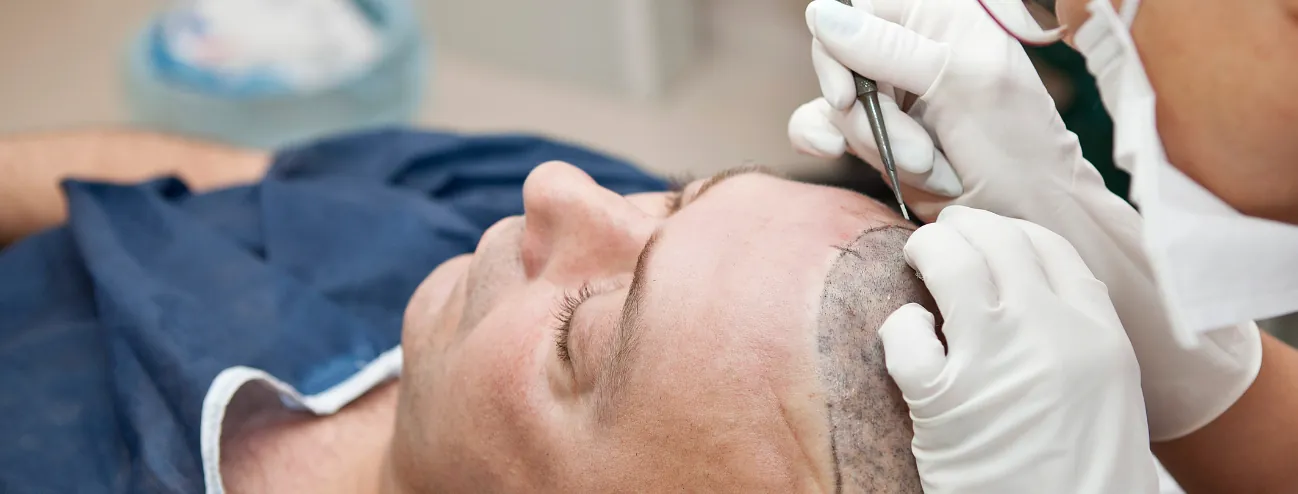
Does a sapphire blade beat a steel one? A little, perhaps, on one specific point. Sapphire FUE is a completely ordinary FUE (follicular unit extraction) with one difference: the small openings where the grafts go are made with a blade of synthetic sapphire rather than steel. Harvesting the follicles from the donor area is exactly the same. The blade can make narrower, cleaner incisions, and that's a real and credible advantage. It's still the same operation, though, and the surgeon's skill matters far more to the result than what the blade is made of.
Below we look at what the blade changes, what the research actually shows compared with what clinics say in their adverts, how healing goes, who has the most to gain, how sapphire FUE relates to DHI, and whether a surcharge is worth the money. All the methods, including FUE, DHI and FUT, are covered in the guide to hair transplant methods. If you're not sure a transplant suits you at all, start with the candidate guide.
- Sapphire FUE is ordinary FUE harvesting with channels made by a sapphire blade. The procedure and the harvesting of follicles are the same.
- The claimed benefits (narrower incisions, denser placement and gentler healing) are physically plausible but small in practice. Large independent studies are lacking.
- What the surgeon does with the hairline and the plan counts for far more than the material of the blade.
- Sapphire FUE and DHI each change a different step of the procedure (the incision and the placement). Many clinics use both.
- The course is the same whichever blade is used: the transplanted hairs shed after 2 to 3 weeks, new hair arrives in months 3 to 4, and around 12 months after the procedure you see the final result.
What is sapphire FUE, and what happens on the day of surgery?
Sapphire FUE is FUE where the openings in the recipient area are made with a synthetic sapphire blade rather than steel. Harvesting the follicles is exactly the same, and only the instrument that makes the small channels has been swapped. So you're getting a variation on one single step, not a new technique.
Whatever it's called, an FUE transplant has two steps. First, individual follicular units are taken from the back and sides of the head. Then an opening is made in the recipient area and the graft is placed in it. The sapphire blade is a detail in step two. Harvesting, graft handling and the rest of the operation stay as they were.
Does anything change in the harvesting?
No. The follicles are removed one by one with a small round punch, sorted by how many hairs they contain, and kept in a cold storage solution until they go in. There's no difference here. "Sapphire" only tells you something about what happens where the grafts will sit.
Where does the sapphire blade come in?
In classic FUE the surgeon makes the channels first. Afterwards the team fills them with grafts. In sapphire FUE the channel is made with a sapphire blade instead of a steel one. The placement itself happens in the same way as after an incision with a steel blade.
Why can the name be misleading?
In an advert, the word "sapphire" can make it sound like a separate, more advanced operation. Think of it instead as a choice of equipment, much like choosing a particular brand of punch. It matters, but the result stands or falls with the person holding the blade.
What does a sapphire blade do differently from a steel blade?
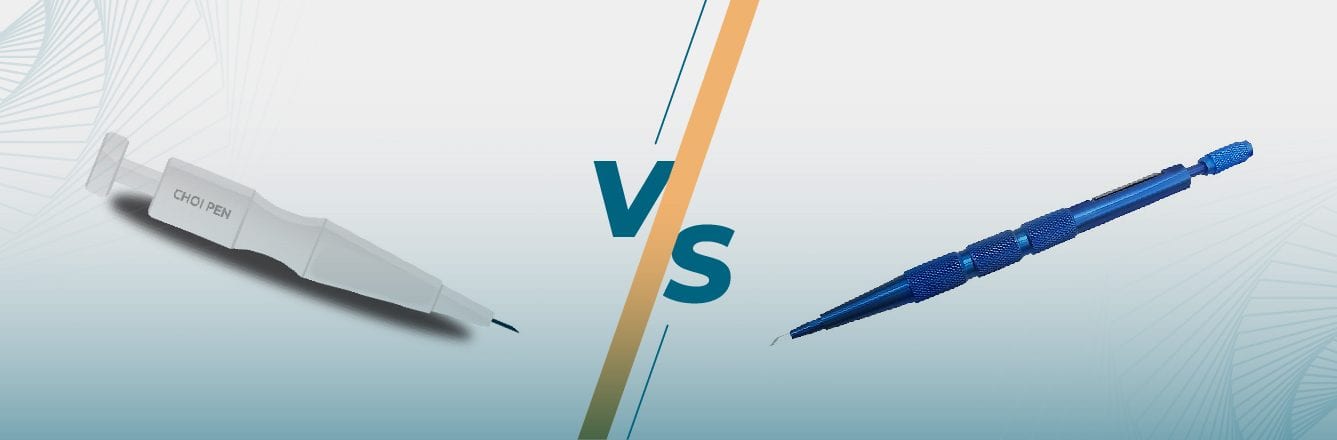
Sapphire is a harder material, and its edge can be made sharper than steel. The incision is therefore narrower and cleaner, V-shaped, with less pressure on the surrounding tissue. In theory that allows denser placement and more consistent angles, but the difference is small, and a skilled surgeon with a steel blade can achieve the same.
What's the physical difference?
Steel is solid and predictable, but blades wear as they're used, and the edge eventually becomes coarser than a sapphire edge. A sapphire blade is ground from a synthetic crystal. The edge stays sharp and even for longer, and the blade usually makes a narrow, V-shaped slit rather than a wider cut. A sharper, narrower cut gives a real, mechanical reason to expect less damage to the tissue around each opening.
What is the blade supposed to do better?
Clinics that use sapphire tend to point to three things. The grafts can sit closer together without the channels merging. Angle and direction are more consistent from hair to hair. And there's less bleeding and squeezing right around the incision. All three follow logically from the cut being narrower and cleaner.
What can't the blade influence?
The blade has nothing to do with harvesting. Where the grafts are distributed, how the hairline is drawn and how many grafts survive are decided elsewhere. The surgeon's plan and hand control these. The blade is therefore one factor that feeds into the result, not the result itself.
Do the claims about sapphire FUE hold up against the research?
Some of them. The mechanics are sound enough, with a harder material, a sharper edge and less damage to the sides, and a few small studies and clinic case series report less swelling and neater incisions. But the research doesn't show that the blade determines how you'll look in a year, and when the surgeons are equally skilled, no larger independent study has found a clearly better result with sapphire.
Which sapphire FUE claims are credible?
The mechanism wasn't invented by the marketing department. A sharper edge that lasts longer really does cause less damage to the tissue beside the incision, and narrower channels really can sit closer together before they start interfering with each other. That part rests on basic surgical mechanics.
How strong is the evidence?
Most published comparisons of sapphire and steel are small and follow patients for a short time. Many are produced or funded by clinics or manufacturers with something to gain from the answer. That's a real weakness, but no reason to dismiss them. There are few large, long-term independent studies measuring how many grafts survive and how dense the hair becomes. So a serious source should call the benefit credible and modest, not proven and large.
What do the experts emphasise?
The international professional organisation for hair surgeons, ISHRS, asks patients to look at the surgeon's training, certification and verifiable results. About blades and instrument brands they say little. That tells you where they think the weight belongs: on the person, not on the equipment in the advert. The full checklist is in the guide to choosing a clinic.
What does "credible but not proven" mean for you?
It means you don't need to rule out a clinic because it uses steel, and you shouldn't choose a clinic just because it uses sapphire. Ask instead why the team chose the blade they use. A good answer is about your hairline, how densely the grafts will be placed and what the team has the most experience with. A weak answer is that "everyone wants sapphire now".
What's the honest conclusion?
In experienced hands, sapphire incisions are probably a real but small technical improvement. Independent research has not shown that they lift the result dramatically, and anyone promising you that is overselling. Treat "sapphire" as a detail you note, not as the reason to choose a clinic.
It depends on your donor area, your hair type and where the loss is. Send three photos and the medical team at the clinic at the top of our ranking will suggest a method and number of grafts.
Goes to the clinic at the top of our ranking.
Does healing differ after sapphire FUE, with fewer scabs?
Slightly, in the first few days. A narrow, clean incision can mean fewer scabs and less minor bleeding, and that's plausible. The healing itself isn't any shorter: the scabs are gone after a week or two, the hairs in the grafts shed after 2 to 3 weeks, and growth comes in months 3 to 4, with sapphire just as with steel.
What can sapphire change in the first few days?
A narrower incision usually means a smaller wound where each graft sits. That fits with some people experiencing slightly less bleeding, redness and scabbing with a sapphire blade. If the effect is real, you'll notice it mostly in the first week or so, while the skin is at its most sensitive.
What stays exactly the same?
The body heals on its own clock, whatever tool made the incision. The scabs itch for a while and come away within a week or two. After 2 to 3 weeks the hairs in the grafts shed while the follicles themselves stay put, and that's normal. Lasting growth starts in months 3 to 4. The result is complete after around 12 months. The blade has no effect on any of this. Washing, sleeping position and what to expect day by day are covered in aftercare after a hair transplant.
Is this a good reason to choose sapphire FUE?
Not on its own. Slightly less swelling and fewer scabs make the first week more comfortable. That's all. How well the hair grows doesn't change. If you choose sapphire just to heal a little faster, you're giving more weight to a short-lived cosmetic effect than to what actually decides how you look after 12 months: the plan, the execution and how carefully you follow the aftercare.
Where on the head does the sapphire blade make the biggest difference?
Mostly at the hairline and the front, where the grafts need to sit densely and evenly and the angles have to be right for it to look natural. On the crown and mid-scalp the blade matters less, because the spacing between grafts there is more forgiving. Whether you should look for sapphire comes down more to how good the surgeon is at hairlines.
Where does denser placement make a real difference?
The hairline is the most demanding area. The single-hair grafts must sit close enough that the line doesn't look see-through, with even angles pointing forwards, without the channels getting so close that neighbouring grafts are damaged. This is where a narrower incision gives the clearest advantage in theory, because it leaves more room for dense placement without weakening the blood supply to each graft.
Where does it matter less?
On a large crown or the mid-scalp the grafts are usually placed a little more sparsely from the outset, and the eye is more forgiving there than at the hairline. A narrow incision does no harm, but fullness and a natural look are decided by other things. The number of grafts, how they're distributed and the surgeon's plan count for more.
Does hair type play a part?
Little, as far as the blade is concerned. Fair, fine hair against light skin gives less contrast, so small irregularities in the hairline show less. Dark, coarse hair against light skin is more revealing, and there precise angling and dense placement matter more. That may argue for a fine incision, but it argues even more for a surgeon with experience of your hair type.
How do you work out what your plan needs?
How many grafts a hairline or a whole plan needs depends on how large the area is, how thick and curly your hair is and what your donor area can supply. The blade has nothing to do with it. A rough estimate beforehand makes the conversation with the clinic easier. Use the graft calculator for a starting point, and have the figure confirmed for your own hair in a personal assessment.
Sapphire FUE or DHI: do you have to choose?
The two don't compete, because they belong to different steps. With sapphire FUE the channel is made with sapphire before the graft is placed. With DHI there's no channel beforehand, because the Choi pen opens the skin and places the follicle in one movement. Many clinics use the pen at the hairline and sapphire channels on the rest of the head.
"Sapphire or DHI" is a common angle in advertising, but the choice doesn't really exist. The sapphire blade makes the incision. DHI is a way of placing grafts. Once you see where in the procedure each one belongs, the comparison becomes much more useful than the sales shorthand.
| Step | Sapphire FUE | DHI |
|---|---|---|
| Harvesting | Follicles are removed individually with a fine punch | Same FUE harvesting |
| Channel in the recipient area | Cut first, with a sapphire blade | The channel step is dropped, because the Choi pen opens the skin and fills the opening in the same movement |
| Placement | The graft is placed in the finished channel, often by another team member | The same instrument places the graft as the opening is made |
| Where control is best | Consistent channel shape and density across an area | Fine control of angle, depth and direction for each individual hair |
| Can they be combined? | Yes. Many use the DHI pen at the hairline, where control counts most, and sapphire channels in larger areas where the demands are less strict | |
Why is "which is best" the wrong question?
They solve slightly different problems. Sapphire makes the channel incision itself finer. DHI removes the channel step and instead gives close, direct control as the graft is placed. A plan built around your hair, your donor area and your goals can use one, the other or both. The full comparison, including FUT, is in the guide to hair transplant methods. If you want to look even more closely at the two instruments, read the comparison of the sapphire blade and the Choi pen.
Does sapphire cost more, and do you get anything for the surcharge?
Often, but not always. Some include the sapphire blade in the FUE price, others charge extra, and some offer it only in a more expensive package with DHI. The blade is a cheap disposable item, so a big jump in price tells you more about the clinic's marketing than about the operation.
Why should the cost difference be small?
A sapphire blade is used once and thrown away. It costs more to make than a steel blade, but measured against the price of a whole hair transplant, the extra cost per patient is tiny. It doesn't explain why two otherwise identical packages at the same clinic differ by large amounts.
What lies behind a big price gap?
The number of grafts and the choice of method count for more than the blade. DHI takes longer and needs more hands, so it's rarely priced the same as an FUE session. If "sapphire FUE" is sold as the top tier of a price list, you're often paying for a longer day, more staff or a bigger package. The blade is the window dressing. What actually drives the price of a hair transplant, from graft count to country and clinic, is in the price guide.
Should you avoid clinics that use steel?
No. Many experienced surgeons create very fine hairlines with steel blades or fine needles, because they know their tools inside out. It's the skill and patience at the operating table that give a natural result. A clinic that uses steel and can show you good, unretouched results is a better choice than a sapphire clinic that can't.
How do you judge whether the surcharge is worth it?
Get the price broken down line by line, so you can see what the sapphire adds. Then ask yourself whether that amount buys you a better surgeon or just a nicer word. Our ranking weighs price against value across the whole clinic, and that says more than any single detail, whether it's called sapphire or something else.
What answers do you need before paying extra for sapphire?
Find out who harvests the follicles and makes the channels, how much experience that particular person has with sapphire blades, and ask to see unretouched photos of patients with hair and skin like yours. Get the price itemised so you can see what the sapphire costs. If the clinic talks more about the blade than about the surgeon, that's a bad sign.
A few direct questions quickly show whether the sapphire blade is part of a well thought-out plan or is mostly used to sell. Write them down before the consultation. The word "sapphire" is no guarantee in itself.
- Who holds the instruments? Who harvests the follicles, and who makes the channels? Is the doctor in the room throughout the day, or only for the first half hour?
- How much experience does the surgeon have with sapphire blades? A thousand operations in total says less than how often this particular technique has been used.
- Are there unretouched photos of hair like mine? A gallery of the best cases says little. Recent photos of someone with roughly your colour, thickness and density say much more.
- Is sapphire included in the base price? Or is it an extra? Get the total price by email.
- What do you do if the plan doesn't hold on the day of surgery? An honest answer that donor hair may be limited, or that the graft count may be adjusted, is safer than a fixed figure promised in advance.
You'll find the longer list in the guide to clinic red flags, and it applies to clinics that don't charge extra for sapphire too. Finally, see how the clinics perform on results and value for money, and let the instruments they boast about count for least.
Frequently asked questions
Is sapphire FUE a separate method?
No. It's ordinary FUE harvesting with one change: the channels in the recipient area are made with a sapphire blade instead of a steel blade. The harvesting, the healing and the whole course are the same.
Does a sapphire blade give a better result than a steel blade?
The blade can make slightly narrower, cleaner incisions, which may leave room for denser placement and slightly less damage around each channel. The evidence for a clearly better long-term result is thin, and the surgeon's skill and planning matter far more than the material of the blade.
Do you heal faster after sapphire FUE?
Any differences are small and mostly cosmetic in the first few days, for example fewer scabs. The main course is the same: the transplanted hairs shed after 2 to 3 weeks, new hair arrives in months 3 to 4, and after around 12 months the result is complete.
What's the difference between sapphire FUE and DHI?
With sapphire FUE it's the incision that differs. With DHI it's the placement, where a Choi pen opens the skin and places the follicle in the same movement. Because they belong to different steps, they're often used together.
Is sapphire FUE more expensive than standard FUE?
Often, but practice varies. Some include it in the FUE price, some add a surcharge, and some offer it only in the most expensive package. The blade itself costs little, so a large price difference mostly tells you how the clinic packages its offer.
Is sapphire FUE suitable for curly or Afro hair?
The blade is used in the recipient area, not during harvesting. So it doesn't change the risk of cutting through the follicles (transection), which is why curly and Afro hair are harder to harvest. For these hair types, what matters most is that the surgeon has harvested a lot of curly hair before. The blade plays only a small part.
Whether you should pay extra for sapphire depends on the plan for your hairline, who operates and what the surcharge actually covers. Ask for a free hair analysis and you'll hear back from the clinic at number 1 in our ranking, with an honest view of your hair and whether sapphire makes any difference for you in particular. You're not committing to anything.
This is general information and not medical advice. Only a qualified surgeon can decide which technique suits your hair, after a personal assessment.
Goes to the clinic at the top of our ranking.
Updated: October 2026 · How our editorial team works