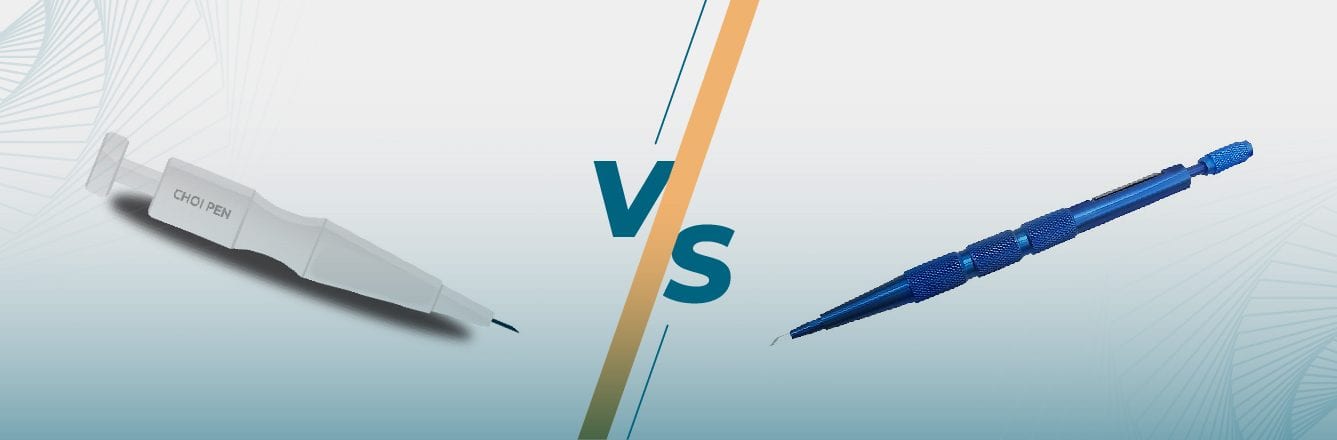
Sapphire blade or Choi pen: does the instrument affect the result?
Sapphire and Choi are often sold as two competing methods. They aren't. Here's what each instrument actually does, and why the surgeon's hand matters more than either.
Are sapphire and Choi two options you have to choose between?
No. The two instruments are used at different steps of the procedure, so pitting them against each other makes little sense. It's a bit like asking whether a painter should use a brush or a palette knife. Both can be used on the same picture.
The sapphire blade makes the channels in the skin where the grafts will sit. The Choi pen handles the actual implantation in DHI. A clinic may use both, just one of them, or neither.
What makes a sapphire blade better than steel?
It gives smoother, more precise incisions. In standard FUE, the surgeon first opens small channels, and the grafts are implanted afterwards. Traditionally, steel blades are used. In sapphire FUE, the blade is made of synthetic sapphire. The idea is that the clean incisions cause less damage to the tissue, may give faster healing and make it possible to place the channels very close together.
The benefit is real, but small. Angle, depth and density are still decided by the surgeon. The blade helps the hand, but doesn't replace it. Read more about the technique on the page about sapphire FUE.
What does the Choi pen do?
It opens the channel and implants the hair in the same movement. The Choi pen is the very core of DHI. The graft is loaded into a hollow needle on the pen, and when the needle is pushed into the skin it creates the channel and places the hair. The surgeon controls depth and direction precisely, and the graft spends less time outside the scalp.
The advantage is greatest at the hairline and when filling in between hair you already have. The downside is that DHI takes longer and needs more hands, so the price per graft is often higher. See more about the DHI method.
What decides the result more than the instrument?
The surgeon. What marketing departments would rather not say out loud is that experience, planning and a good eye for aesthetics matter far more than the name of the instrument. How real the result looks is decided by how the channels are angled, how single-hair and multi-hair grafts are distributed, and how the hairline is drawn. The blade material comes a long way down the list.
A highly skilled surgeon with perfectly ordinary equipment will give you a better result than an average operator with the most expensive tools on the market.
Why do clinics market themselves on instruments?
Because words like sapphire and Choi sound advanced, and that sells. But a tool is never better than the hand holding it. When a clinic mainly advertises its equipment, and says little about who operates and what they've achieved, it may be an attempt to draw your attention away from what counts.
What should you ask about instead?
If “sapphire and Choi!” is the headline argument in the ad, dig a little deeper. Ask these questions:
- Who performs the procedure itself, the surgeon or technicians?
- How many patients are operated on per day?
- Can I see unretouched before and after photos of people with my hair type?
It's the answers to these that tell you something about your result, not what the blade is made of. If you want to understand the methods in more depth, read the overview of the methods. You'll find the full checklist for before you decide under choosing a clinic. Send the questions to the clinics you're considering today, and compare the answers side by side.
It depends on your donor area, your hair type and where the loss is. Send three photos and the medical team at the clinic at the top of our ranking will suggest a method and number of grafts.
Goes to the clinic at the top of our ranking.