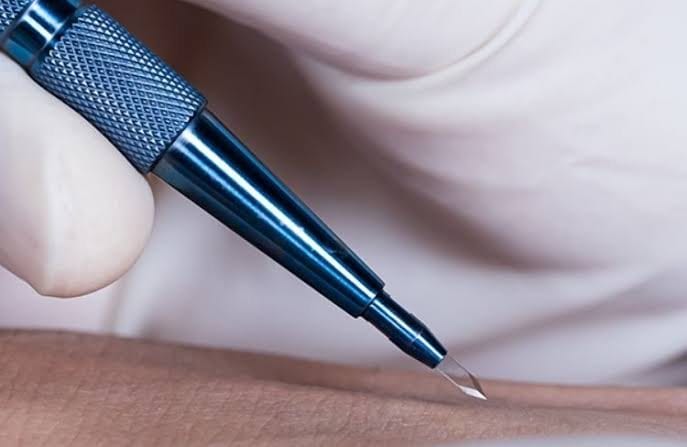
Sapphire FUE: what do you actually get for the sapphire blade?
Sapphire FUE is an ordinary FUE procedure with one difference: the incisions in the recipient area are made with a sapphire blade rather than a steel one.
Sapphire FUE is an ordinary FUE procedure with one difference: the incisions in the recipient area are made with a sapphire blade rather than a steel one. Extraction is unaffected, only this one step changes, and there is little research showing that it gives a different end result.
What is actually made of sapphire in sapphire FUE?
Only the blade that makes the openings the grafts go into. Sapphire is a hard crystalline material that can be ground to a very thin, smooth edge that doesn't dull quickly. Harvesting, the grafts and implantation are exactly the same as in other FUE, so this is one new instrument in one of the steps.
What do clinics promise sapphire will deliver?
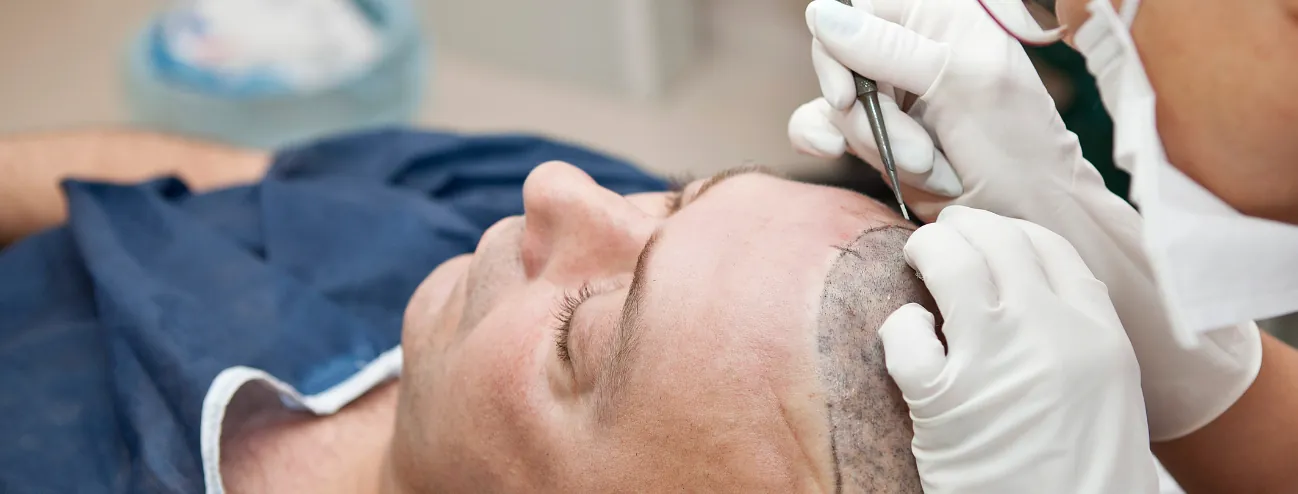
The claims are cleaner incisions with less tissue damage, openings so small and precise that grafts can sit closer together, possibly faster healing in the recipient area, and fewer scabs. Mechanically that makes sense, and research shows that the way the openings are made really does affect how many grafts survive.
- Cleaner incisions and less tissue damage
- Small, precise openings that allow grafts to be placed closer together
- Possibly faster healing where the grafts are implanted
- Fewer scabs
The logic holds up. A thinner, sharper blade gives a cleaner incision, and that's a reasonable thing to want. Review articles also confirm that the way recipient sites are made affects how many grafts survive.
Does sapphire FUE give better results than FUE with a steel blade?
Clinics that use sapphire often report that, in practice, patients heal faster and have less irritation and redness in the recipient area. The research, however, is thin and inconsistent. A large observational study from 2026 found somewhat higher graft survival with sapphire, while a 2023 study found less damage to the small blood vessels with steel blades. So it is not proven that sapphire gives a better end result, and the surgeon's experience matters more than the blade.
What should you look at instead when clinics advertise sapphire?
Treat sapphire as a side issue, not as a reason to choose a clinic. Your outcome depends on who harvests the grafts, how many follicles are transected, how long the grafts are kept outside the body and who implants them. The blade material is far down the list.
You'll find more about the method in our guide to sapphire FUE. We explain why heavy marketing of techniques is often a bad sign under red flags at clinics.
Sources and caveats
- Parsley WM, Perez-Meza D. Review of factors affecting the growth and survival of follicular graft. Journal of Cutaneous and Aesthetic Surgery, 2010;3(2). jcasonline.com
- Saket K. Accuracy in Hair Repair: Assessing Sapphire FUE, Forceps Methods, and Treatment Times in Contemporary Hair Transplantation. Journal of Maxillofacial and Oral Surgery, 2026;25(4):1155-1165. pubmed.ncbi.nlm.nih.gov/42528810
- Balik O. Determination of Scalp Vascular Topography by Laser Doppler Flowmetry and Comparison of Vascular Damage by Different Blades in Hair Transplantation. The Journal of Craniofacial Surgery, 2023;34(8):e803-e806. pubmed.ncbi.nlm.nih.gov/37811982
- Ahmad M, Ismail M. Effect of different shapes of recipient site creation micro-blades at varying angles and wound injury. Journal of Cosmetic Dermatology, 2021;20(11):3610-3615. pubmed.ncbi.nlm.nih.gov/33599101
This article is based on published research and standard clinical practice. It provides general information and is not medical advice. Instructions from your own surgical team come first: if they tell you something different from what is written here, follow them.
Wondering what's possible for your hair?
Send three sharp photos of your hair, from the front, the top and the back. You'll get an honest answer on what can be done, roughly how many grafts it would take and what it costs.
- Free and with no obligation
- Photos are assessed by the clinic's medical team
- Replies usually within an hour in the daytime


A study tells you something about groups. Only a doctor who has seen your photos can say what applies to your hair. The medical team at the clinic at the top of our ranking offers a free assessment.
Goes to the clinic at the top of our ranking.