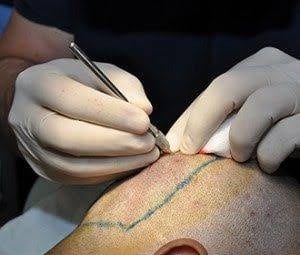
Manual or motorised punch: does the tool matter in FUE?
Less than you might think: both can give fine results with a skilled surgeon. A manual punch is rotated with the fingers, while a motorised punch is driven round or back and forth by a motor.
A manual punch is rotated with the fingers, while a motorised punch is driven round or back and forth by a motor. The motor gives a faster pace and spares the surgeon physical strain. The hand gives a better feel for the tissue. Both can give fine results with a skilled surgeon.
How do a manual and a motorised FUE punch differ?
The manual punch is turned around the hair group with the fingers, and the surgeon feels the resistance from the tissue as they go. The motorised one rotates or oscillates by itself and cuts faster without the surgeon having to use as much force. Both should deliver the same thing: an even plug of tissue with the follicle intact in the middle.
What do you gain and lose with each type of punch?
A motorised punch works faster, which shortens the procedure day and the time the first grafts spend outside the body. A manual punch gives the surgeon more feel for depth and resistance, which some prefer in challenging donor areas. With a manual punch the surgeon gets more tired after several thousand grafts, and a motorised punch can heat up from friction if it is used carelessly.
- Speed. A motor is faster, so the day is shorter and the earliest grafts wait less.
- Feel. With a manual punch the surgeon senses depth and resistance better, which is why some choose it in difficult donor areas.
- Fatigue. Harvesting several thousand grafts by hand is tiring, and a tired hand becomes less precise.
- Friction heat. A motorised punch can heat the tissue if it is used carelessly.
- With curly or Afro-textured hair the follicle curves beneath the skin, and this is where the choice of technique counts most.
What actually determines how many follicles are transected in FUE?
It isn't the type of punch. What counts is that the punch is sharp and the right diameter for the hair, that it goes to the right depth and follows the same angle as the follicle, and that the person harvesting has enough experience. Review articles show that damage high up at the bulge region is worse than damage lower down at the bulb, which is why a clean extraction matters more than a fast one.
What should you ask the clinic about its punch technique?
Ask what type of punch and what diameter they plan to use for you, who in the team harvests the grafts, what proportion of follicles they usually transect and how they measure it, and how they make sure the punch stays sharp through a long day.
- Which punch and which diameter suit my hair?
- Who harvests the grafts?
- How many follicles do you usually transect, and how do you count them?
- What do you do to keep the punch sharp all day?
Sources and caveats
- Kim J, Ko YU, Yi KH. The condition of hair follicles produced by different punching methods during FUE surgery. Journal of Cosmetic Dermatology, 2024;23(12):4202-4207. pubmed.ncbi.nlm.nih.gov/39152658
- Chauhan K, Tandon M, Kumar A, Taneja N, Hamid SAT. A comprehensive review of evolution of advanced follicular unit excision systems. Journal of Cutaneous and Aesthetic Surgery, 2025;18(2):69-77. pubmed.ncbi.nlm.nih.gov/40212421
- Chouhan K, Roga G, Kumar A, Gupta J. Approach to Hair Transplantation in Advanced Grade Baldness by Follicular Unit Extraction: A Retrospective Analysis of 820 Cases. Journal of Cutaneous and Aesthetic Surgery, 2019;12(4):215-222. pubmed.ncbi.nlm.nih.gov/32001965
- Rose PT. Hair restoration surgery: challenges and solutions. Clinical, Cosmetic and Investigational Dermatology, 2015;8:361-370. pubmed.ncbi.nlm.nih.gov/26203266
- Parsley WM, Perez-Meza D. Review of factors affecting the growth and survival of follicular graft. Journal of Cutaneous and Aesthetic Surgery, 2010;3(2). jcasonline.com
This article is based on published research and standard clinical practice. It provides general information and is not medical advice. Instructions from your own surgical team come first: if they tell you something different from what is written here, follow them.
Wondering what's possible for your hair?
Send three sharp photos of your hair, from the front, the top and the back. You'll get an honest answer on what can be done, roughly how many grafts it would take and what it costs.
- Free and with no obligation
- Photos are assessed by the clinic's medical team
- Replies usually within an hour in the daytime


A study tells you something about groups. Only a doctor who has seen your photos can say what applies to your hair. The medical team at the clinic at the top of our ranking offers a free assessment.
Goes to the clinic at the top of our ranking.