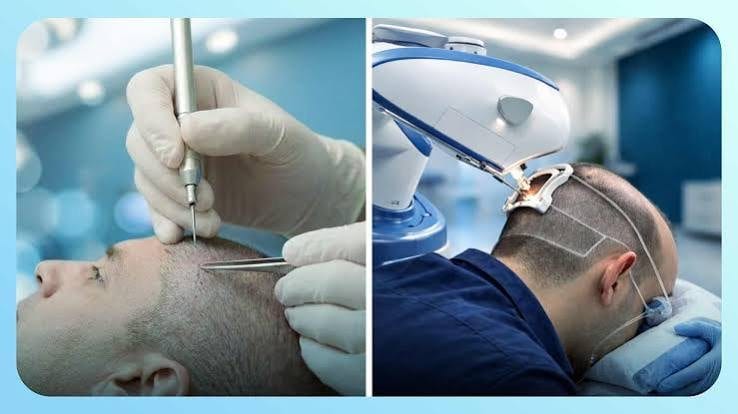
Robotic FUE (ARTAS) or manual FUE: what does the machine do better?
Mainly consistency. The robot photographs the donor area and aims the punch itself, keeping the same angle and depth without tiring, while many surgeons find hands do a better job where the donor area is irregular. Few clinics use one.
A robot can assist during harvesting by photographing the donor area and aiming the punch by itself. Few clinics use one, mostly because the machines are expensive and because many surgeons find that hands do a better job where the donor area is irregular.
What does the robot do during robot-assisted FUE (ARTAS)?
The system uses a camera and image analysis to find the follicular units, calculate the angle of each one and guide a punch that extracts them. The aim is the same angle, depth and force through long procedure days without precision dropping off from fatigue. The robot doesn't draw the hairline, and it neither decides how the grafts are distributed nor implants them, so those decisions are still made by people.
What are the benefits of a robot during extraction?
Clinics that use automated extraction highlight that the angle stays the same across thousands of grafts, that the machine doesn't tire towards the end of a long day, that the punch depth is the same for every follicle, and that extractions are spread systematically across the donor area so no spot is depleted too heavily.
- The same extraction angle from the first to the last of several thousand grafts
- No fatigue late in the day
- The same punch depth every time
- Planned distribution, so no single spot is over-harvested
What are the weaknesses of robotic FUE?
The machines are expensive to buy and run, and that bill ends up with the patient. Many surgeons believe a trained eye still beats automated image recognition when the donor area is irregular. The systems struggle most with very curly hair, and they are not clearly faster than a skilled manual team.
- Cost. Both purchase and maintenance are expensive, and the patient pays.
- Irregular donor areas. Where hair direction and density change, many surgeons believe human judgement beats the machine's pattern recognition.
- Hair type. The machine struggles most with very curly hair.
- Speed. Not necessarily faster than a skilled team working by hand.
How common is robotic FUE compared with manual FUE?
Robot-assisted extraction is still rare. Among members of the professional society ISHRS, a robot was used in 1.3 % of FUE procedures in 2024. So the fact that a clinic has a robot tells you little about its quality.
You'll find the latest figures on our statistics page.
Sources and caveats
- Rose PT, Nusbaum B. Robotic hair restoration. Dermatologic Clinics, 2014;32(1):97-107. pubmed.ncbi.nlm.nih.gov/24267426
- Rose PT. Hair restoration surgery: challenges and solutions. Clinical, Cosmetic and Investigational Dermatology, 2015;8:361-370. pubmed.ncbi.nlm.nih.gov/26203266
- Zhu Y, Yang K, et al. A Comparative Study on the Application of Robotic Hair Restoration Technology Versus Traditional Follicular Unit Excision in Male Androgenetic Alopecia. Journal of Cosmetic Dermatology, 2024;23(12):4213-4222. pubmed.ncbi.nlm.nih.gov/39297414
- Chauhan K, Tandon M, Kumar A, Taneja N, Hamid SAT. A comprehensive review of evolution of advanced follicular unit excision systems. Journal of Cutaneous and Aesthetic Surgery, 2025;18(2):69-77. pubmed.ncbi.nlm.nih.gov/40212421
- Parsley WM, Perez-Meza D. Review of factors affecting the growth and survival of follicular graft. Journal of Cutaneous and Aesthetic Surgery, 2010;3(2). jcasonline.com
This article is based on published research and standard clinical practice. It provides general information and is not medical advice. Instructions from your own surgical team come first: if they tell you something different from what is written here, follow them.
Wondering what's possible for your hair?
Send three sharp photos of your hair, from the front, the top and the back. You'll get an honest answer on what can be done, roughly how many grafts it would take and what it costs.
- Free and with no obligation
- Photos are assessed by the clinic's medical team
- Replies usually within an hour in the daytime


A study tells you something about groups. Only a doctor who has seen your photos can say what applies to your hair. The medical team at the clinic at the top of our ranking offers a free assessment.
Goes to the clinic at the top of our ranking.