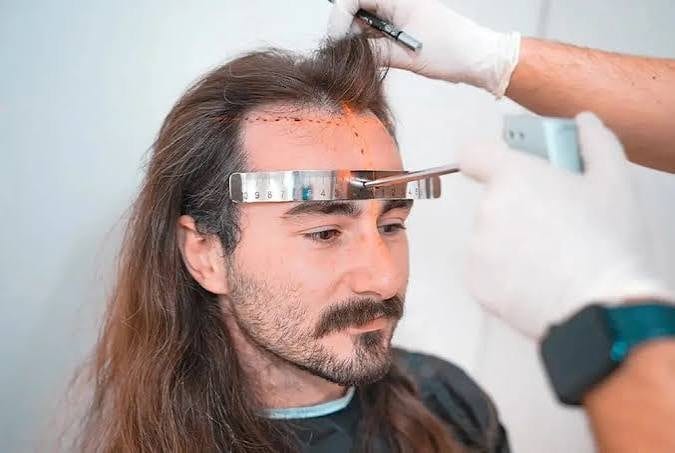
FUE without shaving: can you keep your hair long?
With unshaven FUE, the grafts are extracted without the back of the head being clipped short, so the surrounding hair hides the fact that you've had surgery.
With unshaven FUE, the grafts are extracted without the back of the head being clipped short, so the surrounding hair hides the fact that you've had surgery. The price is a slower, more demanding procedure, usually with fewer grafts, and that is reflected in what it costs.
What does it mean to have FUE without shaving?
Normally the back of the head is clipped very short so the surgeon can see the angle at which each hair leaves the skin and drill precisely. With unshaven FUE this step is skipped, either entirely or by clipping narrow strips that are then hidden by longer hair above. Sometimes the recipient area can keep its hair too, and the option is offered more often to women and for smaller sessions. The surrounding hair covers the extraction holes from day one.
The standard approach starts with the back of the head being clipped right down, so the surgeon can see the follicular units clearly and reach them. The result is a shaved area at the back and sides of the head that stays visible for several weeks.
With unshaven FUE, the units are extracted from between hairs left at full length. Sometimes small windows are clipped and hidden under the longer hair above, which is called partial shaving. Other times nothing is clipped at all. Either way, the surrounding hair covers the holes from day one.
A 2026 case series described a modified unshaven method in which extraction was done with a flared ring punch. The transection rate came out at 3 %. A series like this is small and has no comparison group. It tells you what one method achieved in one group of patients, and it can't show more than that.
Why is unshaven FUE harder to perform?
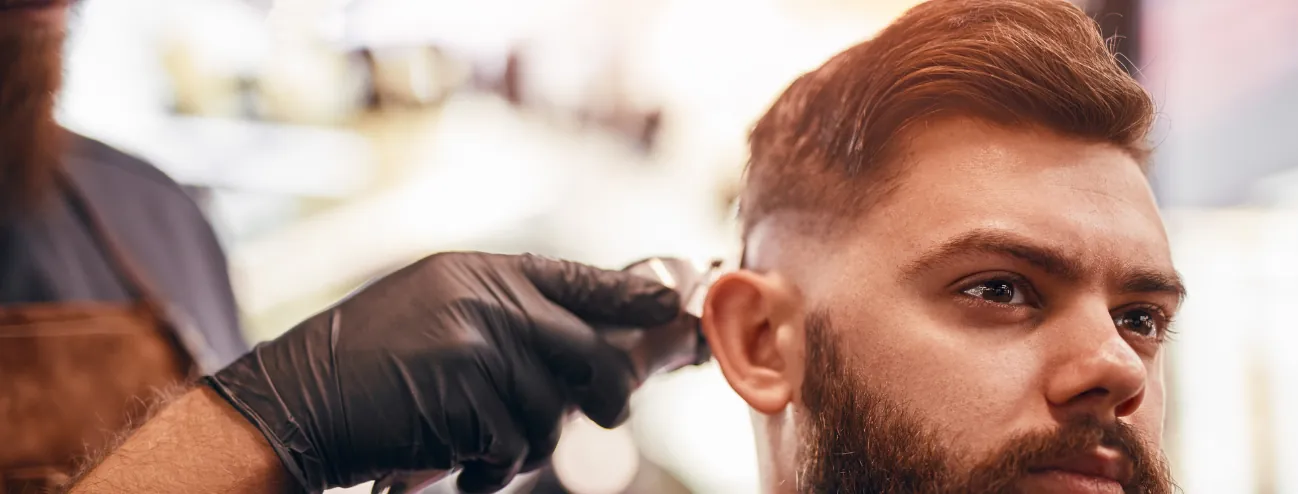
Long hair hides the angle at which each follicle leaves the skin, an angle the punch has to follow. As a result, harvesting is slower and the first grafts spend longer outside the body. Each graft has to be trimmed by hand, it's harder to spread the extractions without a clear overview, and with less experienced surgeons the risk of transecting follicles goes up.
Extraction in long hair is more demanding and takes longer.
- Poorer visibility. With hair around them, the follicular units are harder to see and their angle is harder to read. That affects how precisely the punch can be aligned.
- Slower pace. Fewer grafts are harvested per hour. A session that would take six hours shaved can become considerably longer.
- More time outside the body. This matters most. When extraction is slower, the grafts wait longer to be implanted, and time outside the body is one of the factors documented to affect how many survive.
- Trickier handling. Long hairs attached to the grafts make sorting and implantation clumsier, and each graft has to be trimmed by hand before it is implanted.
- Smaller sessions. The number of grafts that can realistically be taken in one session is usually lower.
That doesn't make the technique unreasonable. It makes it a trade-off, and you are entitled to have that trade-off explained.
Who is unshaven FUE a good choice for?
It suits you if you can't show that you've had a procedure, and it suits women, who rarely want the back of the head clipped and often need fewer grafts. It also works for smaller jobs such as adjusting the hairline or covering a scar, and for repairs where the surrounding hair is needed as cover. Partial shaving is the usual compromise.
The techniques are most often used for women. They usually have long hair, most don't want a clipped patch at the back of the head, and the grafts are often implanted among existing hair rather than into a bare area.
Men who can't have visible downtime choose them too. That includes those who don't want to explain a shaved back of the head at work, and those who have no plans to tell anyone about the procedure.
Partial shaving is the most common middle ground. The surgeon clips small areas that longer hair falls over, so the surgeon gets the visibility back while everything stays hidden. You get most of the benefit, and the technical cost is smaller.
Does FUE without shaving spare your donor reserve?
No. Unshaven extraction hides the donor area from day one, but just as many follicular units are removed, the reserve is depleted just as much, and you get the same small scars, only hidden under longer hair. Extraction proportion, spread and lifetime reserve are exactly the same as when the head is shaved before the session. What you pay for is discretion, not protection of the donor area.
Marketing often mixes up two things here, so let's separate them clearly.
- It hides. You have coverage from day one and no clipped strip giving the procedure away. If you can't show that you've been away, that's the whole point.
- It doesn't spare the reserve. Just as many follicular units are removed, and just as much of your donor capital is used up.
- It doesn't mean fewer scars. Each hole heals into a small scar, exactly as it otherwise would. Long hair covering them doesn't mean they're gone.
- The maths is unchanged. The proportion taken, how the extraction is spread and how much you have left for the rest of your life follow the same rules as when you are shaved.
If you choose unshaven to keep the procedure hidden, you should know that you are buying discretion. Your donor area is not protected by it.
How much can you realistically have done with unshaven FUE?
A fully unshaven day usually allows fewer grafts than if the back of the head had been clipped. If a clinic offers a very high number of grafts without shaving, ask them directly how they keep the pace up and how long the grafts are kept outside the body. A common compromise is to clip narrow strips that are hidden by the hair above.
The no-shave options are described in more detail in our guide to transplants without shaving.
What should I ask before FUE without shaving?
Find out whether anything will be clipped at all, what graft count is achievable, how long the grafts will be outside the body and how they're stored meanwhile. The two most important figures are how many grafts the surgeon transects with unshaven versus shaved extraction, and how many unshaven procedures they have done. This is a clearly harder skill.
- Do you clip nothing at all, or small areas, and how much longer does the session take then?
- What is an achievable number of grafts for me with this method?
- How long do you expect the grafts to be outside the body, and how are they stored in the meantime?
- What proportion of grafts do you transect with unshaven extraction, and what proportion when you shave?
- How many unshaven procedures have you performed?
Give the most weight to the last two answers. Unshaven extraction is clearly harder, and ordinary FUE experience doesn't automatically cover that skill.
Sources and caveats
- Jimenez F, Gupta AK, Shapiro R, Talukder M. Unshaven Follicular Unit Excision: Critical Analysis of Current Nomenclature and Proposal for Standardized Terminology. Dermatologic Surgery, 2026;52(8):736-742. pubmed.ncbi.nlm.nih.gov/41805884
- Umar S, Khanna R, Gonzalez A, Chouhan K, Maldonado JC, Oguzoglu OT, Nusbaum A. No-Shave Long Hair Follicular Unit Excision Using an All-Purpose Skin-Responsive Device. Clinical, Cosmetic and Investigational Dermatology, 2023;16:3681-3691. pubmed.ncbi.nlm.nih.gov/38144157
- Brigante R, Wells A. Direct No-Shave Follicular Unit Excision (DNS FUE): A Modified Technique and Case Series. Cureus, 2026;18(1):e102271. doi.org/10.7759/cureus.102271
- Muricy MA, Rosa DJF, Schalch FO. Nonshaven Follicular Unit Extraction with Pretrimming Method and a Large-Session Hair Transplantation: Experience of a Brazilian Surgical Team. Aesthetic Surgery Journal Open Forum, 2026;8:ojag144. pubmed.ncbi.nlm.nih.gov/42568460
- Parsley WM, Perez-Meza D. Review of factors affecting the growth and survival of follicular graft. Journal of Cutaneous and Aesthetic Surgery, 2010;3(2). jcasonline.com
- Rassman WR, Bernstein RM, McClellan R, Jones R, Worton E, Uyttendaele H. Follicular unit extraction: minimally invasive surgery for hair transplantation. Dermatologic Surgery, 2002;28(8):720-728. pubmed.ncbi.nlm.nih.gov/12174065
- Romera de Blas C, Vega Díez D, Ricart Vayá JM, Gómez Zubiaur A. Complications in follicular unit excision hair transplantation: current evidence and practical approaches. Frontiers in Medicine, 2026;13:1750989. pubmed.ncbi.nlm.nih.gov/41709896
- Kim J, Ko YU, Yi KH. The condition of hair follicles produced by different punching methods during FUE surgery. Journal of Cosmetic Dermatology, 2024;23(12):4202-4207. pubmed.ncbi.nlm.nih.gov/39152658
This article is based on published research and standard clinical practice. It provides general information and is not medical advice. Instructions from your own surgical team come first: if they tell you something different from what is written here, follow them.
Wondering what's possible for your hair?
Send three sharp photos of your hair, from the front, the top and the back. You'll get an honest answer on what can be done, roughly how many grafts it would take and what it costs.
- Free and with no obligation
- Photos are assessed by the clinic's medical team
- Replies usually within an hour in the daytime


A study tells you something about groups. Only a doctor who has seen your photos can say what applies to your hair. The medical team at the clinic at the top of our ranking offers a free assessment.
Goes to the clinic at the top of our ranking.