Donor area scars after FUE: how visible will they be?
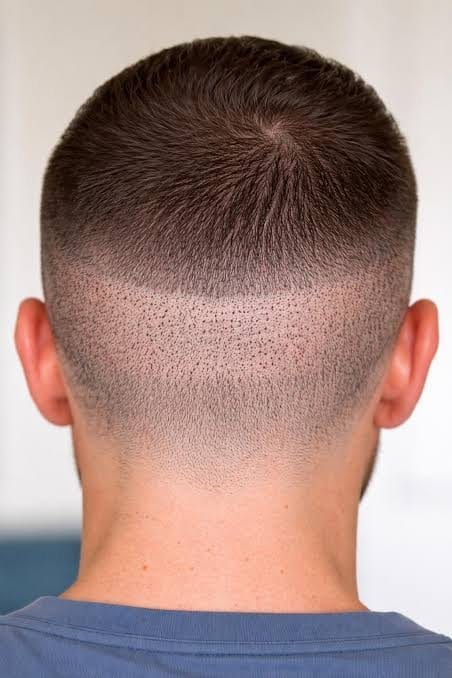
After FUE you're left with hundreds, perhaps thousands, of tiny round scars at the back of the head, and no line.
After FUE you're left with hundreds, perhaps thousands, of tiny round scars at the back of the head, and no line. Individually they are almost impossible to see. The risk lies in the total: if the clinic harvests too much, or too many times, the donor area becomes sparse and patchy, and that can't be reversed.
What do the scars look like after FUE?
Each extraction becomes a small white dot, roughly as wide as the punch, which isn't visible at a normal hair length. If you clip your hair very short and stand in harsh light, the dots can show up as a fine dotted pattern. How visible they are depends on the punch size, the number of grafts, how evenly the extractions were spread, the contrast with your skin colour and how you wear your hair.
What is the real risk with scarring after FUE?
The problem is rarely one single visible scar. It's that the back of the head as a whole looks thinner because too much was harvested, or from too small an area. The damage is permanent, since follicles that have been removed don't come back. This is the most common uncorrectable mistake in the field, and it tends to happen when someone chases a high graft count in a single session.
What makes FUE scars more visible?
Scars become more visible when more grafts are taken than the back of the head can tolerate, when extractions are clustered in a small area instead of spread out, when the punch is larger than necessary, when harvesting takes place outside the safe zone, when further procedures are done without anyone measuring the density that remains, and when you yourself scar easily.
- More grafts than the back of the head really has to give
- Extraction concentrated in a small area rather than spread out
- A punch wider than the hair requires
- Harvesting outside the safe zone, where the hair thins over time anyway
- Repeat procedures without re-measuring the remaining density
- An inherited tendency to visible scarring
How do you keep FUE scarring to a minimum?
Agree on a graft count based on measured donor density, make sure the extractions are spread evenly within the safe zone and that the punch is matched to your hair, and ask to see the back of the head of previous patients with short hair. If you want to conceal even more afterwards, scalp micropigmentation is still an option.
- A graft count based on measured density in the donor area
- Extraction spread across the whole zone considered safe
- A punch size that suits your hair
- Ask to see the donor area of previous patients with short haircuts
- Scalp micropigmentation afterwards if you'd like extra camouflage
Sources and caveats
- Rose PT. Hair restoration surgery: challenges and solutions. Clinical, Cosmetic and Investigational Dermatology, 2015;8:361-370. pubmed.ncbi.nlm.nih.gov/26203266
- Romera de Blas C, Vega Díez D, Ricart Vayá JM, Gómez Zubiaur A. Complications in follicular unit excision hair transplantation: current evidence and practical approaches. Frontiers in Medicine, 2026;13:1750989. pubmed.ncbi.nlm.nih.gov/41709896
- Zontos G, Williams KL Jr, Nikiforidis G. Minimizing injury to the donor area in follicular unit extraction (FUE) harvesting. Journal of Cosmetic Dermatology, 2017;16(1):61-69. pubmed.ncbi.nlm.nih.gov/27557792
- Kumaresan M, Deepa MS. Occipital Donor Area Grading and Profile in Indian Population. Journal of Cutaneous and Aesthetic Surgery, 2023;16(2):101-106. pubmed.ncbi.nlm.nih.gov/37554682
- Parsley WM, Perez-Meza D. Review of factors affecting the growth and survival of follicular graft. Journal of Cutaneous and Aesthetic Surgery, 2010;3(2). jcasonline.com
This article is based on published research and standard clinical practice. It provides general information and is not medical advice. Instructions from your own surgical team come first: if they tell you something different from what is written here, follow them.
Wondering what's possible for your hair?
Send three sharp photos of your hair, from the front, the top and the back. You'll get an honest answer on what can be done, roughly how many grafts it would take and what it costs.
- Free and with no obligation
- Photos are assessed by the clinic's medical team
- Replies usually within an hour in the daytime


A study tells you something about groups. Only a doctor who has seen your photos can say what applies to your hair. The medical team at the clinic at the top of our ranking offers a free assessment.
Goes to the clinic at the top of our ranking.