Failed FUE: the signs, the causes and what can be fixed
A failed result has typical signs: hair at the wrong angle, a ruler-straight hairline, multi-hair grafts right at the front, a depleted donor area and lower density than promised.
A failed result has typical signs: hair at the wrong angle, a ruler-straight hairline, multi-hair grafts right at the front, a depleted donor area and lower density than promised. Almost all of these trace back to choices made before the procedure started, not to random bad luck.
Which design errors give away a poor FUE result?
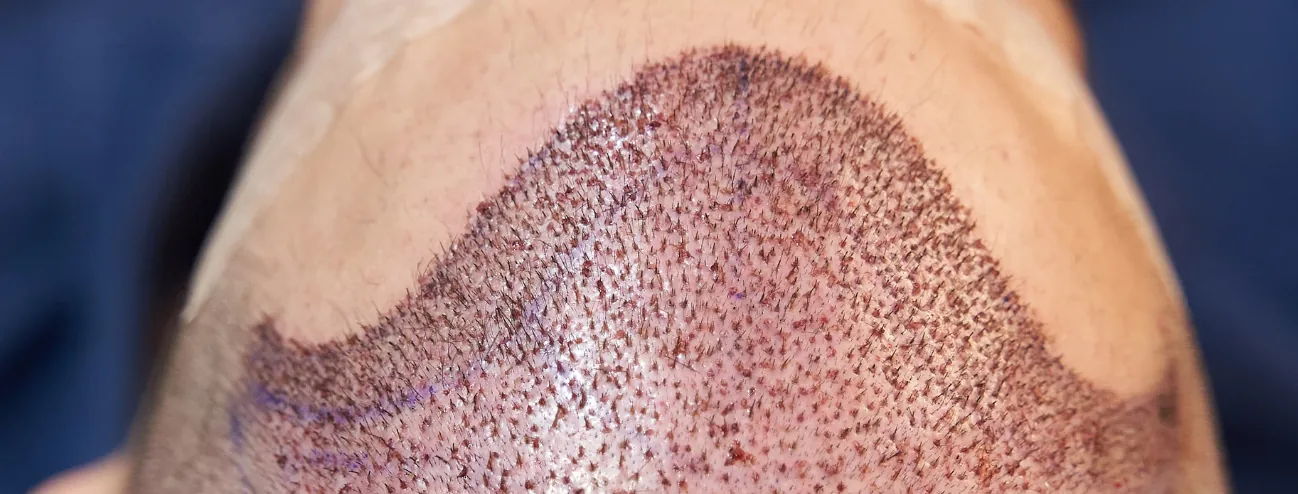
A ruler-straight hairline gives the procedure away fastest, because real hairlines are always irregular. Other design errors are a hairline set too low, which looks more and more out of place as hair loss continues, multi-hair grafts at the very front that give a tufty, plug-like look, no soft transition zone, and temples that are poorly shaped or not symmetrical.
- A ruler-straight hairline. Nothing gives the procedure away faster, because a natural hairline is always irregular
- A hairline set too low. It looks more and more wrong the more hair you lose behind it
- Grafts with two or more hairs at the very front, which give a tufty look reminiscent of old-style plugs
- No soft transition, so the density starts like a wall
- Poorly shaped temples, or a hairline that isn't symmetrical
Which technical errors ruin an FUE result?
Typical technical errors are hair at the wrong angle that stands up instead of lying flat, a crown whorl that is missing or turns the wrong way, grafts placed too deep with pits or cysts as a result, grafts placed too shallow so they stick up, and uneven distribution that leaves visible patches.
- The wrong angle, so the hair stands straight up instead of lying flat
- The whorl in the crown is missing or turns the wrong way
- Grafts placed too deep, resulting in pits or cysts
- Grafts placed too shallow, so they stick up from the skin
- Uneven distribution, which leaves visible patches
Why does less hair grow than the graft count suggests?
If growth is thin even though the clinic quoted a high number of grafts, the usual causes are transection during extraction, rough handling, grafts that spent too long outside the body or dried out, or poor incisions for them to be placed in. You can't see any of this on the day of surgery. It only shows after about twelve months. If the donor area has been over-harvested, you'll see it as lasting, even thinning at the back and sides of the head.
What can be repaired after a failed FUE procedure?
More density can usually be added if there is donor hair left. Wrong angles require the grafts to be removed and replanted, which is both demanding and expensive. If the hairline is too low, it is sometimes possible to raise it by removing grafts. A depleted donor area, on the other hand, can't be built back up, and then camouflage is the only option left.
- More density can usually be added, as long as there is donor hair left
- Wrong angles can only be corrected by removing the grafts and replanting them. That is demanding and expensive
- A hairline that sits too low can in some cases be moved up by removing grafts
- A depleted donor area can't be built back up. Then only camouflage remains
We go through what can realistically be corrected in the guide to repair.
Sources
- Epstein JS. Revision surgical hair restoration: repair of undesirable results. Plastic and Reconstructive Surgery, 1999;104(1):222-232. pubmed.ncbi.nlm.nih.gov/10597701
- Bernstein RM, Rassman WR, Rashid N, Shiell RC. The art of repair in surgical hair restoration part I: basic repair strategies. Dermatologic Surgery, 2002;28(9):783-794. pubmed.ncbi.nlm.nih.gov/12269870
- Romera de Blas C, Vega Díez D, Ricart Vayá JM, Gómez Zubiaur A. Complications in follicular unit excision hair transplantation: current evidence and practical approaches. Frontiers in Medicine, 2026;13:1750989. pubmed.ncbi.nlm.nih.gov/41709896
- Parsley WM, Perez-Meza D. Review of factors affecting the growth and survival of follicular graft. Journal of Cutaneous and Aesthetic Surgery, 2010;3(2). jcasonline.com
Here we summarise published studies and standard clinical practice. The text is intended as general information and is not medical advice. Nor does it replace the instructions from the team operating on you. If they tell you something different from what is written here, their advice applies.
Wondering what's possible for your hair?
Send three sharp photos of your hair, from the front, the top and the back. You'll get an honest answer on what can be done, roughly how many grafts it would take and what it costs.
- Free and with no obligation
- Photos are assessed by the clinic's medical team
- Replies usually within an hour in the daytime


A study tells you something about groups. Only a doctor who has seen your photos can say what applies to your hair. The medical team at the clinic at the top of our ranking offers a free assessment.
Goes to the clinic at the top of our ranking.