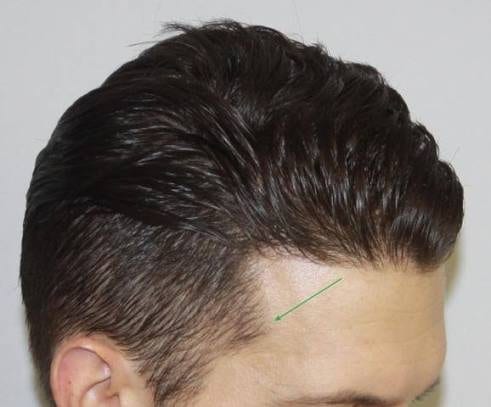
Temple points and hair transplants: a small area with high demands
The temple points frame the face, and when they disappear, most people look older than they expect.
The temple points frame the face, and when they disappear, many people look older than they had expected. They are also among the hardest places to transplant well: the hairs are fine, the angle is very flat, and there is no room for the wrong direction.
Why do the temple points matter so much for the face?
On each side of the forehead there is a small, triangular patch of hair, the temple point. They frame the face and connect the hairline to the sideburns. If they disappear, the face looks longer and older, even if the central hairline is intact, which is why a few grafts here can change the overall impression more than the number suggests.
What makes the temples difficult to transplant?

Temple hair lies almost against the skin, it is finer than scalp hair so coarse grafts stand out, and only single-hair grafts work because multi-hair grafts become visible tufts. The direction also changes over a small area, down and backwards, and the skin is thin with visible blood vessels.
- A very flat angle. The hair lies practically against the skin.
- Fine hairs. Your own temple hair is finer than scalp hair, and coarse grafts give themselves away.
- Single-hair grafts only. Multi-hair grafts immediately show as small tufts.
- Changing direction over a small area, curving down and backwards.
- Thin skin where the blood vessels show through.
How does the surgeon plan the temples?
The surgeon uses only single-hair grafts, ideally your finest donor hairs, and places them with restraint, because overfilled temples look stuck on and get worse with age. Symmetry is checked carefully, since no face is perfectly symmetrical, and with limited donor hair the surgeon weighs the temples against the central hairline.
- Single-hair grafts only, ideally from the finest donor hairs
- Restrained placement, since overfilled temples look stuck on and age badly
- A careful check of symmetry, because no face is perfectly symmetrical
- A trade-off against the central hairline when donor supply is limited
What can you expect from the result?
The temples often need a few hundred grafts on each side, and the job is more precision work than volume. The result depends entirely on the execution, because the same number of grafts can look completely natural or clearly transplanted, depending on the angles. So ask for close-up photos of temples the surgeon has done before.
Sources
- Garg AK, Garg S. Decoding Facial Esthetics to Recreate an Esthetic Hairline: A Method Which Includes Forehead Curvature. Journal of Cutaneous and Aesthetic Surgery, 2017;10(4):195-199. pubmed.ncbi.nlm.nih.gov/29491654
- Soni S, Dodia H. Marking of temporal point and lower border of temporal triangle in planning hair transplantation for male-pattern baldness. Indian Journal of Plastic Surgery, 2018;51(3):316-320. pubmed.ncbi.nlm.nih.gov/30983733
- Shapiro R, Shapiro P. Hairline design and frontal hairline restoration. Facial Plastic Surgery Clinics of North America, 2013;21(3):351-362. pubmed.ncbi.nlm.nih.gov/24017977
This article is based on published research and standard clinical practice in the field. It offers general information and is not medical advice. The instructions from the team that operates on you always come first, including where they differ from what is written here.
Wondering what's possible for your hair?
Send three sharp photos of your hair, from the front, the top and the back. You'll get an honest answer on what can be done, roughly how many grafts it would take and what it costs.
- Free and with no obligation
- Photos are assessed by the clinic's medical team
- Replies usually within an hour in the daytime


A study tells you something about groups. Only a doctor who has seen your photos can say what applies to your hair. The medical team at the clinic at the top of our ranking offers a free assessment.
Goes to the clinic at the top of our ranking.