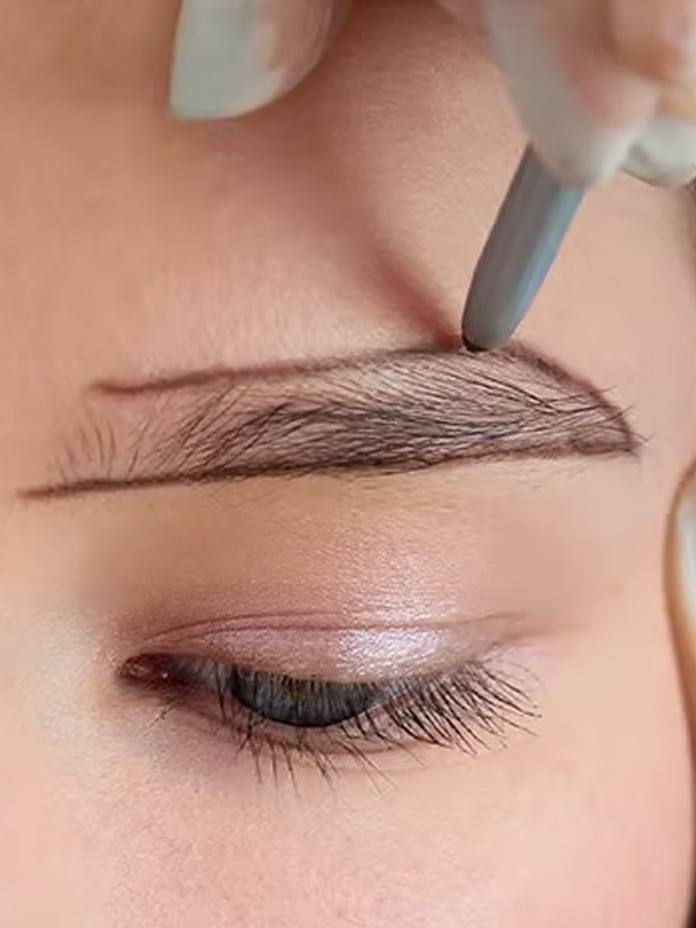
Eyebrow transplant with FUE: small area, high demands
The extraction itself is the same as in an ordinary FUE. The difficulty lies in the placement, where each hair has to be placed on its own, almost flat against the skin and in a direction that changes from the inner to the outer end of the brow.
In an eyebrow transplant, the grafts are harvested with the same FUE technique as usual. Placing them is far more demanding: single-hair grafts, an angle almost flat against the skin and a direction that changes from the inner to the outer end of the brow. The area is small, but the procedure is hard to get exactly right.
Why are eyebrows harder than the scalp?
Brow hairs lie almost flat against the skin and change direction along the brow, while scalp hair emerges at a steeper angle. At the inner end the hairs point upwards, and further out they turn to point outwards, so the surgeon has to place each graft individually and adjust the angle every few millimetres. Get the direction right, and density matters less.
What kind of grafts and donor hair does the surgeon use?
The surgeon uses single-hair grafts almost exclusively, because units with two or three hairs end up looking like small tufts in a brow. One brow typically needs up to around 200 grafts, and the donor hair is preferably taken where the scalp hair is finest, often above the ears or low on the nape of the neck.
- Single-hair grafts almost without exception, since several hairs in one graft give a tufted look
- Up to around 200 grafts per brow is common
- Donor hair taken from the finest hairs, often above the ears or at the nape of the neck
- Colour and thickness have to match more closely than in a scalp transplant
What happens in the months after the procedure?
The new brow hairs fall out and come back following the same pattern as other transplants: growth becomes visible after three to four months, growth is often complete after six to eight, and the result is assessed at twelve. Since it's scalp hair, it keeps growing like scalp hair, gets longer than normal brow hair and needs trimming roughly every other week for as long as you have it.
Trimming is the part many people underestimate. Some find it easy, others find it a constant small chore.
Who is an eyebrow transplant suitable for?
The procedure suits you best if you've lost brow hair after a lot of plucking, after a scar or an injury, or if your brows have always been thin. If you have alopecia areata (patchy hair loss), it only becomes an option once the condition has been stable for a long time, and you shouldn't have surgery while an inflammatory condition is active.
- Brows that have been over-plucked, or lost after scarring or injury
- Brows that have been thin since birth
- Alopecia areata (patchy hair loss), but only after a long, stable period
- Not while an inflammatory condition in the area is active
The guide to eyebrow transplants has more on who is suitable and what results are realistic.
Sources
- Rajput RJ. Hair Transplant for Eyebrow Restoration. Indian Journal of Plastic Surgery, 2021;54(4):489-494. pubmed.ncbi.nlm.nih.gov/34984090
- Klingbeil KD, Fertig R. Eyebrow and Eyelash Hair Transplantation: A Systematic Review. The Journal of Clinical and Aesthetic Dermatology, 2018;11(6):21-30. pubmed.ncbi.nlm.nih.gov/29942421
- Cheng H, Qi J, Zhu F, Sun Z, Jiang N, Zhang J. Periauricular hair transplantation enhances the cosmetic results of eyebrow transplantation: A retrospective study in Chinese recipients. Journal of Plastic, Reconstructive & Aesthetic Surgery, 2024;98:309-317. pubmed.ncbi.nlm.nih.gov/39321534
This text is based on published research and standard clinical practice in the field. It gives you general knowledge and is not medical advice. The instructions from the team operating on you take priority, including where they differ from what is written here.
Wondering what's possible for your hair?
Send three sharp photos of your hair, from the front, the top and the back. You'll get an honest answer on what can be done, roughly how many grafts it would take and what it costs.
- Free and with no obligation
- Photos are assessed by the clinic's medical team
- Replies usually within an hour in the daytime


A study tells you something about groups. Only a doctor who has seen your photos can say what applies to your hair. The medical team at the clinic at the top of our ranking offers a free assessment.
Goes to the clinic at the top of our ranking.