Graft angle: what makes a hair transplant look natural
The angle and direction of the hairs decide more about how natural the result looks than how densely they are packed.
For a result to look real, angle and direction count for more than density. Every area of the scalp has its own angle at which hair grows out, and grafts placed against that pattern look unnatural, however many there are.
Why is the angle so decisive?
Hairs lying the same way reflect light evenly and support each other, so the scalp looks covered. If hairs stand at random angles, they scatter the light and look artificial even when density is good. The graft has no choice either, as it grows at the angle at which the recipient site was made.
How does the angle change from the hairline to the crown?
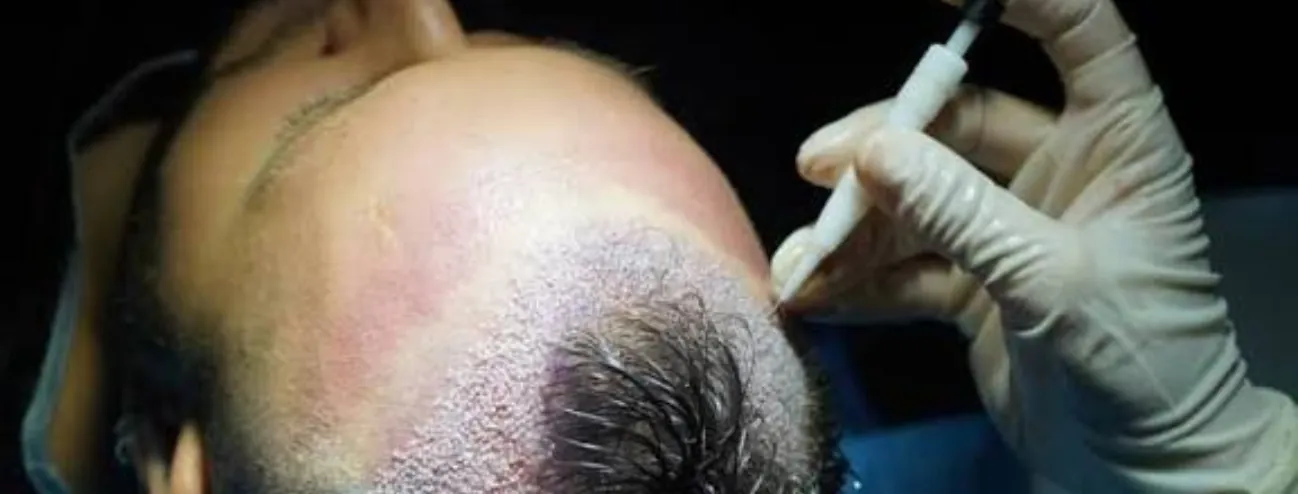
Right at the front of the hairline, hair grows at an acute angle, almost flat against the skin and pointing forwards. In the middle of the top the angle is moderate and points forwards and slightly out to the side, at the temples the hair lies very flat and points down towards the ear and backwards, and at the crown a whole whorl has to be rebuilt rather than the area being filled evenly.
- Hairline: a very low angle, almost flat to the skin, pointing forwards
- Middle of the top: a medium angle, mostly forwards and slightly to the side
- Temples: very flat, pointing down and backwards, and among the hardest areas to get right
- Crown: a whorl that has to be recreated, not an area that simply needs filling
How can you recognise poor angling?
Typical signs are hairs sticking straight up, a pluggy, doll's hair look even though single grafts were used, and a hairline that looks drawn with a pen. Other signs are a crown with no whorl or one that turns the wrong way, and hair that refuses to lie neatly in any direction.
- Hairs sticking straight up from the scalp
- A pluggy, doll's hair look, even with single grafts
- A hairline that looks drawn with a ruler rather than grown
- No whorl at the crown, or a whorl that turns the wrong way
- Hair you can't get to lie neatly however you comb it
Can a wrong angle be corrected afterwards?
No. The angle is locked in the moment the surgeon creates the recipient site, and neither styling, products nor any other treatment can change the direction in which the hair grows out of the skin. The only solution is to remove the misplaced grafts and then redo the work.
That is exactly why dedicated repair surgery exists, and why it pays to get the angles right the first time.
Sources
- Shapiro R. Principles and techniques used to create a natural hairline in surgical hair restoration. Facial Plastic Surgery Clinics of North America, 2004;12(2):201-217. pubmed.ncbi.nlm.nih.gov/15135130
- Avram M, Rogers N. Contemporary hair transplantation. Dermatologic Surgery, 2009;35(11):1705-1719. pubmed.ncbi.nlm.nih.gov/19674037
- Fan Z, Gan Y, Qu Q, et al.. A novel model for designing and performing parietal whorl hair transplantation. Journal of Cosmetic Dermatology, 2020;19(8):2011-2015. pubmed.ncbi.nlm.nih.gov/31840359
- Kim J, Wan J, Jang T, Yi KH. Natural Asymmetry in Hair Growth Direction: Implications for Hairline Design in Male Patients. The Journal of Craniofacial Surgery, 2025;36(7):e843-e845. pubmed.ncbi.nlm.nih.gov/40100127
- Gómez-Zubiaur A, Mir-Bonafé JM, Muñoz Moreno-Arrones O, et al.. FUE for the repair of unnaturally designed or low hairlines in men with androgenetic alopecia: a retrospective, multicenter observational study. Frontiers in Medicine, 2026;13:1735251. pubmed.ncbi.nlm.nih.gov/41907238
- Parsley WM, Perez-Meza D. Review of factors affecting the growth and survival of follicular graft. Journal of Cutaneous and Aesthetic Surgery, 2010;3(2). jcasonline.com
This article is based on published research and standard clinical practice in the field. It offers general information and is not medical advice. The instructions from the team that operates on you always come first, including where they differ from what is written here.
Wondering what's possible for your hair?
Send three sharp photos of your hair, from the front, the top and the back. You'll get an honest answer on what can be done, roughly how many grafts it would take and what it costs.
- Free and with no obligation
- Photos are assessed by the clinic's medical team
- Replies usually within an hour in the daytime


A study tells you something about groups. Only a doctor who has seen your photos can say what applies to your hair. The medical team at the clinic at the top of our ranking offers a free assessment.
Goes to the clinic at the top of our ranking.