Sagittal or coronal slits: which way should the recipient slit run?
Sagittal and coronal describe whether the recipient slit follows the direction of hair growth or crosses it. Respected surgeons use both, and no conclusive evidence shows that one gives a better result.
A recipient slit can either run along the hair's direction of growth (sagittal) or across it (coronal, also called lateral). The choice governs how the hairs in a graft spread out and how flat they lie. Surgeons have disagreed about this for many years, and both camps have good arguments.
What is the difference between a sagittal and a coronal slit?
A sagittal slit, often called parallel, runs in the same line as the hair grows. A coronal slit, also described as lateral or perpendicular, crosses that line. The graft is laid into the slit, and when it holds several hairs, they spread out along the length of the slit. So the direction of the slit decides which way the hairs fan out.
What are the advantages of coronal slits?
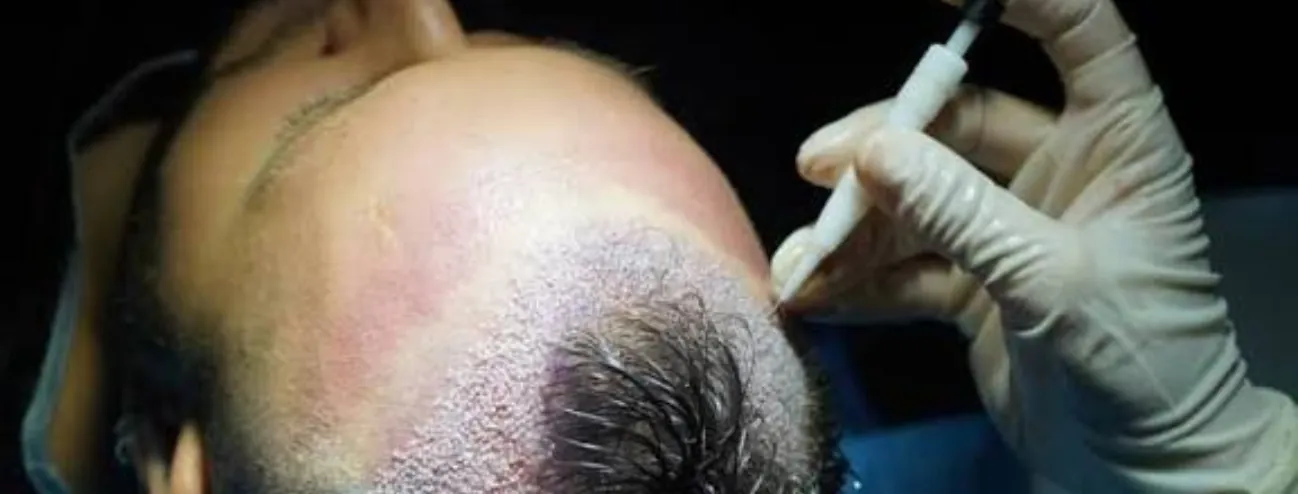
With coronal slits, the hairs in a graft spread sideways rather than forwards and backwards, which can make the coverage look wider. The hair can also lie flatter against the skin, and each graft can contribute more to the density you actually see.
- A graft with two or more hairs spreads from side to side rather than from front to back, which can make the coverage look greater
- The hair can lie closer to the scalp
- Each graft can give more visible density
What are the advantages of sagittal slits?
Sagittal slits run parallel to the hairs already growing in the area. Some surgeons believe this reduces the risk of damaging those follicles when placing grafts between thinning native hair. Many also find the angle easier to control, and the approach has many years of very good results behind it.
- The slit runs the same way as the hairs already there. Some surgeons believe this makes it less likely to hit existing follicles when filling in an area that is thinning
- Many find the angle easier to control
- The method has been used for a long time with very good results
Should slit direction decide which clinic you choose?
No. Respected surgeons use both directions, many mix them from area to area, and no conclusive evidence shows that one gives a better result. Think of the direction as the surgeon's technical habit. Far more decisive are who performs the surgery, how many grafts are transected, how long the grafts spend outside the body and how the plan allows for hair you'll lose later.
Both slit directions are among the techniques we compare in the guide to hair transplant methods.
Sources
- Unger WP. Recipient area hair direction and angle in hair transplanting. Dermatologic Surgery, 2004;30(6):829-836. pubmed.ncbi.nlm.nih.gov/15171759
- Nakatsui T, Wong J, Groot D. Survival of densely packed follicular unit graft using the lateral slit technique. Dermatologic Surgery, 2008;34(8):1016-1022. pubmed.ncbi.nlm.nih.gov/18462426
- Atodaria PR, Venkataram A, Mysore V, Atodaria KP. Optimal Hair Transplant Recipient Site Slit Design: Minimizing Vascular Damage. Indian Journal of Plastic Surgery, 2021;54(4):471-476. pubmed.ncbi.nlm.nih.gov/34984087
- Parsley WM, Perez-Meza D. Review of factors affecting the growth and survival of follicular graft. Journal of Cutaneous and Aesthetic Surgery, 2010;3(2). jcasonline.com
Here we summarise published studies and standard clinical practice. The text is intended as general information and is not medical advice. Nor does it replace the instructions from the team operating on you. If they tell you something different from what is written here, their advice applies.
Wondering what's possible for your hair?
Send three sharp photos of your hair, from the front, the top and the back. You'll get an honest answer on what can be done, roughly how many grafts it would take and what it costs.
- Free and with no obligation
- Photos are assessed by the clinic's medical team
- Replies usually within an hour in the daytime


A study tells you something about groups. Only a doctor who has seen your photos can say what applies to your hair. The medical team at the clinic at the top of our ranking offers a free assessment.
Goes to the clinic at the top of our ranking.