Crown hair transplant: why the crown is so hard to fill
The crown is large, curved and grows in a spiral. It needs more grafts than any other area of the head, and it tends to get bigger as hair loss continues.
The crown is large, curved and grows in a spiral. It uses up grafts at a rate no other part of the head matches, while the hair loss around it keeps spreading. Many surgeons deliberately push it further back in the plan, and in most cases that's good advice, not a shortcoming.
Why does the crown whorl have to be recreated?
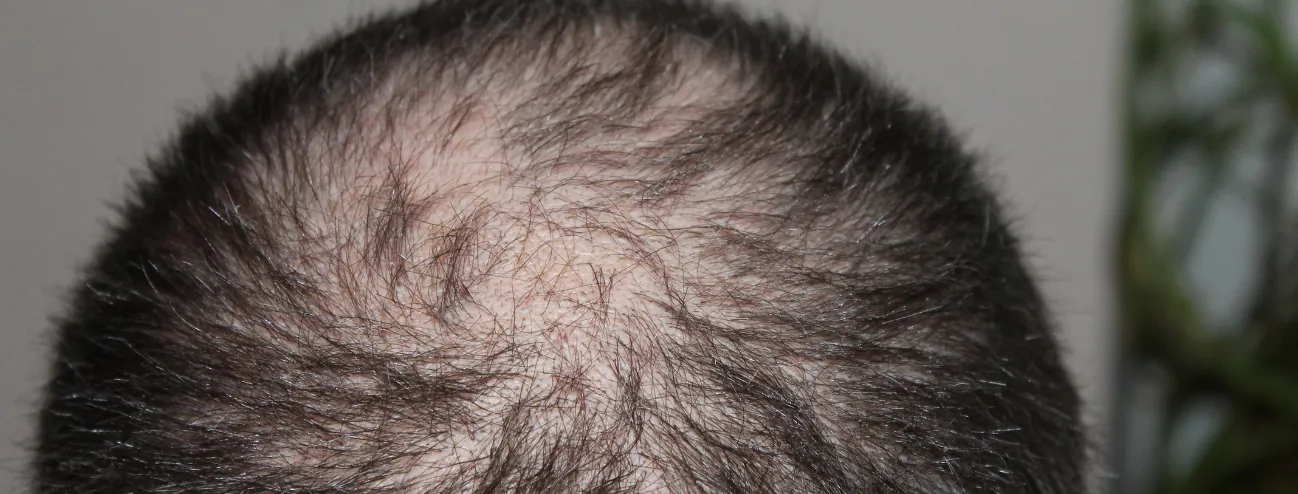
In the crown, hair grows in a spiral out from a centre point, so both angle and direction change across the whole area. The surgeon therefore has to recreate the spiral, graft by graft, and can't settle for planting an even carpet. If that fails, the crown lacks both shape and direction, and no amount of extra density can save it.
Why is the crown so hard to cover?
The crown curves outwards when seen from above and behind. Overhead light falls straight down on it, so the skin shows through more easily here than on the flatter area at the front, and you need denser hair to get the same coverage. The crown doesn't frame the face either, so each graft there gives less visible benefit than it would in the hairline.
Why is the crown a moving target?
Hair loss in the crown usually spreads outwards over the years: if you fill the crown at 35, ten years later you may have an island of hair surrounded by a growing bald ring. That looks worse than an untreated crown and costs even more grafts to correct. There's no stronger reason to hold off on the crown, especially when the patient is young.
What is a sensible strategy for the crown?
A sensible plan makes the hairline and the middle of the top the first priority, since they frame the face, and tries hair loss medication to keep the crown stable before any grafts go there. It accepts partial coverage that looks full from a distance, sets aside donor hair for the loss still to come, and can add micropigmentation, which costs less.
- Make the hairline and the middle of the top the first priority, because they frame the face
- Get the crown stable with medication before grafts are placed there
- Accept coverage that looks full, without aiming for complete restoration
- Save donor hair for the loss that may still come
- Talk to the clinic about micropigmentation, which is a cheaper add-on
You'll find more on this in the guide to crown hair transplants.
Sources
- Devroye J. Management of the crown. Facial Plastic Surgery Clinics of North America, 2013;21(3):397-406. pubmed.ncbi.nlm.nih.gov/24017981
- Goldin J, Zito PM, Raggio BS. Hair Transplantation. StatPearls (NCBI Bookshelf), 2025 (updated 2 August 2025). pubmed.ncbi.nlm.nih.gov/31613520
- Fan Z, Gan Y, Qu Q, et al.. A novel model for designing and performing parietal whorl hair transplantation. Journal of Cosmetic Dermatology, 2020;19(8):2011-2015. pubmed.ncbi.nlm.nih.gov/31840359
- Chouhan K, Roga G, Kumar A, Gupta J. Approach to Hair Transplantation in Advanced Grade Baldness by Follicular Unit Extraction: A Retrospective Analysis of 820 Cases. Journal of Cutaneous and Aesthetic Surgery, 2019;12(4):215-222. pubmed.ncbi.nlm.nih.gov/32001965
- Parsley WM, Perez-Meza D. Review of factors affecting the growth and survival of follicular graft. Journal of Cutaneous and Aesthetic Surgery, 2010;3(2). jcasonline.com
This article is based on published research and established clinical practice in the field. It gives you general knowledge and is not medical advice. The instructions from the team operating on you take precedence, including where they differ from what is written here.
Wondering what's possible for your hair?
Send three sharp photos of your hair, from the front, the top and the back. You'll get an honest answer on what can be done, roughly how many grafts it would take and what it costs.
- Free and with no obligation
- Photos are assessed by the clinic's medical team
- Replies usually within an hour in the daytime


A study tells you something about groups. Only a doctor who has seen your photos can say what applies to your hair. The medical team at the clinic at the top of our ranking offers a free assessment.
Goes to the clinic at the top of our ranking.