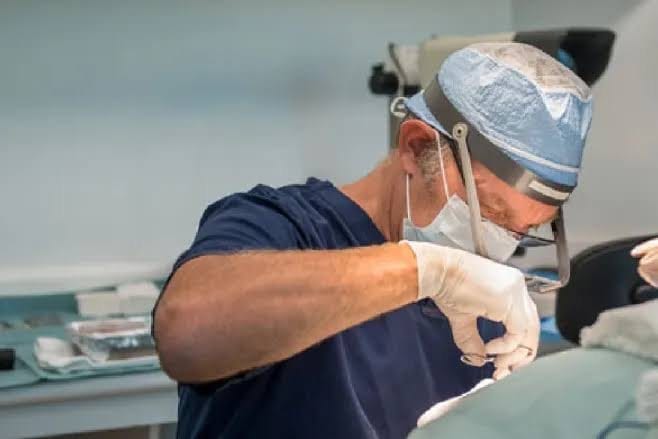
Recipient sites in a hair transplant: how the incisions are made
The incisions in the recipient area decide the angle, direction, depth and density of the hair. This is where a natural result is won or lost.
When the surgeon makes the recipient sites, the angle, direction, depth and density of every single hair are decided. The incision comes first and the graft afterwards, and a finished incision can't be moved. That's why this step decides much of how natural the result looks.
What is a recipient site?
A recipient site is the small incision in the scalp where one graft will sit. The angle of the incision gives the hair its direction of growth, the depth decides where the graft rests, and the distance to neighbouring incisions sets the density. The surgeon makes the incisions with a small blade or a needle, or with an implanter pen in DHI, where incision and implantation happen in a single movement.
What choices are made when a recipient site is created?
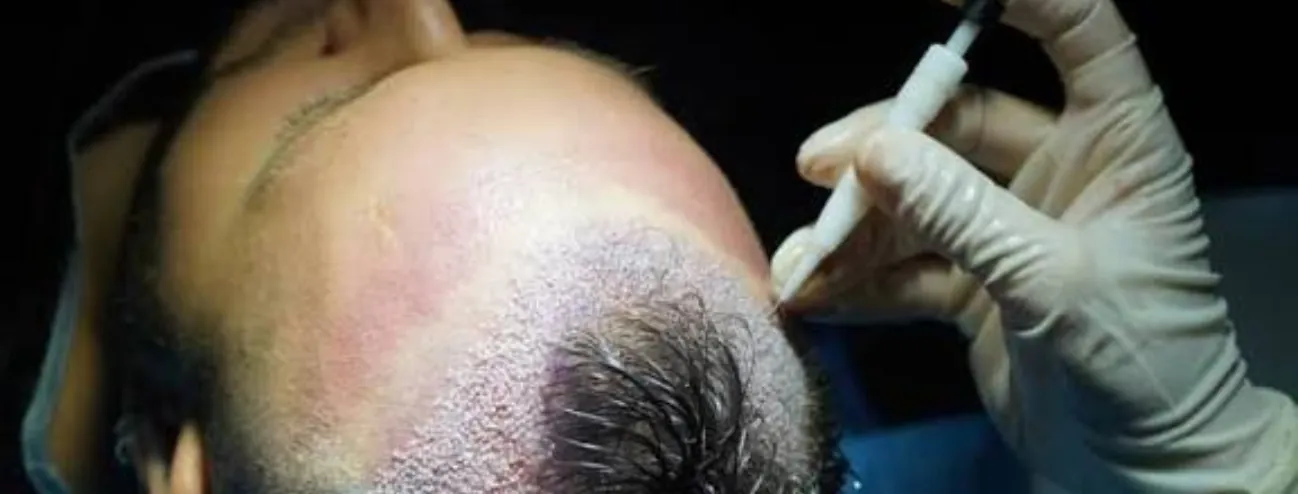
The surgeon decides the angle and direction based on the hair's natural pattern in the area, and the depth: a shallow incision lets the graft stick up, while one that is too deep can make it sink, with cysts or pits as a result. The size is matched so the graft sits without being squeezed, density is weighed against blood supply, and the tool is a blade, needle or pen.
- Angle and direction: the incision must follow the way the hair naturally grows in that exact spot.
- Depth: if the incision is too shallow, the graft sticks up above the skin. If it is too deep, the graft can sink, which brings a risk of cysts and small pits.
- Size: the incision should hold the graft firmly without squeezing it.
- Density and spacing: more coverage always has to be weighed against how much blood the area can supply.
- Tool: blade, needle or implanter pen.
How densely can recipient sites be placed?
Blood supply sets the limit. If the incisions sit too close together, they share a limited amount of blood. A 2010 review refers to a small study of a single patient in which around 98 per cent of grafts grew when 61 and 72 units per cm² were implanted. It also mentions that 100 per cm² has been implanted, without stating how many of those survived. If the surgeon packs grafts more densely than the skin can tolerate, fewer grafts survive, and the result ends up thinner rather than fuller.
Who makes the recipient sites, and why does it matter?
Usually the surgeon. Making the incisions is when the design becomes something physical in the skin, so the surgeon most often keeps this step even where technicians handle extraction and implantation. If a clinic can't give you a clear answer about who makes the incisions, ask more questions before you book.
This step is also where the different methods differ most clearly. Read more in the guide to transplant methods.
Sources
- Parsley WM, Perez-Meza D. Review of factors affecting the growth and survival of follicular graft. Journal of Cutaneous and Aesthetic Surgery, 2010;3(2). jcasonline.com
- Unger WP. Recipient area hair direction and angle in hair transplanting. Dermatologic Surgery, 2004;30(6):829-836. pubmed.ncbi.nlm.nih.gov/15171759
- Atodaria PR, Venkataram A, Mysore V, Atodaria KP. Optimal Hair Transplant Recipient Site Slit Design: Minimizing Vascular Damage. Indian Journal of Plastic Surgery, 2021;54(4):471-476. pubmed.ncbi.nlm.nih.gov/34984087
- Nakatsui T, Wong J, Groot D. Survival of densely packed follicular unit graft using the lateral slit technique. Dermatologic Surgery, 2008;34(8):1016-1022. pubmed.ncbi.nlm.nih.gov/18462426
- Romera de Blas C, Vega Díez D, Ricart Vayá JM, Gómez Zubiaur A. Complications in follicular unit excision hair transplantation: current evidence and practical approaches. Frontiers in Medicine, 2026;13:1750989. pubmed.ncbi.nlm.nih.gov/41709896
Here we summarise published studies and standard clinical practice. The text is intended as general information and is not medical advice. Nor does it replace the instructions from the team operating on you. If they tell you something different from what is written here, their advice applies.
Wondering what's possible for your hair?
Send three sharp photos of your hair, from the front, the top and the back. You'll get an honest answer on what can be done, roughly how many grafts it would take and what it costs.
- Free and with no obligation
- Photos are assessed by the clinic's medical team
- Replies usually within an hour in the daytime


A study tells you something about groups. Only a doctor who has seen your photos can say what applies to your hair. The medical team at the clinic at the top of our ranking offers a free assessment.
Goes to the clinic at the top of our ranking.