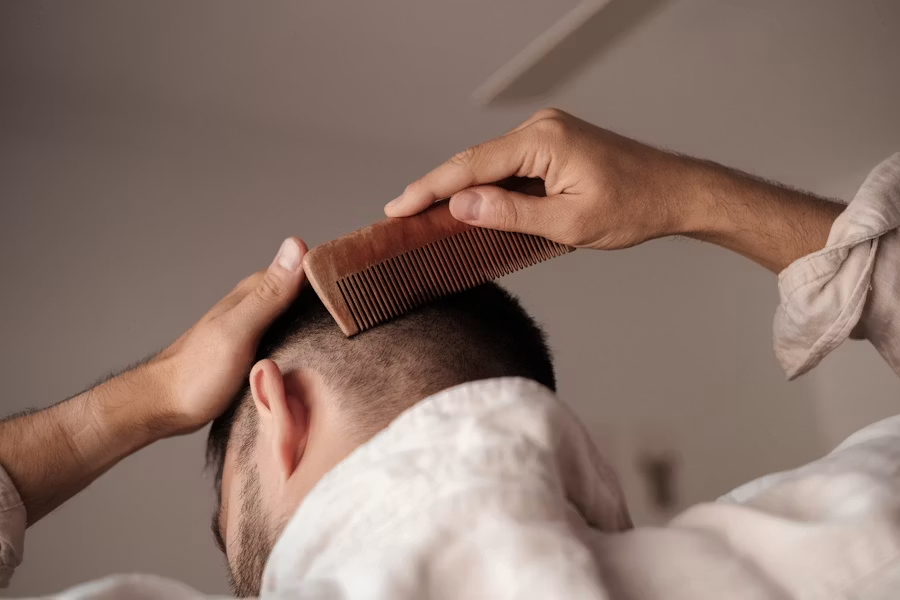
Donor capacity: how many grafts do you really have?
The hair at the back of your head is a savings account you can't pay into. Here's roughly how much you have, what happens when too much is taken, and how to make it last.
Why can't the clinic just take more hair from the back of the head?
Because the back of the head then becomes visibly thin, and that damage can rarely be repaired. Typically, a donor area gives 5,000 to 8,000 grafts over a lifetime before it looks thin. It looks as if there's plenty of hair back there, but only a certain share can be removed before the scalp shows through. Specialists call this donor depletion. The back of the head becomes sparse, and it's hard to hide with your hairstyle.
Skilled surgeons therefore work with a safe harvesting density. They extract grafts well spaced apart and leave the rest dense enough for the back of the head to still look normal. That rule decides how much can be moved for you.
How many grafts does a donor area yield over a lifetime?
Typically somewhere between 5,000 and 8,000 grafts before the donor area looks thin. Some have more, others less, depending on density and how large the area is.
The follicles at the back and sides are largely resistant to DHT, the hormone that makes the follicles on top shrink. They stay stable for life, which is why they're suitable for transplanting. But they don't grow back once they've been taken. Every graft that is moved is gone from the back of the head for good. A hair transplant redistributes hair. It doesn't create new hair.
See also do I have enough donor hair.
What happens when a clinic overharvests?
The back of the head becomes thin for good. Overharvesting is one of the most serious mistakes made at disreputable clinics, and sadly it isn't rare. To be able to write a high graft count on the quote, and send a matching bill, grafts are taken out far too densely.
Then there are no DHT-resistant hairs left to take, and a thin donor area can almost never be corrected. This is a big part of why you should choose based on the clinic, not the price. You'll find the warning signs in the guide to choosing a clinic.
Why do young patients need to think further ahead?
Because their hair loss probably isn't finished. If all the donor hair is spent on a low, boyish hairline when you're 25, you'll have nothing left when the crown starts going at 40.
A good clinic therefore deliberately leaves some in reserve at the back, and designs the hairline for a head that may lose more. How well that can be predicted is the topic of whether future hair loss can be predicted. See also causes of hair loss.
How do you make the reserve last longer?
By keeping the hair you have. That's the most effective way to stretch your donor supply. With finasteride and minoxidil you lose less of your own hair, so you need fewer grafts, both in the first round and later.
Surgery and medication are rarely an either/or. The guide to slowing hair loss without surgery covers which treatments have evidence behind them.
Can beard or body hair extend the donor area?
A little, in some cases. Some clinics harvest from the beard or body (BHT, body hair transplant) to supplement a limited donor area on the scalp. It can add a few extra grafts. The problem is that facial and body hair is built differently, feels different and grows on a different cycle from scalp hair. It rarely suits the hairline and is better used to add fullness at the crown.
So it's an add-on with clear limits, not a new unlimited source. The basic rule still applies. The reserve on your scalp runs out, and the smartest plan is to use medication to keep the hair you have, so you need less from the donor area. There's more on this in body hair as a donor source, and on choosing between beard and scalp hair in beard hair and the donor area.
What's the first step if you're considering a transplant?
Have your donor area assessed by someone who actually looks at it, not by a form. Ask for a concrete estimate of how many grafts you can safely give in total, and how many the clinic plans to use now. You can ask for a realistic assessment before you decide.
That depends on your donor area, your hair loss and your health, and a doctor needs to look at it. Send three photos and get an honest answer from the medical team at the clinic at the top of our ranking.
Goes to the clinic at the top of our ranking.