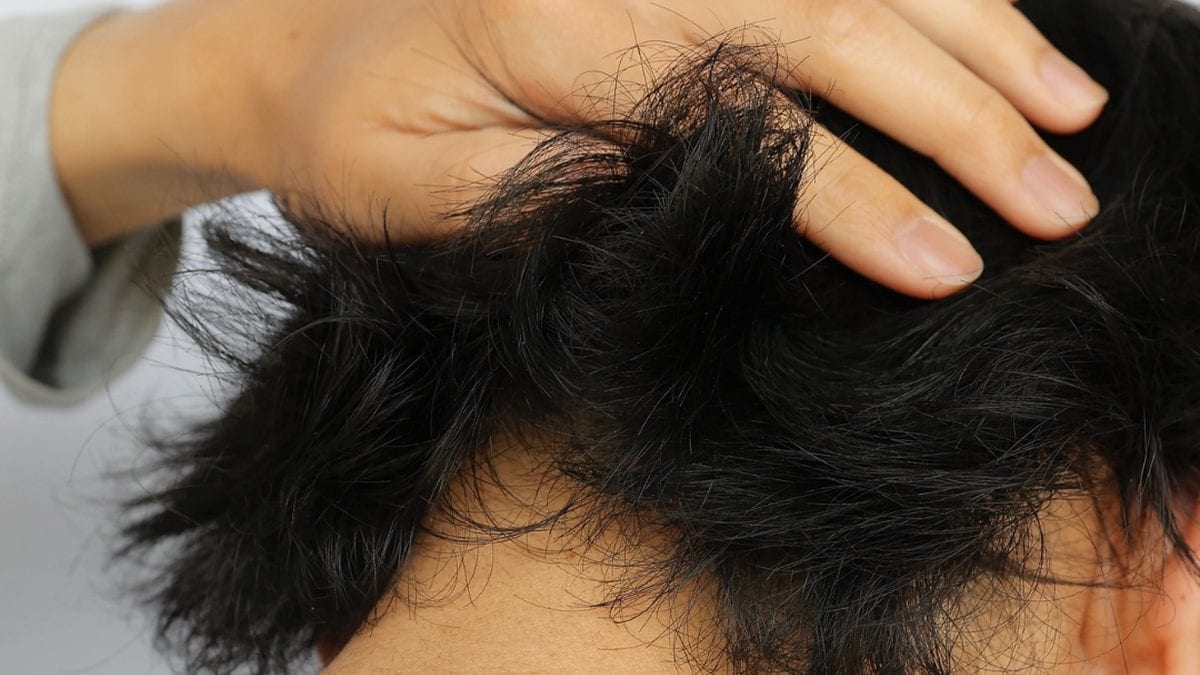
How much donor hair do you have for the rest of your life?
The surgeon multiplies the size of the safe area by the density and subtracts what must be left for the back of the head to look normal.
To estimate how much donor hair you have over your lifetime, the surgeon multiplies the size of the safe zone by the density. Then enough is subtracted for the back of the head to still look normal. The answer is a finite number, and every operation uses some of it up for good.
Does donor hair grow back after the grafts are taken?
No. Donor hair is a budget you can't top up. A follicular unit that has been taken out never comes back, so every graft in the recipient area has been withdrawn for good from a limited account. A hair transplant doesn't give you more hair. It moves hair you already have.
No idea matters more when managing the donor area, and none is skipped more often in the consultation room. When a follicular unit is taken out of the donor area, nothing new grows there. The number of units is fixed from the start, and every graft that ends up at the front of the head is gone from the stock at the back.
A transplant is a move, then, not a top-up. You don't get more hair in total. You get hair moved from a place where it isn't needed to a place where it is useful.
Well-planned surgery therefore doesn't start with the question of how many grafts you can get today. It starts with how many grafts you will need over a long life, and whether the stock will stretch that far.
How does the surgeon calculate your donor reserve?
The surgeon takes the size of the safe zone, measured in cm², and multiplies it by how many units there are in each cm². Ideally that should be more than 50. That gives the number of units you have. That figure is then multiplied by the share you can lose without the back of the head looking sparse. That gives you the realistic reserve. Clinics set that share differently, so estimates vary widely.
The calculation has three parts, and all three require judgement.
- How big the area is. The size of the safe zone in square centimetres, assessed from your pattern, your age and hair loss in your family. This is the most uncertain part, because the edges are estimated and can't be measured.
- How dense the hair is. The number of follicular units per cm², counted with a densitometer in several places. Ideally more than 50.
- How much can safely be removed. The share you can take without the donor area starting to look sparse. It is well below 100 %, because the hair left behind has to hide the gaps from the extractions.
Area times density gives the total number of units you have. Multiply that by the share that can safely be removed and you get the realistic budget for your lifetime. Surgeons make different assumptions about exactly this last part. That is why two clinics can give the same patient completely different figures.
Why is there disagreement about how large a share can be taken?
There is no percentage everyone agrees is safe, because it depends on how dense the hair is to begin with. If there are 80 units in each cm², you can lose a larger share than someone with 45 without it showing. An over-harvested donor area is a known complication of FUE and can't be repaired, alongside loss of pigment, thick scars and cysts in the skin.
After extraction, the donor area looks normal because the surrounding hair hides the small wounds. Remove too much and the remaining hair can't do that job. The back of the head looks thin, and with slightly longer hair the small, dot-shaped scars become visible.
There is no fixed limit that the specialist community has agreed on. The limit moves with the density you start with. If you start at 80 units per cm², you can give up more units, both in number and as a share, than with 45, before anyone notices.
Specialists regard an over-harvested donor area as a known complication of FUE. It is on the same list as loss of pigment, thickened scars and cysts in the skin. The risk is very real, and unlike most complications there is no repair. Follicles that have been taken are gone.
What makes your donor budget smaller?
Being young, because you probably have more hair loss ahead of you. Men in your family who have ended up at Norwood stage 6 or 7, so you have to plan for a later stage than the one you are at now. Low density, fine hair, a previous operation and diffuse thinning that already shows in the donor area also make the reserve smaller.
- You are young. A man of 25 will probably need more coverage over his lifetime than a man of 50 with the same pattern today. He simply has more hair loss ahead of him.
- Hair loss in your family is extensive. If the men on your side ended up at stage 6 or 7 on the Norwood scale, that is what you should plan for, not the stage you are at now.
- Density is low, or the hair is fine. Both mean each graft covers less.
- You have had surgery before. Previous FUE or a scar from the strip method makes the reserve smaller and can also shrink the area it is possible to take from.
- The thinning is diffuse. If there is miniaturisation in the donor area itself, the stock is smaller than a simple count would suggest.
How does a responsible surgeon plan your donor reserve?
The surgeon tells you how large a reserve you are estimated to have for life, plans for the worst pattern you could conceivably develop, prioritises the hairline and middle of the head over the crown and holds some back for later. If you are quoted a price for as many grafts as possible in one session, the focus is on today's operation. Your head at fifty has been forgotten.
If the surgeon takes your donor reserve seriously, you'll be told how large it is estimated to be for the rest of your life. You'll hear which future pattern the plan allows for in the worst case. The grafts are distributed by what matters most, typically hairline and midscalp before the crown, and some are held back for a possible later operation.
If the offer is priced on how many grafts can be harvested in one day, it is today's procedure that is in charge, not how your head looks when you are fifty. The goals are different, and only the second one serves you.
Feel free to ask this question outright: "If I lose all the hair I can lose, will I still have enough donor hair to cover it with the plan you are proposing?" The way the clinic answers says a lot about how it thinks.
Sources
- Jimenez F, Ruifernández JM. Distribution of human hair in follicular units. A mathematical model for estimating the donor size in follicular unit transplantation. Dermatologic Surgery, 1999;25(4):294-298. pubmed.ncbi.nlm.nih.gov/10417585
- Romera de Blas C, Vega Díez D, Ricart Vayá JM, Gómez Zubiaur A. Complications in follicular unit excision hair transplantation: current evidence and practical approaches. Frontiers in Medicine, 2026;13:1750989. pubmed.ncbi.nlm.nih.gov/41709896
- Maas D, et al. Rethinking the occipital scalp as a control in advanced androgenetic alopecia. Journal of the American Academy of Dermatology, 2026 (ahead of print). pubmed.ncbi.nlm.nih.gov/42398778
- Rassman WR, Bernstein RM, McClellan R, Jones R, Worton E, Uyttendaele H. Follicular unit extraction: minimally invasive surgery for hair transplantation. Dermatologic Surgery, 2002;28(8):720-728. pubmed.ncbi.nlm.nih.gov/12174065
This article summarises published research and standard clinical practice. It is meant as general information and is not medical advice. Nor does it replace the advice you get from your own surgical team. If your team tells you something different from what is written here, follow your team.
Wondering what's possible for your hair?
Send three sharp photos of your hair, from the front, the top and the back. You'll get an honest answer on what can be done, roughly how many grafts it would take and what it costs.
- Free and with no obligation
- Photos are assessed by the clinic's medical team
- Replies usually within an hour in the daytime


A study tells you something about groups. Only a doctor who has seen your photos can say what applies to your hair. The medical team at the clinic at the top of our ranking offers a free assessment.
Goes to the clinic at the top of our ranking.