How many grafts per cm² can safely be taken from the donor area?
There is no single number for how many grafts can safely be taken per square centimetre. It depends on how dense your hair is to begin with.
There is no fixed, safe extraction number. What matters is the share of units taken relative to the density you started with, and how evenly the extractions are spread. Clustered extractions in an area of average density give a worse result than evenly spread extractions where density is higher.
Why is there no fixed limit on extractions per cm²?
Because the answer depends on how dense your hair is to begin with. Take 20 units per cm² from an area with 80 and 60 remain, and nobody notices. Start at 45 and lose the same number, and you have 25 left, which looks thin. What makes sense is the share taken of the density measured on you.
Many patients ask for a concrete number for how many grafts can be taken per square centimetre. Without knowing the density you start with, there is no such number, and an answer given without that information tells you nothing.
A worked example shows why. If the back of your head has 80 units per cm² and the surgeon takes 20, 60 remain. That is enough for the area to still look untouched. If there are only 45 and the surgeon takes the same number, 25 remain. That looks clearly sparse at most hair lengths.
That is why it is the share that counts, and it has to be calculated from the density actually measured on you. If a clinic gives you an extraction density without having measured your density, the number is just decoration.
Does it matter how the extractions are spread, or only how many there are?
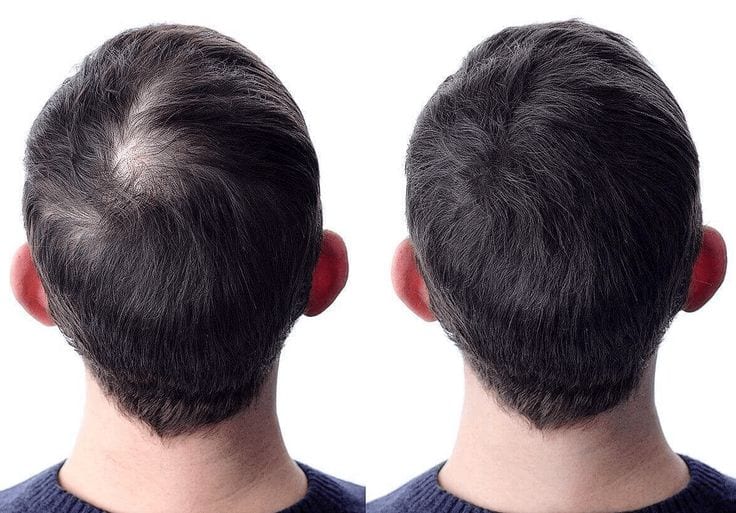
It matters a lot. Two heads that have given up the same number of grafts can look very different. Spread the extractions evenly and the area just looks a little thinner, which the eye doesn't react to. Take many grafts from the middle of the back of the head and few from the edges, and you get a patch that looks damaged. The surgeon controls the pattern, and in large, rushed sessions evenness is often the first thing sacrificed.
If two donor areas have lost exactly the same number of grafts, one can look fine and the other damaged. The difference lies in how the extractions were spread.
When extractions are spread evenly across the whole safe zone, the remaining follicles stand at regular intervals. The eye reads an evenly lower density as normal. If the surgeon instead takes most from the easiest spot in the middle of the back of the head and leaves the edges alone, the result is a patch that is clearly thinner than the hair around it. The eye picks that up straight away as damage.
Here technique and planning matter equally. The surgeon or technician decides the pattern, and when a large session has to be finished at full speed, even spacing is the first thing to go.
Which factors about you decide how densely extractions can be placed?
Most important is the density you start with. Thick hairs hide extractions better than fine ones. Dark hair on pale skin reveals thinning and scars most easily. If you wear a clipper cut, you have less margin. Curly or Afro-textured hair gives good coverage, but the extraction is more demanding. And if you have had surgery before, you start lower.
- The density you start with. This carries the most weight, as explained above.
- How thick your hairs are. Coarse hairs hide extraction sites better than fine ones. If you have fine hair, a depleted donor area will show sooner.
- The contrast between hair and skin. With dark hair and pale skin, both thinning and the white scars show more than when the colours are close together.
- How short you cut your hair. If you want to wear a number two clipper cut, the margin is much smaller than with 3 cm long hair.
- Your hair type. Curly and Afro-textured hair covers more per follicle. That helps the back of the head, even though the extraction itself is technically demanding.
- Whether you have had surgery before. If you have given up grafts before, you have less to work with, and the maths for the next session changes.
How does punch size relate to safe extraction density?
The punch diameter determines how large a scar each extraction leaves. A smaller punch leaves smaller dots that are harder to see, but the risk of cutting through the follicle rises if the surgeon isn't precise. Equipment has been developed further to resolve this trade-off. In one comparison of methods, the yield was 90.5 % with an oscillating punch and 88.3 % with a rotary punch.
The scar from each extraction is as large as the punch. Smaller punches leave smaller dots, which is good for how the back of the head looks. But they make it easier to cut through the follicle if the hand holding them isn't precise.
This trade-off has driven much of the technical development. Review articles on how FUE systems have evolved describe how punch design and mechanics have changed to deal with it. In one comparison of punching methods, an oscillating method achieved a yield of 90.5 %, against 88.3 % for a rotary one.
For the donor area, this means punch diameter is more than a technical detail. It affects how the area the grafts were taken from will look in a few years.
What should you ask the clinic about extraction density?
Ask how dense the hair in your donor area is, and how much of it the clinic wants to take. Ask how large an area the extractions will be spread over, what size punch will be used, who does the extraction and how long it takes. Also ask to see the back of the head of previous patients a year later, with short hair. That question is the most useful, because clinics that take too much will wriggle out of it.
- What donor density did you measure on me, and how much of it do you plan to remove?
- How large an area will the extractions be spread over?
- What punch diameter do you use?
- Who does the extraction itself, and how much time is set aside?
- Can I see the back of your patients' heads a year after the procedure, with short hair?
The last question tells you the most. A clinic that routinely takes too much has no such photos to show. It will steer you towards before and after photos of the hairline instead.
Sources
- Romera de Blas C, Vega Díez D, Ricart Vayá JM, Gómez Zubiaur A. Complications in follicular unit excision hair transplantation: current evidence and practical approaches. Frontiers in Medicine, 2026;13:1750989. pubmed.ncbi.nlm.nih.gov/41709896
- Kim J, Ko YU, Yi KH. The condition of hair follicles produced by different punching methods during FUE surgery. Journal of Cosmetic Dermatology, 2024;23(12):4202-4207. pubmed.ncbi.nlm.nih.gov/39152658
- Chauhan K, Tandon M, Kumar A, Taneja N, Hamid SAT. A comprehensive review of evolution of advanced follicular unit excision systems. Journal of Cutaneous and Aesthetic Surgery, 2025;18(2):69-77. pubmed.ncbi.nlm.nih.gov/40212421
- Jimenez F, Ruifernández JM. Distribution of human hair in follicular units. A mathematical model for estimating the donor size in follicular unit transplantation. Dermatologic Surgery, 1999;25(4):294-298. pubmed.ncbi.nlm.nih.gov/10417585
This article summarises published research and common clinical practice. It is meant as general information and is not medical advice. Nor does it replace the advice you get from your own surgical team. If your team tells you something different from what is written here, follow your team.
Wondering what's possible for your hair?
Send three sharp photos of your hair, from the front, the top and the back. You'll get an honest answer on what can be done, roughly how many grafts it would take and what it costs.
- Free and with no obligation
- Photos are assessed by the clinic's medical team
- Replies usually within an hour in the daytime


A study tells you something about groups. Only a doctor who has seen your photos can say what applies to your hair. The medical team at the clinic at the top of our ranking offers a free assessment.
Goes to the clinic at the top of our ranking.