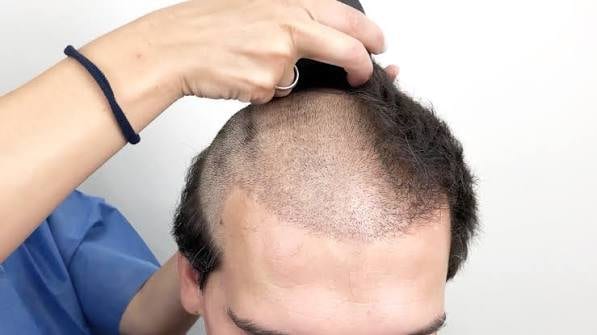
Can you shave your head after FUE?
Sometimes. It depends entirely on how many grafts were taken.
Sometimes. What decides it is how much was taken. If the donor area was harvested moderately, it can usually be clipped right down. If it was harvested hard, you'll see a paler patch and clear dots as soon as the hair is shorter than about 6 mm.
Is a shaved head always possible after FUE?
No, only under certain conditions. FUE spares you the long scar that rules out a short back after the strip method. Instead you get a large number of tiny, paler dots, and whether they show depends on how closely they are spaced and how much contrast there is between skin and hair. A shaved head is only possible if the donor area was harvested moderately. Nobody can promise it to you, whatever the advertising says.
One argument you often hear for FUE over the strip method is that you can shave your head afterwards. No claim comes up more often in FUE advertising. It is true, but only under certain conditions.
FUE does spare you the long line that makes it impossible to cut the back really short after the strip method. Instead you get a large number of tiny, paler dots spread across the back of the head. Whether anyone sees them at a given hair length depends on how close together the extractions are and how much colour contrast you have.
Put more precisely: FUE can make it possible to shave your head, provided the donor area was harvested carefully. It is not a promise. If a clinic promises you this while planning to take a record number of grafts, it is promising two things that can't both be true.
What decides how short you can go before the dots show?
The most important factor is extraction density. If only a small share of the units was taken, and spread evenly, the back of the head looks normal even with very short hair. If a lot was taken, you get a paler area. Small punches leave dots that only show at shorter lengths. Pale skin with dark hair is the hardest case. Evenly spaced extractions hide better than clustered ones. And each new session adds more dots to the same area.
- Extraction density. This matters most. If the back of the head has given up a small share of its units, evenly spread, it looks normal even when the hair is very short. If a lot has been taken, you get a clearly paler area.
- Punch diameter. The smaller the dot, the shorter the hair must be before it shows.
- Colour contrast. Pale skin with dark hair is the worst combination. When the pale dots and pale skin are surrounded by dark stubble, the eye sees a dotted, pale patch. With less contrast you get away with it more easily.
- How the extractions are spread. Evenly spaced extractions hide much better than clustered ones.
- How many sessions you've had. Each new session adds more dots to the same, limited area.
At what hair length do the dots start to show?
Nobody can give a number that applies to everyone, but the pattern is this. If the hair is longer than about 6 mm, a well-harvested area looks like untouched skin. Between 3 and 6 mm is a grey zone: careful harvesting is fine, heavy harvesting looks paler. If the hair is shorter than 3 mm, or shaved, the dots show up close, and if the extraction was heavy, you'll see the thinning at conversation distance.
There is no number that applies to everyone. If a clinic gives you one without having examined the back of your head, it is a guess. Roughly speaking, it looks like this:
- Longer than about 6 mm: If the extraction was done properly, the back of the head is in practice impossible to tell apart from untouched skin.
- About 3 to 6 mm, that is a number two to four clipper cut: This is the typical grey zone. A carefully harvested back of the head usually gets away with it. One that has given a lot starts to look paler.
- Shorter than about 3 mm, or fully shaved: Most people will have dots that show when someone looks closely. If the extraction was heavy, the thinning is visible even when you are standing talking to someone.
If being able to shave your head later matters to you, say so at the consultation, and the number of grafts has to be adjusted. It can't be sorted out afterwards.
What can you do if the donor area is already too thin to shave?
There are still some solutions. Scalp micropigmentation works best. Pigment in and around the dots reduces the contrast, and a shaved look can become possible again, but the treatment needs maintenance. Letting your hair grow costs nothing and helps straight away. Grafts from the beard or body can add density, but they use up even more of the reserve.
If you find out after surgery that a shaved head is no longer an option, you have few choices. But you do have some.
- Scalp micropigmentation works best. Pigment placed in and around the dots reduces the contrast, and you can go back to a shaved or very short look. It is a tattoo that needs topping up, but for exactly this problem it works well.
- Let your hair grow longer. It costs nothing and helps straight away.
- Beard or body hair can be implanted into the thin area to add density. The price is that you use up even more of your donor reserve.
What should you ask before FUE if you want to be able to shave your head later?
Ask straight out: "With my density and the number of grafts you are proposing, will I be able to have a number two clipper cut afterwards?" Then ask for photos the surgeon has taken personally of patients' donor areas twelve months on, clipped short. Careful clinics have such photos and are happy to show them. If the clinic replies "yes, FUE doesn't leave scars", that is a warning sign, not reassurance.
Sources
- Rassman WR, Bernstein RM, McClellan R, Jones R, Worton E, Uyttendaele H. Follicular unit extraction: minimally invasive surgery for hair transplantation. Dermatologic Surgery, 2002;28(8):720-728. pubmed.ncbi.nlm.nih.gov/12174065
- Romera de Blas C, Vega Díez D, Ricart Vayá JM, Gómez Zubiaur A. Complications in follicular unit excision hair transplantation: current evidence and practical approaches. Frontiers in Medicine, 2026;13:1750989. pubmed.ncbi.nlm.nih.gov/41709896
- Chauhan K, Tandon M, Kumar A, Taneja N, Hamid SAT. A comprehensive review of evolution of advanced follicular unit excision systems. Journal of Cutaneous and Aesthetic Surgery, 2025;18(2):69-77. pubmed.ncbi.nlm.nih.gov/40212421
- Kim J, Ko YU, Yi KH. The condition of hair follicles produced by different punching methods during FUE surgery. Journal of Cosmetic Dermatology, 2024;23(12):4202-4207. pubmed.ncbi.nlm.nih.gov/39152658
This article summarises published research and common clinical practice. It is meant as general information and is not medical advice. Nor does it replace the advice you get from your own surgical team. If your team tells you something different from what is written here, follow your team.
Wondering what's possible for your hair?
Send three sharp photos of your hair, from the front, the top and the back. You'll get an honest answer on what can be done, roughly how many grafts it would take and what it costs.
- Free and with no obligation
- Photos are assessed by the clinic's medical team
- Replies usually within an hour in the daytime


A study tells you something about groups. Only a doctor who has seen your photos can say what applies to your hair. The medical team at the clinic at the top of our ranking offers a free assessment.
Goes to the clinic at the top of our ranking.