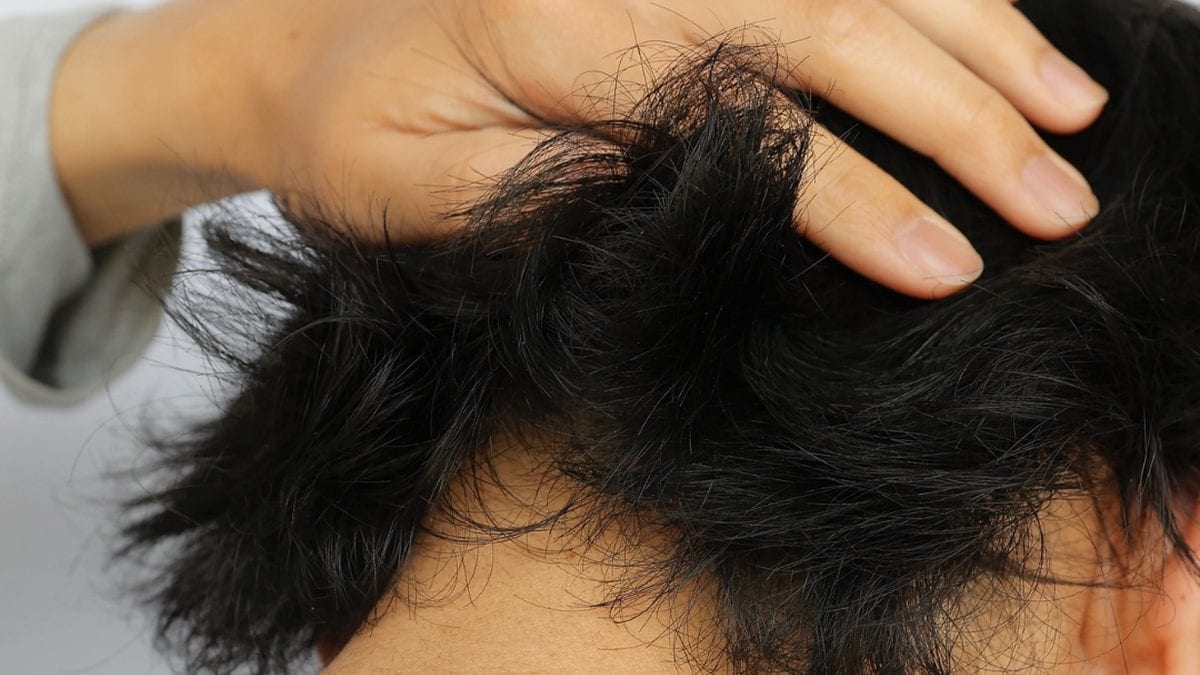
Linear scar or dot scars: FUT and FUE seen from the back
FUT leaves one long line across the back of your head. FUE leaves hundreds or thousands of tiny dots.
FUT leaves one long line across the donor area. FUE leaves hundreds, perhaps thousands, of small round dots. Both methods scar, and which one suits you best comes down almost entirely to how short you want to cut your hair in the years ahead.
How do FUT and FUE harvest donor hair?
In FUT, also called the strip method, a horizontal, elongated strip of skin is cut from the back of the head and the wound is stitched or stapled into one long scar. In FUE the units are removed one by one with a small punch, as Rassman, Bernstein and colleagues described in 2002. These wounds are not closed, and each one becomes a small, round dot spread across the donor area.
Both methods take follicular units from the same safe zone at the back of the head. The difference lies in how they do it.
In FUT (follicular unit transplantation), also called the strip method, the surgeon cuts out an elongated strip of skin across the back of the head. The wound is stitched or stapled closed, and the strip is divided under a microscope into individual follicular units. You are left with one long scar line running from side to side.
In FUE (follicular unit extraction), the units are removed one at a time with a small punch. Rassman, Bernstein and colleagues described the technique in 2002. The holes are not stitched. Each one heals by itself into a small, round dot, so you end up with many small scars spread across the donor area.
How do the two types of scar change over the years?
A well-stitched FUT line can't be seen under medium-length hair. But it is continuous, it can widen over time, and it limits how short you can cut the back of your head. Each FUE dot is invisible when the extractions aren't too close together, but the dots cover the whole area. If the donor area has been heavily harvested, you'll see a scattered thinning when you shave or use a number one clipper.
The FUT line
When the strip method goes well, the scar becomes a thin line, often just a couple of millimetres wide, and nobody can see it under medium-length hair. The problem is that it is continuous. Whether it stretches depends on how elastic your scalp is, how the surgeon stitches, how tightly the wound is closed and how you yourself scar. If it does stretch, the line becomes a wider band, and you need longer hair to hide it.
In practice this means that most people who have had the strip method cannot have the back cut very short. That limit is lifelong, not something that passes.
The FUE dots
FUE spreads the scars out. Each dot is small, and as long as the extraction density is moderate, they are invisible under hair of normal length. The weakness is the mirror image of the strip's. The scars lie across the whole donor area rather than along one line, so once they show, they show everywhere.
With a number one clipper cut or a shaved head, a heavily harvested FUE area can look like an even thinning across the whole back of the head. So the claim that you can shave your head after FUE is only true under certain conditions. It depends on how hard the donor area was harvested.
What question really decides whether FUT or FUE suits you?
The hair length you picture for the next twenty years. If you could see yourself cutting your hair very short, FUE with careful density is the safest, and the strip method is a poor fit. If you always wear medium length, both work, and a strip scar that stays completely hidden is then a real advantage. If you need a very large number of grafts over time, the methods are often combined.
Ask yourself this: what hairstyle do I picture in ten and twenty years?
- Perhaps very short, or shaved: Choose FUE with careful extraction density, and accept that the number of grafts has to be kept down. The strip method is the wrong choice.
- Always medium length, and that won't change: Both methods work, and nobody will ever see the strip scar. In that case FUT has some advantages worth weighing up.
- A need for a very large number of grafts over your lifetime: Many surgeons use both methods across several sessions. For example, they take a strip first and use FUE later, or the other way round.
Which advantages of FUT get forgotten in the scar debate?
Two things are rarely mentioned. FUT takes a defined strip from the area where the hair is densest instead of spreading the extractions, and some surgeons believe this preserves the look of the donor area better when the need is large. The follicles are also dissected under a microscope rather than blindly with a punch. On the other hand, FUT needs stitches, takes longer to heal, can leave a stretched scar and numbness, and sets a permanent limit on hair length.
FUE has taken over most of the market. Part of the reason is clinical, part of it is sales. Two aspects of FUT are rarely mentioned to patients, and they deserve to be said.
The first is that the strip method doesn't spread extraction across the whole donor area. It removes one defined strip where the hair is densest and leaves the rest alone. When the need for grafts is very large, some surgeons believe the back of the head then looks more untouched.
The second is that the follicles in a strip are cut out while the surgeon can see them under the microscope. With FUE the punch goes in without the follicle beneath the skin being visible. That affects how many are cut through.
On the other hand, the FUT wound has to be stitched, healing takes longer and is more painful, the scar can stretch, the donor area can become numb, and you have to live with a limit on how short you can cut your hair.
Which sales claims about scarring don't hold up?
FUE is not scarless. It actually leaves more scars than FUT, but each one is small and they are spread out. Nor is FUT outdated. Many experienced surgeons still choose it when a patient needs as many grafts as possible over a lifetime. What you really have to decide is which weakness you can best live with: a line you have to keep hidden, or a thinning that shows if you cut your hair very short.
No claim in the field is more misleading than the idea that FUE is "scarless". FUE gives you more scars than FUT, even though each one is small and they are spread over a larger area.
Nor is it true that FUT is outdated. Experienced surgeons still use the method, especially for people who need as much donor hair as possible over their lifetime and always keep some length in their hair.
So ask yourself which weakness you would rather live with, and stop looking for the best method in theory. The choice is between a line you have to keep covered and a scattered thinning that appears if you cut your hair very short.
The type of scar you get follows from the method. We compare the methods in our overview of transplant methods.
Sources
- Rassman WR, Bernstein RM, McClellan R, Jones R, Worton E, Uyttendaele H. Follicular unit extraction: minimally invasive surgery for hair transplantation. Dermatologic Surgery, 2002;28(8):720-728. pubmed.ncbi.nlm.nih.gov/12174065
- Romera de Blas C, Vega Díez D, Ricart Vayá JM, Gómez Zubiaur A. Complications in follicular unit excision hair transplantation: current evidence and practical approaches. Frontiers in Medicine, 2026;13:1750989. pubmed.ncbi.nlm.nih.gov/41709896
- Chauhan K, Tandon M, Kumar A, Taneja N, Hamid SAT. A comprehensive review of evolution of advanced follicular unit excision systems. Journal of Cutaneous and Aesthetic Surgery, 2025;18(2):69-77. pubmed.ncbi.nlm.nih.gov/40212421
- Jimenez F, Ruifernández JM. Distribution of human hair in follicular units. A mathematical model for estimating the donor size in follicular unit transplantation. Dermatologic Surgery, 1999;25(4):294-298. pubmed.ncbi.nlm.nih.gov/10417585
This article summarises published research and common clinical practice. It is meant as general information and is not medical advice. Nor does it replace the advice you get from your own surgical team. If your team tells you something different from what is written here, follow your team.
Wondering what's possible for your hair?
Send three sharp photos of your hair, from the front, the top and the back. You'll get an honest answer on what can be done, roughly how many grafts it would take and what it costs.
- Free and with no obligation
- Photos are assessed by the clinic's medical team
- Replies usually within an hour in the daytime


A study tells you something about groups. Only a doctor who has seen your photos can say what applies to your hair. The medical team at the clinic at the top of our ranking offers a free assessment.
Goes to the clinic at the top of our ranking.