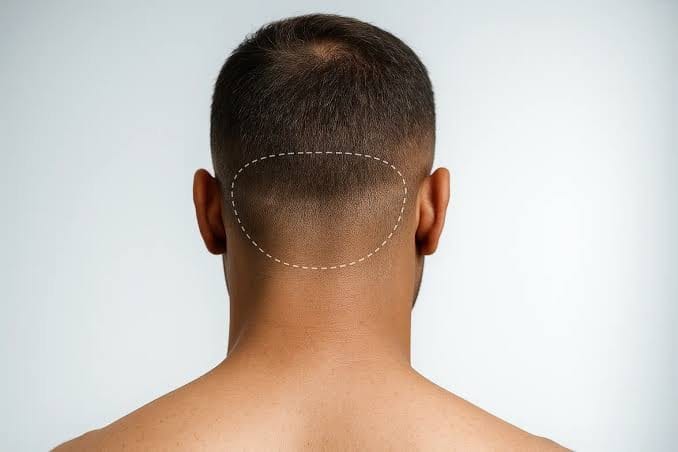
Does FUE punch size affect the scars at the back of your head?
Yes. Every graft taken with FUE leaves a small, colourless dot about as wide as the punch.
After each FUE extraction, a small, round, colourless dot is left behind, roughly as wide as the punch. The smaller the punch, the less visible the dots, but the surgeon then has to be more precise. Balancing small scars against the risk of cutting through the follicle is at the very heart of donor area extraction technique.
What does the punch do when grafts are taken with FUE?
The punch is a small, tube-shaped instrument that cuts a circle around each follicular unit so it comes free of the surrounding tissue. Rassman, Bernstein and colleagues described the method in 2002 as a minimally invasive procedure. The wound goes through the full thickness of the skin and heals into a small, round dot, usually slightly paler than the rest of the skin. These dots are what you see as white spots.
In FUE, the surgeon cuts around each follicular unit with a thin, cylindrical punch. The unit then comes loose and can be pulled out. The method was presented by Rassman, Bernstein and colleagues in 2002 in the journal Dermatologic Surgery. They called it minimally invasive hair transplantation, because the grafts were harvested with small punches instead of by cutting out a strip of skin.
The punch leaves a small, circular hole through the full thickness of the skin. It closes without stitches and becomes a tiny scar, in most people slightly paler than the surrounding skin. If you cut your donor hair very short, these white dots are what show.
There will always be some scarring. What separates one result from another is the size of each dot, how many dots there are, and how well the surrounding hair hides them.
What do you gain and lose with small and large punches?
Small punches leave small dots and less total wound area, so you can cut your hair shorter. In return they have to be placed with complete precision, or the risk of cutting through the follicle rises. Large punches are more forgiving, giving fewer damaged grafts and more protective tissue around each graft, but the scars and the total wound area are larger. No one size suits everyone.
The punches in common use differ by only a few tenths of a millimetre in diameter. Even so, the difference between the smallest and the largest is noticeable, in both directions.
Small punch
A small punch leaves small dots and less total wound area over a session. The back of the head can then take a shorter cut. The price is less room for error. The punch has to hit the centre of the unit at the right angle, because the distance between the cutting edge and the follicles is small. If it misses, the follicle is cut through instead of freed. This is called transection. The graft is lost, and you have a wound with nothing to show for it.
Large punch
A large punch is more forgiving. The extra space absorbs small errors in placement, fewer follicles are cut through, and the grafts carry more surrounding tissue with them. Some surgeons believe this protects them during handling. The downside is that each extraction leaves a larger scar, and the total wound area is greater.
What is right depends on how precise the person operating is, what your hair and skin are like, and how short you want to wear your hair.
Why isn't the smallest punch always best?
Because a punch that is too narrow for the hair cuts into the edge of the follicle. Thick hairs, large follicular units and curved follicles need more room, and a transected follicle produces no hair. The right size follows your hair, not a number in an advert.
The right diameter follows your hair, not a number in an advert. Thick hairs need a wider punch than fine ones, and follicular units of three or four hairs take up more space than single hairs. Afro-textured hair has a curved follicle under the skin and needs extra clearance. If the punch is too narrow for the hair, more follicles are cut through, and a transected follicle produces no hair.
If a clinic advertises the smallest punch for everyone, it has made up its mind before seeing your hair. It is also a sign that the race to quote the lowest possible number isn't always in the patient's best interest.
Has newer equipment made the choice between scarring and safety easier?
Yes, to some extent. New punch shapes and drive mechanics aim to give small scars without the risk of a small punch. In a 2024 comparison, the methods gave a yield of 90.5 % with an oscillating and 88.3 % with a rotary technique. A case series published in 2026, using a flared ring punch, reported that 3 % of grafts were transected on average. That figure comes from one small series with no comparison group.
Much of the development of FUE equipment has been about combining small scars with low risk. Reviews of advanced extraction systems track one generation after another, with new punch shapes and new ways of driving them, all aimed at this balance.
In a 2024 comparison, an oscillating punching method gave a yield of 90.5 %, while a rotary one gave 88.3 %. That gives an idea of how much such design choices matter. The differences are real, but modest.
A 2026 case series described a modified no-shave technique in which the surgeon used a flared ring punch. On average, 3 % of grafts were transected. The figure comes from a handful of patients with no comparison against other methods. It shows what one technique achieved in one published case. It is not a standard to measure others against.
What decides how visible the dot scars are on you?
The number of extractions counts, because small dots add up when volume is high. Spread evenly, they hide better than in clusters. The dots show most when the skin is pale and the hair dark. Some people heal with thicker scars, but that is uncommon. And in practice, the hair length you choose matters most of all.
Punch diameter is only one of several factors, and it doesn't decide the result on its own.
- How many extractions are made. Even small dots add up to a lot of wound when the number of grafts is very high.
- How they are spread. Evenly spaced dots blend into normal density. Dots grouped in clusters don't.
- Colour contrast. The white dots show most on pale skin with dark hair above.
- How your skin heals. Some people lose more pigment from the scar than others. Thickened scars in the donor area do occur, but rarely.
- How short you cut your hair. In everyday life, this is what mostly decides whether anyone ever sees the dots.
What should you ask about punch size and transected grafts before FUE?
Ask what punch diameter the clinic will use on your hair type, and why. Ask what proportion of transected grafts they aim for, and whether they count the grafts extracted and the grafts implanted separately. Also ask whether they change size in different parts of the donor area. Ask to see the back of the head of previous patients a year later, with a clipper cut. And if you want to be able to shave your head in future, the surgeon needs to know.
- What size punch do you use on hair like mine, and why do you choose it?
- What proportion of transected grafts do you consider acceptable?
- Do you count the grafts extracted and the grafts implanted separately?
- Do you change size in different parts of the donor area, and how do you harvest the widest follicular units?
- Can I see the donor area of previous patients after twelve months with a clipper cut?
If you want to keep the option of very short hair open, you need to say so at the consultation. The plan should look different then, and the surgeon can't read it from a photo of how you wear your hair today.
Sources
- Rassman WR, Bernstein RM, McClellan R, Jones R, Worton E, Uyttendaele H. Follicular unit extraction: minimally invasive surgery for hair transplantation. Dermatologic Surgery, 2002;28(8):720-728. pubmed.ncbi.nlm.nih.gov/12174065
- Chauhan K, Tandon M, Kumar A, Taneja N, Hamid SAT. A comprehensive review of evolution of advanced follicular unit excision systems. Journal of Cutaneous and Aesthetic Surgery, 2025;18(2):69-77. pubmed.ncbi.nlm.nih.gov/40212421
- Kim J, Ko YU, Yi KH. The condition of hair follicles produced by different punching methods during FUE surgery. Journal of Cosmetic Dermatology, 2024;23(12):4202-4207. pubmed.ncbi.nlm.nih.gov/39152658
- Brigante R, Wells A. Direct No-Shave Follicular Unit Excision (DNS FUE): A Modified Technique and Case Series. Cureus, 2026;18(1):e102271. doi.org/10.7759/cureus.102271
- Romera de Blas C, Vega Díez D, Ricart Vayá JM, Gómez Zubiaur A. Complications in follicular unit excision hair transplantation: current evidence and practical approaches. Frontiers in Medicine, 2026;13:1750989. pubmed.ncbi.nlm.nih.gov/41709896
- Jiménez-Acosta F, Ponce-Rodríguez I. Follicular Unit Extraction for Hair Transplantation: An Update. Actas Dermo-Sifiliográficas, 2017;108(6):532-537. pubmed.ncbi.nlm.nih.gov/28483047
- Rose PT. Hair restoration surgery: challenges and solutions. Clinical, Cosmetic and Investigational Dermatology, 2015;8:361-370. pubmed.ncbi.nlm.nih.gov/26203266
- Ahmad M. Comparison of tissue loss by different punches: A new A-design. Journal of Cosmetic Dermatology, 2019;18(1):303-307. pubmed.ncbi.nlm.nih.gov/29921001
- Park JH, You SH. Various Types of Minor Trauma to Hair Follicles During Follicular Unit Extraction for Hair Transplantation. Plastic and Reconstructive Surgery Global Open, 2017;5(3):e1260. pubmed.ncbi.nlm.nih.gov/28458974
- Parsley WM, Perez-Meza D. Review of factors affecting the growth and survival of follicular graft. Journal of Cutaneous and Aesthetic Surgery, 2010;3(2). jcasonline.com
This article summarises published research and common clinical practice. It is meant as general information and is not medical advice. Nor does it replace the advice you get from your own surgical team. If your team tells you something different from what is written here, follow your team.
Wondering what's possible for your hair?
Send three sharp photos of your hair, from the front, the top and the back. You'll get an honest answer on what can be done, roughly how many grafts it would take and what it costs.
- Free and with no obligation
- Photos are assessed by the clinic's medical team
- Replies usually within an hour in the daytime


A study tells you something about groups. Only a doctor who has seen your photos can say what applies to your hair. The medical team at the clinic at the top of our ranking offers a free assessment.
Goes to the clinic at the top of our ranking.