Norwood stage and donor reserve: plan for the worst pattern
The plan has to fit the head you may have in twenty years, not just the head you have now.
A good plan allows for the hair loss you may not have had yet. When the donor reserve is measured against the worst Norwood stage you could plausibly reach, the result keeps looking good over the years. When it's measured against today's stage, many end up with a nice hairline in front of a bare crown.
Why does planning around your current Norwood stage go wrong?
Because inherited hair loss carries on after surgery. If you're at Norwood 3 at thirty, you may be at Norwood 5 or 6 at fifty, and a patient who spends his reserve on a low, dense hairline early may have a bare crown and an empty donor area by his mid-forties.
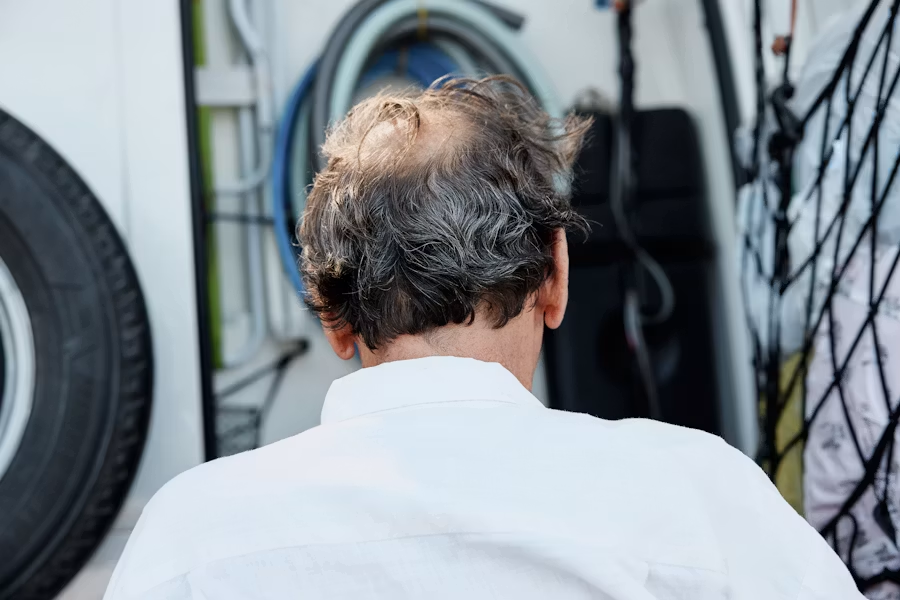
Androgenetic alopecia, inherited hair loss, doesn't stand still. Norwood 3 at thirty can become Norwood 5 or 6 at fifty. It's the end pattern, not the starting point, that decides how much scalp needs covering over a lifetime.
Even so, it's tempting to plan around what's in the mirror today. It feels logical, but it's the field's most common recipe for a poor end result. The patient uses most of his reserve in his early thirties building a dense hairline low on the forehead. At around forty-five he still has that hairline. Behind it, the crown has opened up, and there are no grafts left to fill it.
So the consultation should turn on a different question from what you've already lost: how much could I end up losing, and is my reserve enough to cover a reasonable estimate of that?
What information is used to estimate your worst Norwood stage?
The surgeon weighs your age, how far and how fast your hair loss has progressed, hair loss in your family on both sides, signs of miniaturisation under magnification and how you respond to medical treatment. None of these gives a sure answer on its own, but together they give a realistic range.
- Age. If hair loss starts early, it has more time to progress, and the range of possible end patterns widens.
- Stage and speed. How quickly you've moved from one stage to the next tells you something, even though the speed varies a lot between people.
- Hair loss in the family. Look at both your mother's and your father's side. If the men in your family have ended up at Norwood 6, that's the number the plan should allow for, wherever you are today.
- Miniaturisation under magnification. Trichoscopy reveals hairs that are getting thinner in areas that look normal to the naked eye. That lets the surgeon see which way your hair loss is heading long before the mirror does.
- Response to medication. If your hair loss is held steady with treatment, the risk looks different from someone who uses nothing. The caveat is that treatment may be stopped.
How does the surgeon work out whether the reserve covers the worst pattern?
The surgeon calculates your lifetime reserve from the size of the safe zone, its density and how much of it can be used, and sets it against the area that needs covering at the worst likely pattern. If the numbers don't add up, the plan has to cover less, accept lower density, take grafts from the beard or body or lean on medication.
The exercise itself is simple to describe. The surgeon estimates how many grafts you can use over your whole lifetime, based on the size of the safe zone, the measured density and the share that can realistically be extracted. Then she estimates the area that needs covering if you end up at the worst likely pattern, and checks whether the numbers meet at a density that looks good.
In young patients with a lot of hair loss in the family, they often don't. Then something has to give. The plan can cover a smaller area, accept slightly lower density, add hair from the beard or body, or rely on medical treatment to keep your own hair so fewer grafts are needed.
Pretending the numbers add up isn't an option. If a 27-year-old whose father and uncles are at Norwood 6 sits in the consultation, and the clinic prices a large first session without a word about where his hair loss may end up, it has either skipped the calculation or chosen to keep the answer to itself.
In what order are areas prioritised when the reserve is limited?
The front hairline and front third come first, ideally with a mature hairline that saves grafts. The middle of the scalp comes next, and the crown last or never, because that's where the need grows fastest.
The order isn't arbitrary, and it's useful to know when the reserve won't stretch to everything.
- The front third first. The front frames the face, and it's what people see first. A dense front and a thin crown look like perfectly normal hair on an adult man. The reverse doesn't.
- A mature hairline. If the line sits a little higher, the area is smaller, fewer grafts are needed and it still suits you at sixty. A low, aggressive hairline is the most expensive design choice you can make.
- The middle of the scalp next.
- The crown last, or never. The crown is round, so the area to cover grows faster than its diameter. In many men it also keeps growing for decades. Several cautious surgeons simply don't operate on the crown in young men.
Which questions show whether the clinic has planned for your worst pattern?
Ask which Norwood stage the plan is based on and why, how large your lifetime reserve is estimated to be, and whether the plan holds if you lose everything you can lose. Also ask how many grafts are being saved for later and how the design copes if your crown thins in ten years.
- Which Norwood stage is the plan based on, and why did you choose it?
- How large is my estimated lifetime donor reserve?
- Does the plan hold if I end up losing everything I can lose?
- How many grafts are you saving for a possible later session?
- What happens to the design if my crown starts thinning in ten years?
If the surgeon has done her homework, the answers come without hesitation, because these are questions she has already asked herself. If she hasn't, the conversation will drift towards how much you can get out of the first session.
Sources
- Maas D, et al. Rethinking the occipital scalp as a control in advanced androgenetic alopecia. Journal of the American Academy of Dermatology, 2026 (ahead of print). pubmed.ncbi.nlm.nih.gov/42398778
- Jimenez F, Ruifernández JM. Distribution of human hair in follicular units. A mathematical model for estimating the donor size in follicular unit transplantation. Dermatologic Surgery, 1999;25(4):294-298. pubmed.ncbi.nlm.nih.gov/10417585
- Xu Y, et al. Case Report: Paired vertex-occipital assessment reveals donor-area involvement in diffuse unpatterned alopecia. Frontiers in Medicine, 2026;13:1797275. pubmed.ncbi.nlm.nih.gov/41982548
- Romera de Blas C, Vega Díez D, Ricart Vayá JM, Gómez Zubiaur A. Complications in follicular unit excision hair transplantation: current evidence and practical approaches. Frontiers in Medicine, 2026;13:1750989. pubmed.ncbi.nlm.nih.gov/41709896
This text is based on published research and common clinical practice. It is meant as general information, is not medical advice and never takes precedence over what your own surgical team asks of you. If they tell you something different from what you read here, their advice is what counts.
Read more in the knowledge guide
Wondering what's possible for your hair?
Send three sharp photos of your hair, from the front, the top and the back. You'll get an honest answer on what can be done, roughly how many grafts it would take and what it costs.
- Free and with no obligation
- Photos are assessed by the clinic's medical team
- Replies usually within an hour in the daytime


A study tells you something about groups. Only a doctor who has seen your photos can say what applies to your hair. The medical team at the clinic at the top of our ranking offers a free assessment.
Goes to the clinic at the top of our ranking.