
The Norwood scale: find out where you are and what it means
Seven stages, from a barely touched hairline to a horseshoe fringe at the back. Here's how to place yourself on the scale, and why your stage shapes both treatment and how many grafts you need.
Which Norwood stage are you at?
Stand in front of the mirror with a hand mirror behind your head and look at two places: the temples and the crown. If your temples have receded a little but the crown is dense, you're probably at stage II or III. If you have both deep recessions and a visibly thin area at the back, you're closer to IV or V. The table below helps you place yourself more precisely.
The scale's full name is Norwood-Hamilton, and it's the tool doctors around the world most often use to grade hereditary hair loss in men. It exists because doctors needed a shared, objective language. With it, hair loss can be described, followed over time and compared in the same way for everyone.
What does each of the seven stages look like?
The scale runs from a slight recession to extensive loss. Keep an eye on the front and the vertex, meaning the hairline and the crown, because the two can progress separately from each other:
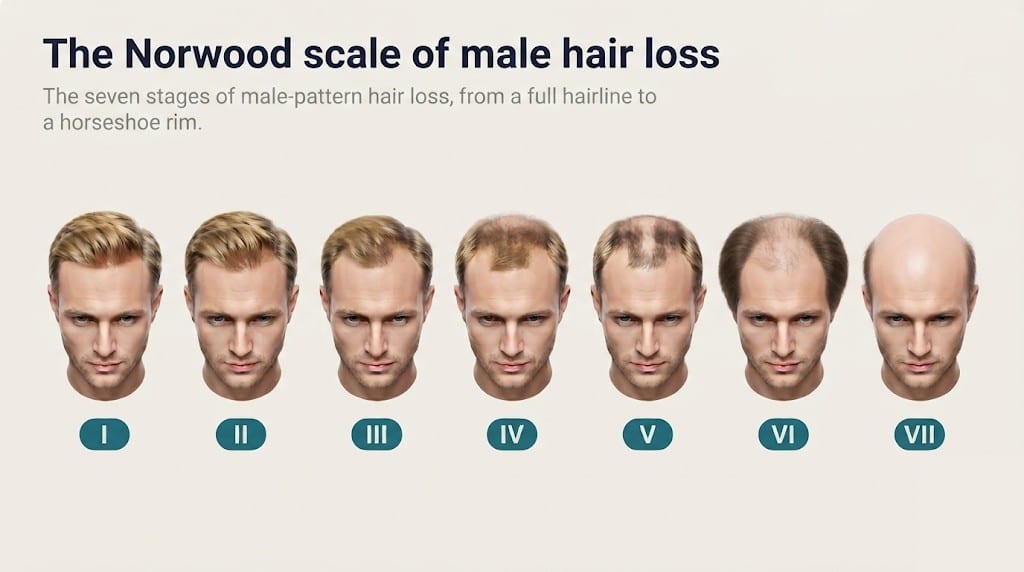
| Stage | What it looks like |
|---|---|
| I | Little or no recession. The hairline looks the way it did when you were a teenager. |
| II | Slight, even recession at the temples. Many adult men have this mature hairline. |
| III | Clear recessions at the temples. Considered the first stage of genuine hair loss. The III vertex variant also has early thinning at the crown. |
| IV | Marked recession at the front and a clear thin area at the crown. Between them sits a fairly wide band of hair. |
| V | The band separating the front from the crown becomes narrow and sparse. The gap between the two thin areas shrinks. |
| VI | The band is gone. The front and crown have merged into one large area without hair. |
| VII | The most advanced stage. All that's left is a horseshoe-shaped fringe along the sides and at the back. |
Some men follow a separate A variant. In these men, the hairline moves back as one continuous front, without the band across the crown. That variant may call for a different plan.
Why does your stage matter so much for treatment?
Because it decides which treatments fit and how far you can get. At the early stages, I to III, medication is often the most important tool you have. With finasteride and minoxidil you can hold on to the hair you still have and slow the androgenic process before more is lost. The sooner you start, the more you keep, and the less invasive everything else becomes.
From stage IV up to VII, a transplant can rebuild coverage. Then your donor capacity becomes the big question. The larger the area to cover, the more important it is to plan for the future, so the donor area isn't used up before the loss has stopped. Both routes are described in more detail: medical treatment without surgery and hair transplant methods.
How many grafts does each stage need?
It varies a lot with head size, hair quality and how dense you want the result to be, but as a rough guide:
- Stage II to III: often 1,500 to 2,500 grafts to rebuild the hairline and temples.
- Stage IV: typically around 2,500 to 3,500 grafts, spread over the front and the start of the crown.
- Stage V to VI: often 3,500 to 5,000 grafts or more, sometimes split over two sessions.
- Stage VII: a need so large that it often exceeds what the donor area can supply for full coverage.
If a clinic promises that a stage VI will be fully covered with a strikingly low graft count, you should be wary. The same goes for clinics that want to harvest an enormous number of grafts without talking about what you need to keep for later. You'll find a more thorough walkthrough in the article on grafts per stage.
Does the scale apply to women too?
No. The Norwood scale was designed for men and describes female hair loss poorly. In women, the loss is usually diffuse and the front hairline stays in place. For women, the Ludwig scale is used instead. It has three grades, I to III, describing how the centre parting becomes wider and thinner. The distinction matters, because women and men have different patterns, get different diagnoses and need different treatment. There's more on this in the overview of causes of hair loss and in the article on hair loss in women.
Can you trust your own assessment?
As a starting point, yes. As a final answer, no. A dermatologist or hair specialist using trichoscopy can see hairs shrinking long before the stage is visible to you, and can therefore estimate how fast the loss is progressing. When treatment is being planned, the pace often counts as much as the stage.
Use the scale as a vocabulary you share with the professional. It helps you ask better questions, understand the advice you get and spot more quickly whether an offer adds up.
What should you do now that you know your stage?
Take two photos today, one of the hairline straight from the front and one of the crown from above, in the same light. Write the stage you think you're at in the file name. If you're at I to III, the next step is a conversation with your doctor about medication. If you're at IV or higher and considering surgery, bring the photos to a consultation and ask how many grafts the clinic thinks you need, and how much donor hair you'll have left afterwards.
This article is general information. It can't replace an examination of your hair.
That depends on your donor area, your hair loss and your health, and a doctor needs to look at it. Send three photos and get an honest answer from the medical team at the clinic at the top of our ranking.
Goes to the clinic at the top of our ranking.