
Hair loss in women: find the cause before you choose a treatment
In women, hair most often thins over the top of the head while the hairline stays put. More than one cause is often at play, and blood tests frequently give the answer.
Why do women notice hair loss so late?
Because the front hairline usually stays where it is. Men typically lose hair at the temples and on the crown, in the Norwood pattern. Women most often get diffuse thinning over the top of the head, and the forehead looks the same as before. The first thing you notice is often a wider parting, or scalp showing through under bright light.
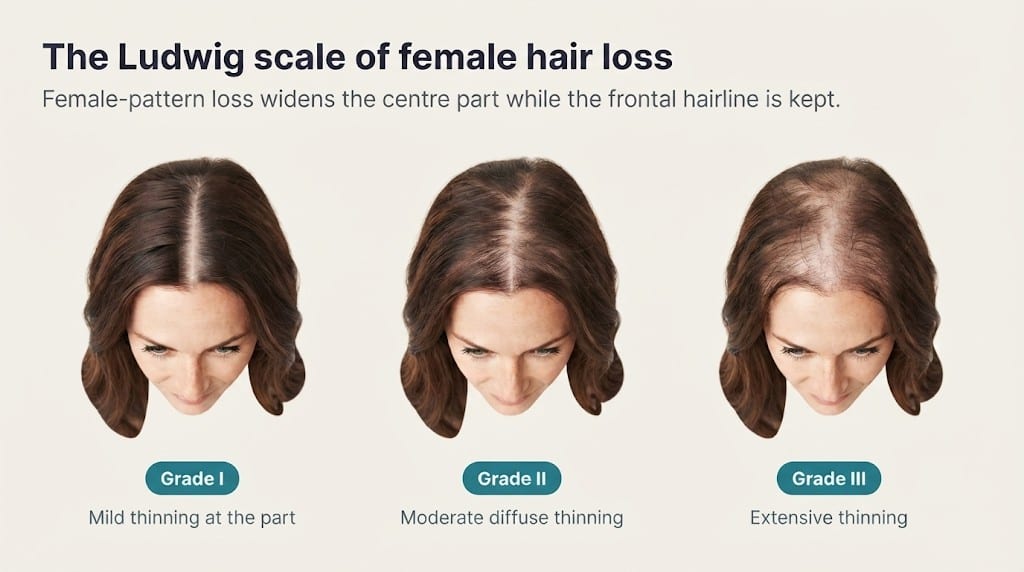
Doctors use the Ludwig scale for this, which has three grades from I to III. The pattern differs from men's, so advice written for men often fits poorly. More on this in the comparison of female and male hair loss.
What causes hair loss in women?
Often several things at once, which is why a proper assessment matters more for women than for men. The most common causes are:
- Hormones: menopause, pregnancy, the contraceptive pill and PCOS.
- Low ferritin, in other words iron deficiency: very common in women, especially with heavy periods. See iron deficiency and hair loss.
- Thyroid: a thyroid gland that is underactive or overactive.
- Telogen effluvium: shedding a few months after giving birth, an illness, a stressful period or major weight loss.
- Hereditary hair loss (FPHL): hair follicles that are sensitive to androgens.
Which tests should you have?
Start with your doctor, not at the pharmacy. A medical assessment is the first step. Ask to have these measured:
- ferritin, where the target is above 70 ng/mL
- vitamin D
- thyroid function (TSH)
- possibly a hormone profile
Very often something turns up that can be corrected, and once the deficiency is gone, the hair often improves noticeably. If the picture is unclear, a dermatologist can decide whether it really is FPHL. Alopecia areata and scarring alopecia can look similar, but are treated in a completely different way.
Which treatments work for women?
Minoxidil is the best-documented treatment and is approved for women, usually at a strength of 2 % or 5 %. Finasteride is usually not given to women who could become pregnant. If the thinning is diffuse and early, PRP can be an add-on, and the doctor can tackle hormonal causes directly. Read more about PRP for female hair loss.
You'll find the different forms and how they're treated in the overview of types of hair loss.
Can women have a hair transplant?
Yes, but the requirements are stricter than for men. A transplant needs a stable donor area with dense hair. With diffuse loss, the hair at the back of the head is often thinner too, and then there's too little to move.
If you have a defined area, such as a high forehead, a scar or FPHL that has been stable for a long time, the result can be good. It takes a thorough assessment. Send us a message if you'd like a no-obligation assessment of whether you could be a candidate.
Why does hair loss feel so hard for women?
Many women experience hair loss as a greater social and emotional burden than men do. In many cultures, thick hair is closely tied to female identity, and women losing hair is rarely talked about. It's easy to feel alone. The worry is real. It isn't vanity.
That's why a thorough and respectful assessment means a lot. An explanation and a plan reassure most people, and a lot of female hair loss can be reversed or treated once the cause has been found.
What should you do first?
Book an appointment with your GP and say you'd like ferritin, vitamin D and thyroid function checked because of hair loss. The results show whether you need to correct a deficiency, or whether it's time to talk about minoxidil. All the documented non-surgical options are in the guide to slowing hair loss.
This article is general information and doesn't replace a medical assessment of you.
For women, the answer depends on the type of hair loss. Send photos discreetly from home and the medical team at the clinic at the top of our ranking will tell you honestly whether a procedure is an option.
Goes to the clinic at the top of our ranking.