
How is female pattern hair loss (FPHL) different from men's?
In women, hair tends to thin evenly on top while the hairline stays put. That's why assessment, medication and the question of surgery need a different approach.
How does female hair loss differ from men's?
FPHL stands for female pattern hair loss. It usually causes even thinning over the top of the head, while the front hairline largely stays in place. Men follow a different pattern, with receding temples and an area on the crown that opens up.
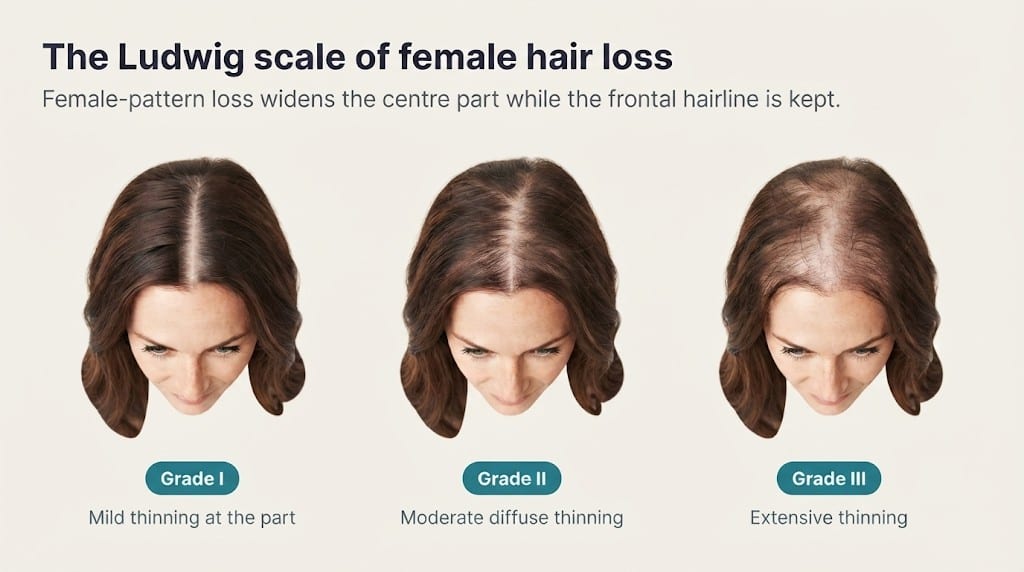
The patterns are so different that they're measured on separate scales. Men are placed on the Norwood scale. For women, doctors use the Ludwig scale, from grade I to III, which describes how much the top has thinned. Read more about how to read the Norwood scale.
Aren't the same hormones behind it?
Partly. In both women and men, an inherited sensitivity to androgens, including DHT, plays a role. But in women several forces are at work at once. Oestrogen and hormonal fluctuations come into the picture, along with other factors. That's why the contraceptive pill, pregnancy and the menopause can trigger FPHL or make it worse.
It also explains why so few women lose all the hair on top. The loss is rarely as purely androgen-driven as it is in men.
Why should women be assessed more thoroughly before treatment?
Because hair loss in women more often has several causes at once. Hormones, too little iron (low ferritin), thyroid problems, stress and telogen effluvium can occur together. Without knowing what's involved, you risk spending months on the wrong treatment.
A blood test looking at ferritin, vitamin D and TSH, possibly with a hormone profile, and an examination by a dermatologist often find something that can be put right. Read more about iron deficiency and hair loss.
Which medicines are used for FPHL?
Not the same ones as for men. Finasteride, a mainstay of treatment for men, is normally not given to women of childbearing age. Minoxidil has evidence and approval for both women and men, and in FPHL it's often the first thing a doctor suggests. Some add PRP.
See the overview of types of hair loss and the treatments with documented effect.
Can women with FPHL have a hair transplant?
Some can, many can't. In men, the donor area at the back of the head is usually dense and stable. In FPHL the loss is diffuse, and the donor area may then be thinner too. That means many women aren't good candidates.
Women with a more defined pattern can still get good results. That might be a high forehead, a scar or FPHL that has stabilised, with dense donor hair. It has to be assessed individually. Send us a message if you'd like help working it out.
Which misconceptions do the most harm?
Because male hair loss is so well known, the rules for men are often applied to women without anyone thinking about it. Two mistakes keep coming up. One is that women can just as well take finasteride. As a rule, women of childbearing age aren't prescribed it. The other is that a transplant is always an option. Surgery needs a stable, dense donor area, and the diffuse pattern of FPHL often weakens exactly that.
The third, and perhaps most fundamental, is the idea that female hair loss is just a weaker version of men's. It's a condition in its own right, with its own causes and its own treatment. It deserves to be assessed for what it is, not measured against a male template. Read more about hair loss in women.
What should you do now?
Book an appointment with your GP and ask specifically for ferritin, vitamin D and TSH, and ask whether a hormone profile is relevant. Bring photos of the top of your head, taken in the same light a few months apart, so the doctor can see how it's developing. Ask for a referral to a dermatologist if the answer is unclear.
For women, the answer depends on the type of hair loss. Send photos discreetly from home and the medical team at the clinic at the top of our ranking will tell you honestly whether a procedure is an option.
Goes to the clinic at the top of our ranking.