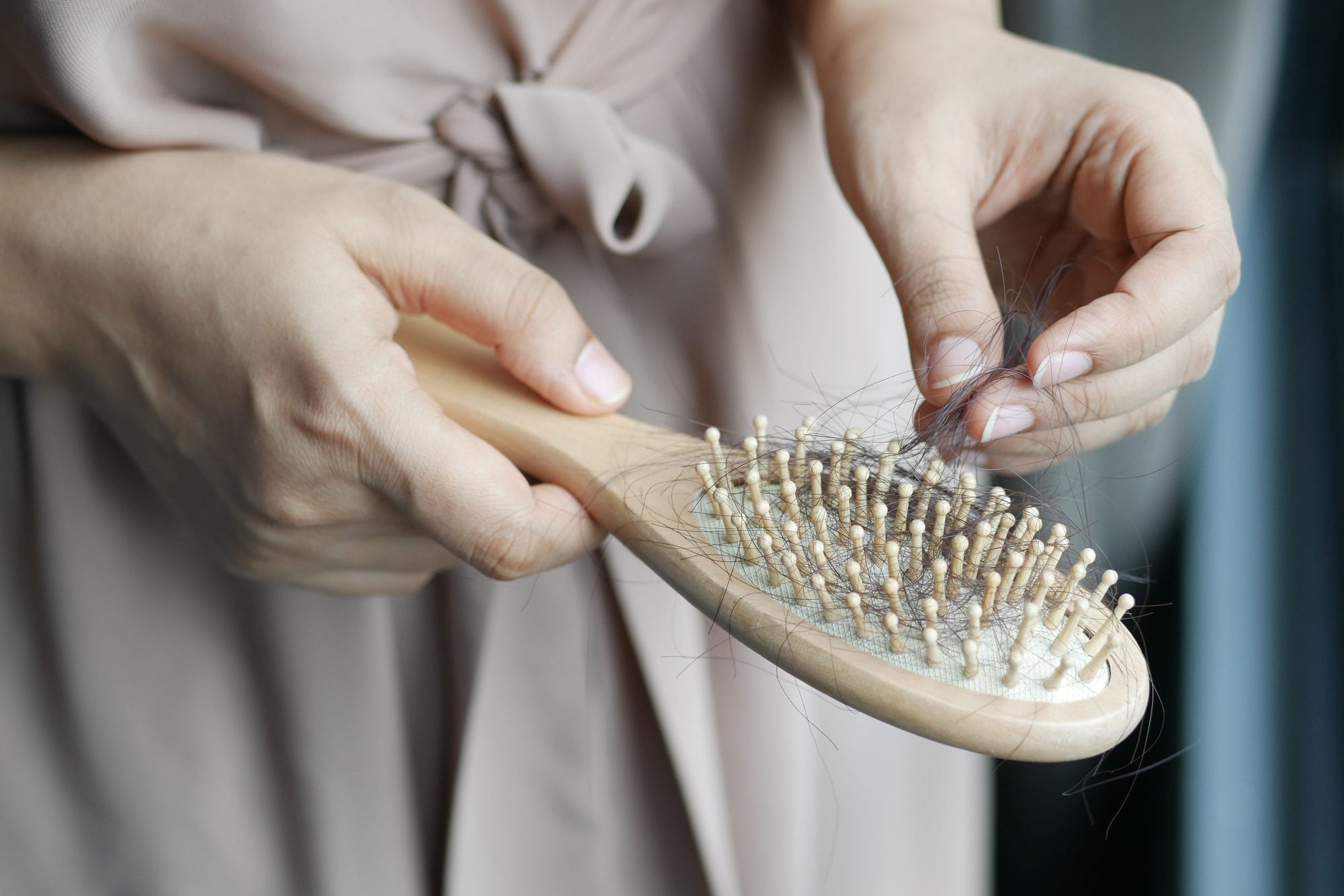
Diffuse hair loss: causes, tests and when a transplant is an option
When hair thins evenly all over the head, the cause can be anything from temporary shedding to genetics, iron deficiency, thyroid problems or medication. Here's the overview, the tests and the honest limits of a transplant.
Diffuse hair loss is even thinning over large parts of the scalp, and it's a description, not a diagnosis. The most common causes are telogen effluvium, hereditary diffuse thinning, iron deficiency, thyroid disorders, medications and diffuse unpatterned alopecia (DUPA). Your GP can measure ferritin, haemoglobin and TSH, and treatment depends on the cause. A hair transplant isn't an option until the cause has been established and the donor area has been examined, and never for telogen effluvium.
What is diffuse hair loss?
Diffuse hair loss means the hair thins evenly over large parts of the scalp, without the classic pattern of receding temples and a thin crown.
"Diffuse" describes what the hair loss looks like, not what causes it. Several different conditions can lie behind evenly thinner hair, and some of them clear up on their own. That's why it's a mistake to assume hereditary hair loss, and why the diagnosis comes before the treatment. You'll find a short introduction to the different types in the guide to the causes of hair loss, and a simple way to track changes in four tests you can do at home.
What are the most common causes of diffuse hair loss?
The most common are telogen effluvium, hereditary diffuse thinning, iron deficiency, thyroid disorders, medications and diffuse unpatterned alopecia (DUPA).
- Telogen effluvium: many hair follicles enter the resting phase at the same time and let go. It's one of the most common causes of diffuse hair loss, and the shedding tends to start 3 to 4 months after the trigger (Malkud, 2015). The trigger can be a fever, surgery, childbirth, major weight loss or prolonged stress. Read more in the article on telogen effluvium and stress and hair loss.
- Hereditary (androgenetic) thinning: in women it typically causes a wider parting and a thinner crown, while men can get a diffuse form instead of the usual pattern (common clinical picture). It comes on slowly and continues. See hair loss in women vs men.
- Iron deficiency: a meta-analysis of 36 studies with 10,029 participants found that women with non-scarring hair loss had lower ferritin than women without hair loss, and that 21 % had very low ferritin (Treister-Goltzman and colleagues, 2022). See iron deficiency and hair loss.
- Thyroid: both an underactive and an overactive thyroid can cause even thinning (Hussein and colleagues, 2023). See thyroid and hair.
- Medications: a wide range of drugs can cause hair loss, from cancer medicines to immunomodulating agents (Alhanshali and colleagues, 2023). In a meta-analysis of 17 studies with almost 1.1 million exposures, use of GLP-1 medicines was linked to a higher risk of telogen effluvium (adjusted odds ratio 1.76 after 12 months). See hair loss and Ozempic. Never stop a prescription medicine on your own.
- DUPA: miniaturisation affects the whole scalp, including the back and sides of the head that would otherwise be used as the donor area. See diffuse hair loss and transplantation.
Several causes can act at once. For example, you can have hereditary thinning and low iron stores at the same time.
How do you tell the different types apart?
Look at the pace, the pattern, what happened 2 to 4 months before, and whether the hairs vary in thickness, but only a doctor can make the diagnosis.
| Type | Pace | Typical signs | Outlook |
|---|---|---|---|
| Telogen effluvium | Sudden, over weeks | Lots of hair in the brush and plughole, evenly over the whole head, a trigger 2 to 4 months earlier | Usually passes, hair is often back within 3 to 6 months |
| Hereditary diffuse thinning | Slow, over years | Wider parting or thinner crown, hairs of varying thickness | Continues without treatment |
| Iron deficiency or thyroid | Varies | Even shedding. Confirmed with a blood test | Improves when the cause is corrected |
| Medication-induced | Weeks to months after starting | Shedding after a new medicine or dose | Often reversible, but must be assessed by your doctor |
| DUPA | Slow, over years | Thinning at the back of the head and above the ears too | Continues. Transplant options are very limited |
A dermatologist can use a hair wash test, a trichogram and trichoscopy (magnified examination of the scalp and hair) to tell the types apart, and in some cases a biopsy (Asghar and colleagues, 2020). Grover and Khurana (2013) write that telogen effluvium is often used as a "wastebasket" diagnosis, and that it can be hard to distinguish from other kinds of diffuse loss. That's exactly why you should involve a doctor.
Which tests can you ask your GP for?
Ask for ferritin and haemoglobin for iron, TSH for your thyroid, and a review of all the medicines and supplements you take.
Which tests are taken is your doctor's call. This is a starting point you can bring to the appointment:
- Ferritin (iron stores) and haemoglobin: your haemoglobin can be normal even when your iron stores are empty. Ferritin rises with inflammation and can hide a deficiency, and there's no agreement on where the cut-off for hair loss should be (iron deficiency and hair loss).
- TSH, possibly free T4: shows whether your thyroid is in balance.
- Vitamin D: some doctors measure it, but the evidence is weaker. See vitamin D and thinner hair.
- Medication list: bring a list of everything you've started in recent months, supplements included.
- Biotin: large doses can give false results on thyroid tests (Li and colleagues, 2017). Say if you take it before the test. See biotin and hair.
Also bring photos of your parting and crown from recent months and a list of what happened 2 to 4 months before the shedding started. That helps your doctor more than lots of blood tests.
How is diffuse hair loss treated?
Treatment depends on the cause. Telogen effluvium usually passes on its own, deficiencies are corrected, and hereditary diffuse thinning is treated with minoxidil and possibly other medicines.
- Telogen effluvium: remove the trigger and give it time. For most people the shedding stops after 3 to 6 months, and full density takes 6 to 12. If it lasts more than six months it's called chronic, and you should see a doctor.
- Iron deficiency and thyroid: treated by a doctor based on test results. Iron without a proven deficiency can do harm.
- Medication-induced: talk to the doctor who prescribed the medicine. Don't stop on your own.
- Hereditary thinning in women: minoxidil has the best evidence. In a study of 381 women over 48 weeks, 5 % minoxidil was better than placebo on all three main outcomes (Lucky and colleagues, 2004). What you can buy at the pharmacy is covered in the article on Regaine and minoxidil in Norway, and spironolactone may be an option after your doctor's assessment.
- Hereditary thinning in men: minoxidil and finasteride, see minoxidil and finasteride and dutasteride.
You'll find more on the options in the guide to non-surgical treatment. If you later consider a hair transplant, it helps to have the medication in place first (combining medication and surgery).
When is a hair transplant an option for diffuse hair loss, and when is it not?
It's not an option until the cause has been established and the back of the head has been examined, and never as a treatment for telogen effluvium.
Not an option, or postponed:
- Telogen effluvium, since the hair grows back without surgery.
- Iron deficiency, thyroid problems or medication side effects that haven't been sorted out yet.
- DUPA. These patients are considered poor candidates, and a 2026 case report shows that the back of the head is often assumed to be healthy without being checked (Xu and colleagues).
May be an option:
- When trichoscopy at several points on the back of the head shows the donor area is stable.
- When the hair loss has a clear pattern, for example a high hairline, and everything else has been ruled out.
- When you're prepared to keep taking medication, since the moved hairs don't protect the rest.
In women the donor area is more often affected, and the reserve is smaller. See the donor area in women and hair transplants for women. A transplant moves hair from one place to another and doesn't create new hair, so it doesn't fix even loss over the whole head. Check whether you're a candidate, and read why the result often fades over time with diffuse hair loss.
When should you see a doctor?
See your GP if your hair loss has lasted more than six months, comes in patches, hurts or itches, or comes with other symptoms.
- The loss lasts longer than six months or is so heavy you can see bare scalp.
- You get round, smooth patches or scarring, which is a different condition from diffuse hair loss.
- Your scalp is red, flaky, tender or painful.
- You have fatigue, weight change or irregular periods at the same time. This may point to iron, thyroid or hormones (our assessment).
- You started a new medicine shortly before the shedding began.
Minoxidil on the scalp isn't meant for sudden hair loss, patchy hair loss or hair loss caused by illness or medication (the patient leaflet for Recrea Forte in Felleskatalogen, the Norwegian medicines directory). So get the diagnosis first.
Common questions about diffuse hair loss
Here are the answers to five questions we're often asked.
Does hair grow back after telogen effluvium?
Usually, yes. The hair follicles aren't damaged, and once the trigger is gone the shedding stops for most people after 3 to 6 months. Full density takes 6 to 12. If the loss persists, you should be checked for other causes.
Can stress alone cause diffuse hair loss?
It can be a trigger, but Grover and Khurana (2013) point out that the role of stress, both as a cause and a consequence of hair loss, needs to be better understood, and that clear evidence for many presumed causes is lacking. Looking for a physical cause therefore still matters.
Do vitamins and supplements help?
Only if you have a proven deficiency. Taking iron without a deficiency carries its own risk. See supplements for hair loss.
Can I have a hair transplant if my hair loss is diffuse?
Sometimes, but only if the donor area has been examined and is stable, and the cause of the hair loss has been established. See the long-term results for diffuse hair loss.
Is diffuse hair loss more common in women?
Women with telogen effluvium see a dermatologist more often (Malkud, 2015), but men can get diffuse loss too. The pattern and course are what count, not your sex. The differences between hereditary hair loss in women and men are explained in the article on women vs men.
Sources
- Malkud S. Telogen Effluvium: A Review. Journal of Clinical and Diagnostic Research, 2015;9(9):WE01-WE03. pubmed.ncbi.nlm.nih.gov/26500992
- Grover C, Khurana A. Telogen effluvium. Indian Journal of Dermatology, Venereology and Leprology, 2013;79(5):591-603. pubmed.ncbi.nlm.nih.gov/23974577
- Asghar F, Shamim N, Farooque U, Sheikh H, Aqeel R. Telogen Effluvium: A Review of the Literature. Cureus, 2020;12(5):e8320. pubmed.ncbi.nlm.nih.gov/32607303
- Treister-Goltzman Y, Yarza S, Peleg R. Iron Deficiency and Nonscarring Alopecia in Women: Systematic Review and Meta-Analysis. Skin Appendage Disorders, 2022;8(2):83-92. pubmed.ncbi.nlm.nih.gov/35415182
- Hussein RS, Atia T, Bin Dayel S. Impact of Thyroid Dysfunction on Hair Disorders. Cureus, 2023;15(8):e43266. pubmed.ncbi.nlm.nih.gov/37692605
- Alhanshali L, Buontempo M, Shapiro J, Lo Sicco K. Medication-induced hair loss: An update. Journal of the American Academy of Dermatology, 2023. pubmed.ncbi.nlm.nih.gov/37591561
- Viquez Burboa GU, et al. GLP-1 Receptor Agonists and Alopecia: A Systematic Review and Meta-Analysis of Incidence, Risk, Subtypes, and Mechanisms. Skin Appendage Disorders, 2026. pubmed.ncbi.nlm.nih.gov/42621629
- Li D, Radulescu A, Shrestha RT, et al. Association of Biotin Ingestion With Performance of Hormone and Nonhormone Assays in Healthy Adults. JAMA, 2017;318(12):1150-1160. pubmed.ncbi.nlm.nih.gov/28973622
- Lucky AW, Piacquadio DJ, Ditre CM, et al. A randomized, placebo-controlled trial of 5% and 2% topical minoxidil solutions in the treatment of female pattern hair loss. Journal of the American Academy of Dermatology, 2004;50(4):541-553. pubmed.ncbi.nlm.nih.gov/15034503
- Xu Y, et al. Case Report: Paired vertex-occipital assessment reveals donor-area involvement in diffuse unpatterned alopecia. Frontiers in Medicine, 2026;13:1797275. pubmed.ncbi.nlm.nih.gov/41982548
- Felleskatalogen. Recrea Forte «Cooper», patient leaflet (uses and when it must not be used). felleskatalogen.no/medisin/pasienter/pil-recrea-forte-cooper-563302
Here we summarise published research as general information. This text doesn't replace a medical assessment, and it doesn't encourage you to start, stop or adjust a medicine. Prescription medicines have contraindications and can interact. So discuss your choice with your doctor, who knows your medical history and medicines.
Wondering what's possible for your hair?
Send three sharp photos of your hair, from the front, the top and the back. You'll get an honest answer on what can be done, roughly how many grafts it would take and what it costs.
- Free and with no obligation
- Photos are assessed by the clinic's medical team
- Replies usually within an hour in the daytime


A study tells you something about groups. Only a doctor who has seen your photos can say what applies to your hair. The medical team at the clinic at the top of our ranking offers a free assessment.
Goes to the clinic at the top of our ranking.