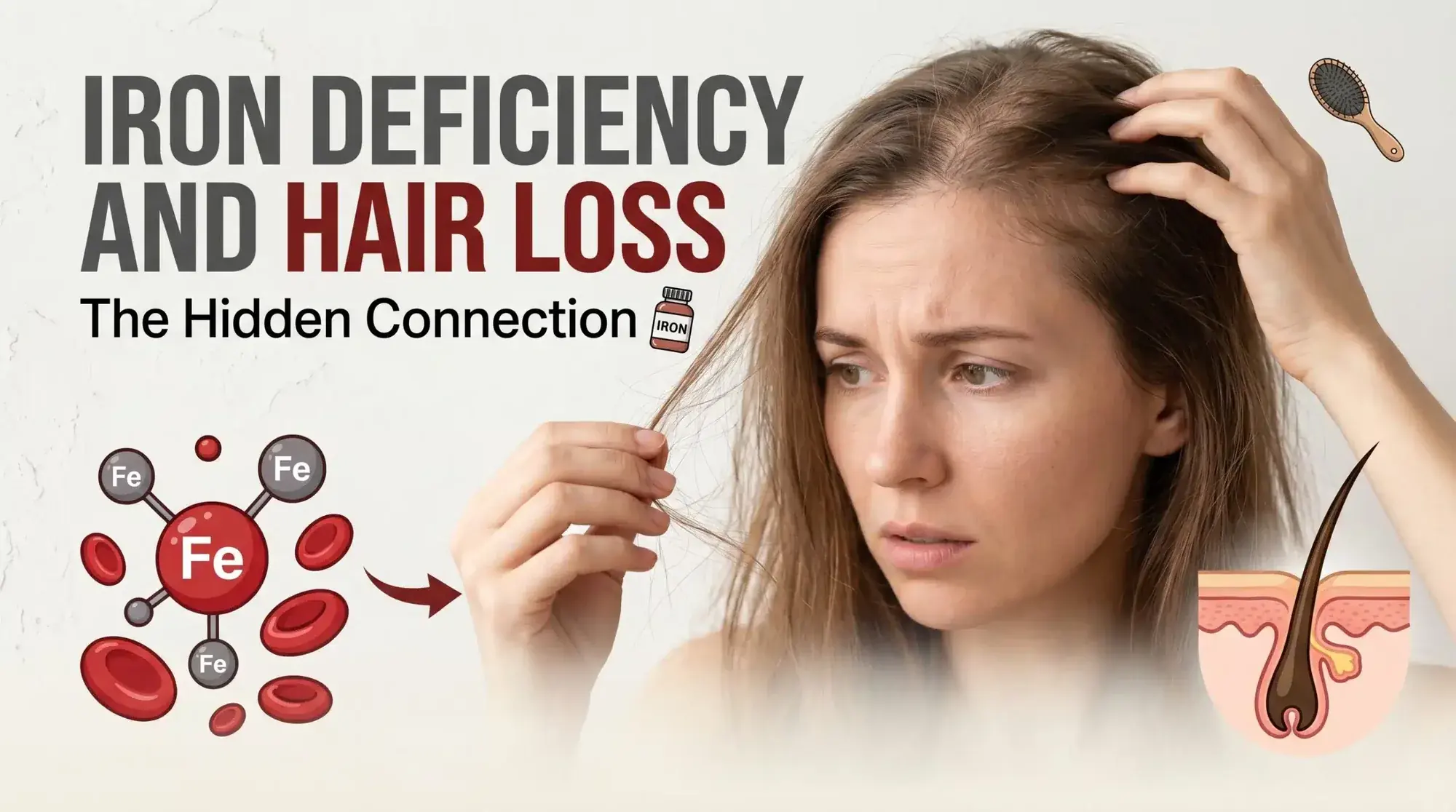
Can iron deficiency cause hair loss? Test before you treat
Yes. Low iron can cause hair shedding, most often in women, and the condition can be treated.
Low iron can cause hair shedding, most often in women, and the condition can be treated. Get tested before you draw conclusions, because unnecessary iron carries its own risks.
Why does your hair notice when you are short of iron?
Hair follicles have one of the most active metabolisms in the body and need iron for their cells to work. When iron stores fall, the body prioritises organs you can't do without, and hair growth loses out. The usual picture is diffuse shedding over the whole head, not a pattern, and it is often described as telogen effluvium.
Which blood test shows iron deficiency in hair loss?
You need ferritin. A standard blood count isn't enough, because haemoglobin can be normal even when your stores are empty. Ferritin shows how much iron you have stored, but the value rises with inflammation and can therefore mask a deficiency. Many hair specialists want ferritin well above the threshold for anaemia, but there is no agreement on where the cut-off should be.
Why shouldn't you start taking iron on your own?
Excess iron stays in the body, because the body lacks a good way to excrete it, and it does harm. Stomach problems are common. A supplement can hide what is really wrong, so the diagnosis comes late, and it can affect how well you absorb other medicines. A deficiency with no known explanation needs to be investigated, not just topped up.
- Excess does harm, because the body can't get rid of what it doesn't need
- Stomach and gut problems are common
- The cause can be masked, and the diagnosis comes later
- Other medicines may be absorbed less well
- An unexplained deficiency should be investigated, because the cause can matter more than the number
Does hereditary hair loss improve once iron deficiency is corrected?
No. Topping up your iron stores removes that one cause, but hereditary hair loss has a different mechanism and isn't affected. Some people have both at once, and then treating one doesn't solve the other. Get a diagnosis before you put it down to genetics, especially if you're a woman.
The work-up is described in our guide to hair loss in women.
Iron deficiency is only one of several explanations for even, all-over hair loss. You will find the full overview in the article on diffuse hair loss.
Sources
- Treister-Goltzman Y, Yarza S, Peleg R. Iron Deficiency and Nonscarring Alopecia in Women: Systematic Review and Meta-Analysis. Skin Appendage Disorders, 2022;8(2):83-92. pubmed.ncbi.nlm.nih.gov/35415182
- Trost LB, Bergfeld WF, Calogeras E. The diagnosis and treatment of iron deficiency and its potential relationship to hair loss. Journal of the American Academy of Dermatology, 2006;54(5):824-844. pubmed.ncbi.nlm.nih.gov/16635664
- Zhang D, LaSenna C, Shields BE. Serum Ferritin Levels: A Clinical Guide in Patients With Hair Loss. Cutis, 2023;112(2):62-67. pubmed.ncbi.nlm.nih.gov/37820340
- Ganz T. Systemic iron homeostasis. Physiological Reviews, 2013;93(4):1721-1741. pubmed.ncbi.nlm.nih.gov/24137020
- Tolkien Z, Stecher L, Mander AP, Pereira DI, Powell JJ. Ferrous sulfate supplementation causes significant gastrointestinal side-effects in adults: a systematic review and meta-analysis. PLoS One, 2015;10(2):e0117383. pubmed.ncbi.nlm.nih.gov/25700159
- Liwanpo L, Hershman JM. Conditions and drugs interfering with thyroxine absorption. Best Practice & Research Clinical Endocrinology & Metabolism, 2009;23(6):781-792. pubmed.ncbi.nlm.nih.gov/19942153
- Almohanna HM, Ahmed AA, Tsatalis JP, Tosti A. The Role of Vitamins and Minerals in Hair Loss: A Review. Dermatology and Therapy, 2019;9(1):51-70. pubmed.ncbi.nlm.nih.gov/30547302
Here we summarise published research as general information. This text does not replace a medical assessment, and it does not encourage you to start, stop or adjust any medicine. Prescription medicines have contraindications and can interact with each other, so discuss the choice with your doctor, who knows your medical history and the medicines you take.
Wondering what's possible for your hair?
Send three sharp photos of your hair, from the front, the top and the back. You'll get an honest answer on what can be done, roughly how many grafts it would take and what it costs.
- Free and with no obligation
- Photos are assessed by the clinic's medical team
- Replies usually within an hour in the daytime


A study tells you something about groups. Only a doctor who has seen your photos can say what applies to your hair. The medical team at the clinic at the top of our ranking offers a free assessment.
Goes to the clinic at the top of our ranking.