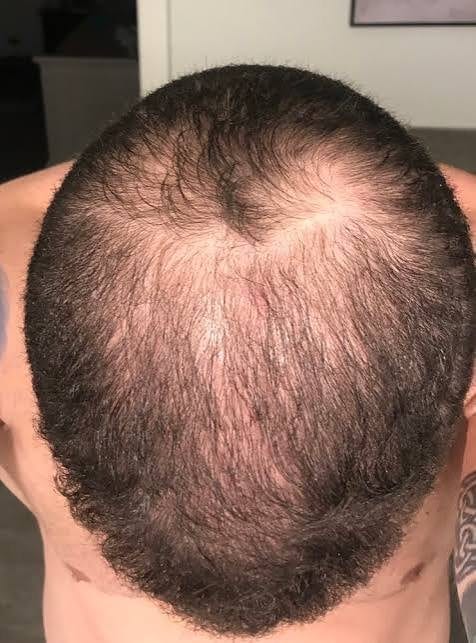
Why do hair transplant results often fade with diffuse hair loss?
When hair thins evenly over the whole head, the donor area may be affected too. That's where long-term results most often fail.
With diffuse hair loss, the back of the head may not be stable, and these are the patients most often disappointed with their result after a few years. If you have diffuse unpatterned alopecia, the transplanted grafts keep thinning, and the donor reserve has been used without lasting benefit.
Why does diffuse hair loss give the weakest long-term results?
Because the method assumes that the hair at the back and sides is stable while the top thins. Patterned hair loss provides that difference almost by itself, but with diffuse hair loss the back of the head can be affected too, and then the transplanted grafts keep thinning after the procedure.
Every hair transplant relies on a difference between two areas. The recipient site has lost hair. The donor area has kept its hair and is expected to go on doing so. In classic patterned hair loss, that difference is built into the diagnosis itself.
In diffuse hair loss, it isn't a given. When thinning spreads across the whole scalp rather than following a known pattern, stability at the back and sides has to be shown by examination. In some of these patients, it turns out not to be there.
That's why long-term results fail more often here than in any other group, and the fault rarely lies in the surgery itself. Grafts from an area that's already thinning keep thinning in their new place. At twelve months, everything may look fine. Then density falls year by year, while the donor reserve has been harvested and the dot scars sit in an area that was never safe to take from.
What is diffuse unpatterned alopecia, and why does it matter before a transplant?
Diffuse unpatterned alopecia (DUPA) is hair loss in which miniaturisation affects the whole scalp, including the back of the neck and the sides that normally serve as the donor area. These patients are considered poor transplant candidates, and a case report published in 2026 argues that the back of the neck is often assumed to be healthy without being checked.
DUPA is the most pronounced form of the problem. Miniaturisation doesn't stop at the top, but also involves the back of the head and the temples, which are exactly the areas the surgeon would otherwise take grafts from.
Specialists regard patients with DUPA as poor candidates for a transplant. Detecting the condition before the procedure is therefore one of the most valuable things a donor assessment can do.
In a case report published in 2026, Xu and co-authors examined the crown and the back of the neck in pairs. They argued that the back of the neck is far too often assumed to be unaffected, so an affected donor area can be overlooked in DUPA. At around the same time, Maas and co-authors published a paper questioning the use of the occipital scalp as a control area in advanced androgenetic alopecia.
Neither is a large study. The practical consequence is still simple: with diffuse hair loss, the donor area must be examined, not taken for granted.
What other causes must be ruled out before diffuse hair loss is treated as hereditary hair loss?
Telogen effluvium, iron deficiency, thyroid disease, diet, medicines, scarring alopecias and DUPA can all cause diffuse thinning. Many of them can be treated without a procedure, and operating before the cause is clear uses up the donor reserve while the real problem goes unsolved.
Androgenetic alopecia is only one of several explanations for evenly thinning hair. Go through these before surgery is even on the table:
- Telogen effluvium. A temporary heavy shedding that normally corrects itself.
- Iron deficiency and thyroid disease. Both can be detected with blood tests.
- Diet and medicines. Nutritional deficiencies and side effects of medicines can cause diffuse hair loss.
- Scarring alopecias. A transplant is considered only once the disease has been inactive for a long time, often one to two years.
- Diffuse unpatterned alopecia. Here, surgery is generally advised against.
Many who end up with a depleted donor area and hair just as thin as before were operated on while the cause was still unknown.
How to tell the causes apart, and which tests you can ask your GP for, is covered in the article on diffuse hair loss.
How should the donor area be examined when hair loss is diffuse?
The donor area should be examined with trichoscopy at several sites, including the outer edges, and the variation in hair shaft thickness should be documented because it reveals miniaturisation. Miniaturisation at the back is compared with the front, and the images are stored. A density count alone isn't enough.
- Trichoscopy of the donor zone at several measuring points, including the back of the neck and the areas above and behind the ears.
- Precise recording of how much hair shaft diameter varies. This is what reveals miniaturisation.
- A direct comparison of miniaturisation at the back and the front. It's the difference between them that confirms the loss has a pattern.
- Assessment by a dermatologist when a cause other than hereditary hair loss is likely.
- Archived photos, so the donor area can later be compared with its own baseline.
Why isn't counting enough? A donor area that is thinning diffusely can have enough follicular units on paper, while each hair gets finer year by year.
Can a transplant still succeed if the donor area is thin but stable?
Yes, if trichoscopy shows the donor area really is stable, a cautious plan can give a good result. The reserve is then usually smaller, the margin for error is tighter than with clearly patterned hair loss, and medical treatment becomes especially important.
Diffuse hair loss isn't automatically a no. If the examination shows a donor zone that is holding steady, surgery can still be a reasonable choice.
The plan then has to be modest. There are usually fewer grafts to take from. The recipient area also has its own hair, which may get thinner over the years, so there's less room for misjudgement than with a clear pattern. Medical treatment, agreed with a doctor, matters more in this group than in any other.
You should also be told how certain the prognosis really is. It rests on the donor area staying stable, and that assumption is only as well tested as current examination methods allow. It's a reasoned judgement, not a guarantee.
Sources
- Xu Y, et al. Case Report: Paired vertex-occipital assessment reveals donor-area involvement in diffuse unpatterned alopecia. Frontiers in Medicine, 2026;13:1797275. pubmed.ncbi.nlm.nih.gov/41982548
- Maas D, et al. Rethinking the occipital scalp as a control in advanced androgenetic alopecia. Journal of the American Academy of Dermatology, 2026 (ahead of print). pubmed.ncbi.nlm.nih.gov/42398778
- Jimenez F, Ruifernández JM. Distribution of human hair in follicular units. A mathematical model for estimating the donor size in follicular unit transplantation. Dermatologic Surgery, 1999;25(4):294-298. pubmed.ncbi.nlm.nih.gov/10417585
- Gupta AK, Venkataraman M, Talukder M, Bamimore MA. Finasteride for hair loss: a review. Journal of Dermatological Treatment, 2022;33(4):1938-1946. pubmed.ncbi.nlm.nih.gov/34291720
- Romera de Blas C, Vega Díez D, Ricart Vayá JM, Gómez Zubiaur A. Complications in follicular unit excision hair transplantation: current evidence and practical approaches. Frontiers in Medicine, 2026;13:1750989. pubmed.ncbi.nlm.nih.gov/41709896
Here we summarise published research and standard clinical practice as general information. The text is not medical advice and cannot replace what your surgical team tells you. If they say something different from what is written here, their advice is what counts.
Wondering what's possible for your hair?
Send three sharp photos of your hair, from the front, the top and the back. You'll get an honest answer on what can be done, roughly how many grafts it would take and what it costs.
- Free and with no obligation
- Photos are assessed by the clinic's medical team
- Replies usually within an hour in the daytime


A study tells you something about groups. Only a doctor who has seen your photos can say what applies to your hair. The medical team at the clinic at the top of our ranking offers a free assessment.
Goes to the clinic at the top of our ranking.