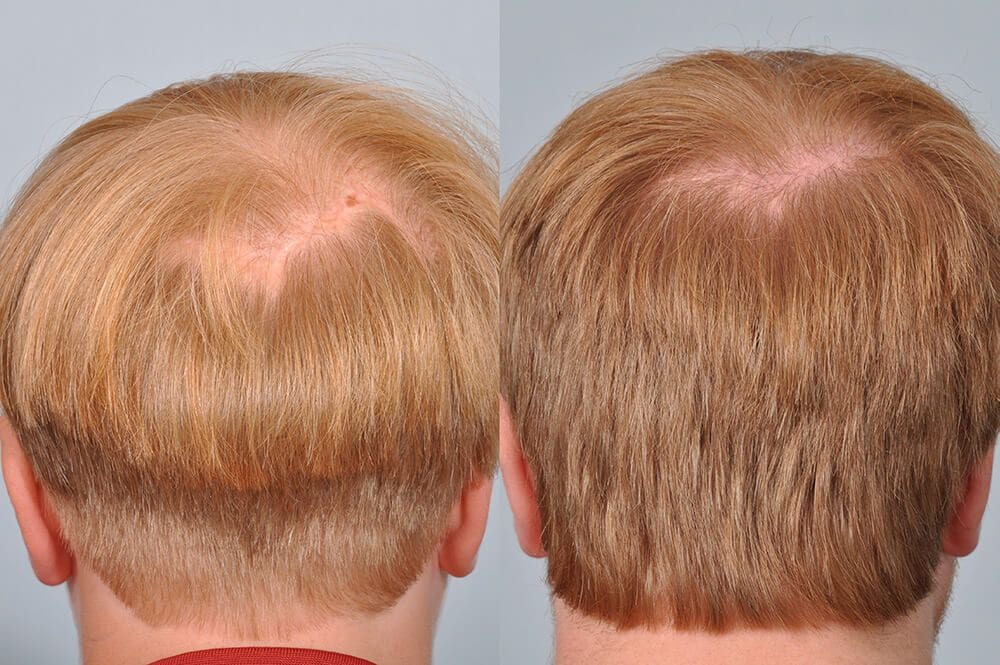
Hair transplant for scarring alopecia: when can it be considered?
A scarring alopecia that has burnt out can be transplanted. But fewer grafts survive in scar tissue, and flare-ups can return.
Transplanting into a scarring alopecia that has burnt out can give a result, but fewer grafts survive in scar tissue, and the risk of the disease flaring up again is real. What has been published is small case series in which patients were followed from a few months to a couple of years.
What is scarring alopecia, and when might a transplant be an option?
This is a group of diseases, including folliculitis decalvans, lichen planopilaris, discoid lupus erythematosus and frontal fibrosing alopecia, in which the hair follicles are destroyed and turn into scar tissue. Surgery is only considered once the disease has been quiet for six months or more, preferably longer. Active inflammation attacks new grafts, and the procedure itself can reawaken the disease.
In scarring (cicatricial) alopecias, the hair follicles are destroyed and replaced by connective tissue. It's a large group. These are the most common:
- Lichen planopilaris
- Frontal fibrosing alopecia
- Discoid lupus erythematosus
- Folliculitis decalvans
- Central centrifugal cicatricial alopecia
The usual requirement before a transplant is that the disease has been quiet for a long time, often one to two years. Grafts placed into active inflammation get attacked by it, and the procedure itself can make the disease flare up.
Whether the disease really is quiet is for a dermatologist to decide. That takes a diagnosis, usually with a biopsy, and several check-ups. A cosmetic clinic can't tell by looking.
What does the research say about transplants in scarring alopecia?
There's little. In 2025, Osipowicz and co-authors described a series of five patients, all with lichen planopilaris, who were followed for more than twelve months, and all were satisfied. That suggests a transplant can work when lichen planopilaris is quiet, but it says nothing certain about the result after ten years. For most other scarring alopecias, the evidence is even weaker.
The research is sparse. In 2025, Osipowicz and co-authors described five patients who had lichen planopilaris. The article appeared in the Journal of Clinical Medicine. The patients were followed for more than twelve months, and all of them said they were satisfied.
Five patients. One diagnosis. Follow-up from a few months up to a couple of years. The result is a useful sign that patients whose lichen planopilaris is quiet can be satisfied after a transplant. But it gives no basis for predicting how things will look in a decade, and it shouldn't be presented that way either.
For the other scarring alopecias, even less has been published about transplants. Beyond case series, what exists is systematic reviews of how many grafts survive in primary scarring alopecia, and they point the same way: lower survival than in healthy skin and a real risk of the disease returning.
Why is the long-term result harder to predict in scarring alopecia?
Scar tissue has a poor blood supply, so fewer grafts survive. The disease can also flare up again after several quiet years and destroy the grafts. The donor area may be affected too, since folliculitis decalvans tends to sit at the back of the head and the crown, and the surgical trauma itself can trigger new disease in the wound (koebnerisation).
- Fewer grafts survive in scar tissue. Blood supply in scars is poor, and at first the grafts live entirely off the tissue they're placed in. Expect a lower yield.
- The disease can come back. These conditions come in waves. Even after two quiet years, a new flare can come, and if it happens after the transplant, the grafts can be lost.
- The donor area can be affected too. Lichen planopilaris can appear anywhere on the head, and folliculitis decalvans tends to sit precisely at the nape and the crown. If grafts are taken from a diseased area, the disease comes with them.
- The operation itself can trigger disease. Some scarring alopecias show koebnerisation, where an injury provokes disease at the injured site. That's a particular concern with a procedure that creates wounds in both the donor and recipient areas.
Can the disease be in the donor area itself?
Yes. Several of these diseases reach the back of the head. Folliculitis decalvans often sits precisely at the nape and the crown, and lichen planopilaris can show up anywhere on the scalp. If the back of the head is affected, the grafts take the disease to their new place, or they die there. The assessment must therefore include a trichoscopic examination for scarring changes, and a density count isn't enough.
This is the part that directly concerns the donor area, and it's the part most often forgotten.
Several of the scarring alopecias can reach the hair at the back of the head. Frontal fibrosing alopecia mainly starts at the front hairline and in the eyebrows, but can spread. Lichen planopilaris has no fixed location. Folliculitis decalvans has a liking for the nape and the crown.
If the back of the head is affected, the grafts carry the disease with them, or they're destroyed in their new place. Harvesting also creates wounds in skin where the inflammation is or recently was active, and that alone can set off new activity.
In these patients, the donor assessment must therefore look for signs of scarring. The surgeon needs to look for missing follicular openings where follicles have disappeared, red and scaly skin around the follicles, and hairs growing in tufts. This takes trichoscopy and dermatological expertise. A density count isn't enough.
How should responsible treatment be planned?
A dermatologist makes the diagnosis and takes a biopsy before surgery is discussed. After that, the disease must have been documented as quiet for six months or longer, and a trichoscopic examination of the donor area for scarring changes is also needed. A test round with a few grafts, to see how many survive, spares the donor reserve. Afterwards, regular follow-up with a dermatologist and sober expectations are needed.
- A dermatologist makes the diagnosis first, with a biopsy where there's reason for one, before surgery is even discussed.
- The disease has proved quiet for a long time, often one to two years, and that's recorded in the medical notes.
- The donor area is examined with trichoscopy for scarring changes: missing follicular openings, redness and scaling around the follicles and tufts of hair (tufting). A density count isn't enough.
- Test grafts. A small number of grafts are placed first, and you see how many survive before going further. That way you don't risk the whole donor reserve.
- The surgeon has experience with exactly this situation, and expectations for survival and relapse are set out in writing.
- Regular follow-up with a dermatologist after the procedure too, because the disease hasn't gone away.
- Clearly lower expectations, both for density and for how long the result lasts, and ongoing medical treatment to keep the disease in check.
If a clinic proposes a full session for a patient whose scarring alopecia hasn't been diagnosed, both the result and the donor area are at risk.
Which forms of scarring hair loss have better prospects with a transplant?
The outlook is best for traction alopecia that has stopped, because the hair was lost to pulling and not to the immune system attacking, and the donor area is usually healthy. Old, quiet scars from accidents or operations are also among the safer cases. The same applies to disease that has burnt out in a limited area, when the donor area is shown to be unaffected.
Not all of these cases are doubtful.
- Traction alopecia that stopped some time ago often offers good possibilities. The cause was hair being pulled, not the immune system attacking, and the donor area is usually completely healthy.
- Scars from injuries and operations are stable and free of inflammation. They're among the safer situations when grafts go into scar tissue.
- Disease that has burnt out in a limited area, where the donor area is shown to be healthy, has the best prospects among the inflammation-driven forms.
Here too, the question of how long results last is as open as elsewhere in the field. Nobody has ten-year data for any of these groups.
Transplanting into scarred skin is covered in more detail under repair and correction.
Sources
- Osipowicz K, Turkowski P, Kowalewski C, Pach J, Regulski P, Wozniak K. Hair Transplantation for Lichen Planopilaris: A Case Series of Five Patients. Journal of Clinical Medicine, 2025;14(17):6199. pubmed.ncbi.nlm.nih.gov/40943957
- Romera de Blas C, Vega Díez D, Ricart Vayá JM, Gómez Zubiaur A. Complications in follicular unit excision hair transplantation: current evidence and practical approaches. Frontiers in Medicine, 2026;13:1750989. pubmed.ncbi.nlm.nih.gov/41709896
- Xu Y, et al. Case Report: Paired vertex-occipital assessment reveals donor-area involvement in diffuse unpatterned alopecia. Frontiers in Medicine, 2026;13:1797275. pubmed.ncbi.nlm.nih.gov/41982548
- Parsley WM, Perez-Meza D. Review of factors affecting the growth and survival of follicular graft. Journal of Cutaneous and Aesthetic Surgery, 2010;3(2). jcasonline.com
- Jimenez F, Ruifernández JM. Distribution of human hair in follicular units. A mathematical model for estimating the donor size in follicular unit transplantation. Dermatologic Surgery, 1999;25(4):294-298. pubmed.ncbi.nlm.nih.gov/10417585
- Yii V, Moussa A, Triwongwaranat D, Smith BRC, Bhoyrul B. A Systematic Review of Follicular Unit Graft Survival Rates After Hair Transplantation in Primary Cicatricial Alopecia. Dermatologic Surgery, 2025;51(11):1052-1057. pubmed.ncbi.nlm.nih.gov/40439233
- Lee JA, Levy DA, Patel KG, Brennan E, Oyer SL. Hair Transplantation in Frontal Fibrosing Alopecia and Lichen Planopilaris: A Systematic Review. The Laryngoscope, 2021;131(1):59-66. pubmed.ncbi.nlm.nih.gov/32045028
- Ekelem C, Pham C, Atanaskova Mesinkovska N. A Systematic Review of the Outcome of Hair Transplantation in Primary Scarring Alopecia. Skin Appendage Disorders, 2019;5(2):65-71. pubmed.ncbi.nlm.nih.gov/30815438
Here we bring together published research and common clinical practice for general information. This text is not medical advice and can't replace what your surgical team tells you. If they say something different from what's written here, their advice applies.
Wondering what's possible for your hair?
Send three sharp photos of your hair, from the front, the top and the back. You'll get an honest answer on what can be done, roughly how many grafts it would take and what it costs.
- Free and with no obligation
- Photos are assessed by the clinic's medical team
- Replies usually within an hour in the daytime


A study tells you something about groups. Only a doctor who has seen your photos can say what applies to your hair. The medical team at the clinic at the top of our ranking offers a free assessment.
Goes to the clinic at the top of our ranking.