Scarring alopecia: when hair follicles don't come back
Itching, burning and flaking alongside hair loss can mean inflammation is destroying the follicles for good. Here are the signs, the most common forms, and why you should see a dermatologist quickly.
Is your scalp itching or burning where the hair is disappearing?
Then you should get it checked by a doctor soon. Hereditary hair loss rarely causes these symptoms, so itching, burning, red skin or flaking in an area where hair is disappearing can mean inflammation is destroying the hair follicles for good.
Most types of hair loss don't hurt. When the scalp itches, burns, feels tender or flakes in the same places the hair is going, that's a warning sign. These are the kinds of symptoms that can point to scarring alopecia, and here time matters a great deal.
What is scarring alopecia?
It's an umbrella term for conditions in which inflammation destroys the hair follicles and scar tissue takes their place. The medical name is cicatricial alopecia.
The difference from hereditary hair loss is crucial. With hereditary loss the follicles shrink, but they're still there. With scarring alopecia the follicles are gone for ever. No medicine can rebuild tissue that has turned into scar, which is why the condition has to be taken seriously. Read more about the different causes of hair loss.
What does scarring alopecia look like on the scalp?
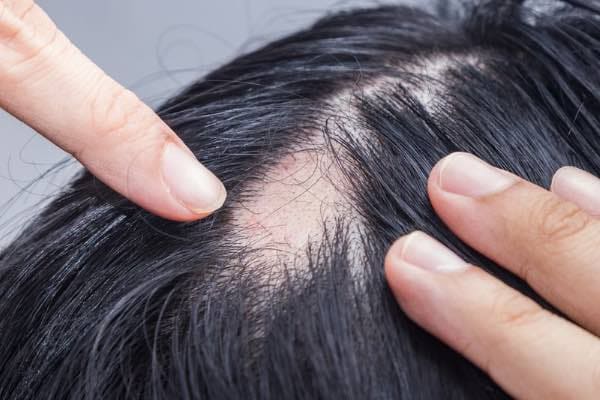
In the affected areas the skin is often smooth and shiny. The tiny openings where hairs normally grow out have disappeared. The edges around the area can be uneven. Alongside itching and burning you may see redness and flaking, which is rarely part of ordinary hereditary loss.
Why is getting a diagnosis urgent?
Because the inflammation keeps destroying follicles for as long as it's active. Treatment aims to stop the process before more is lost. Tissue that has turned into scar is lost. Follicles that are still healthy, on the other hand, can be saved.
So every month of active disease can cost you hair permanently. Get a referral to a dermatologist quickly, and never wait and see when your hair is disappearing while your scalp itches, burns or flakes.
What types of scarring alopecia are there?
- Frontal fibrosing alopecia. Seen mostly in women past the menopause. The hairline recedes, and the eyebrows often thin at the same time.
- Lichen planopilaris. Each hair follicle gets a ring of inflammation around it, and the skin itches and turns red.
- Folliculitis decalvans. Here both bacteria and inflammation play a part.
- Discoid lupus. A skin disease that can also leave scarring on the scalp.
All the forms need to be investigated by a dermatologist, and a biopsy is often needed to make the right diagnosis.
How is scarring alopecia treated?
Medically, and under a dermatologist's follow-up. Anti-inflammatory treatments are usually used, either on the skin or as medicine that works throughout the body. Minoxidil and finasteride do nothing for the disease itself.
Can a hair transplant help with scarring alopecia?
Sometimes. The requirement is that the disease has shown no sign of activity for at least six months, and often the wait is longer. Operate while the inflammation is active and it will destroy the new grafts too. Scar tissue also often has a poorer blood supply than healthy skin, which means lower graft survival. Read more about transplanting into scar tissue.
What should you do if you suspect scarring alopecia?
Take clear photos of the area in good light, and note when you first noticed itching, burning or flaking. Book an appointment with your GP (fastlege) and ask for a referral to a dermatologist. Show the photos and describe your symptoms. Hold off on supplements, shampoos and everything else until you have a diagnosis.
This article is general information and does not replace a medical assessment of you.
If your hair loss has only just started, a procedure may not be the right step yet. The medical team at the clinic at the top of our ranking can look at your photos and tell you honestly whether to wait, start with treatment or consider more.
Goes to the clinic at the top of our ranking.