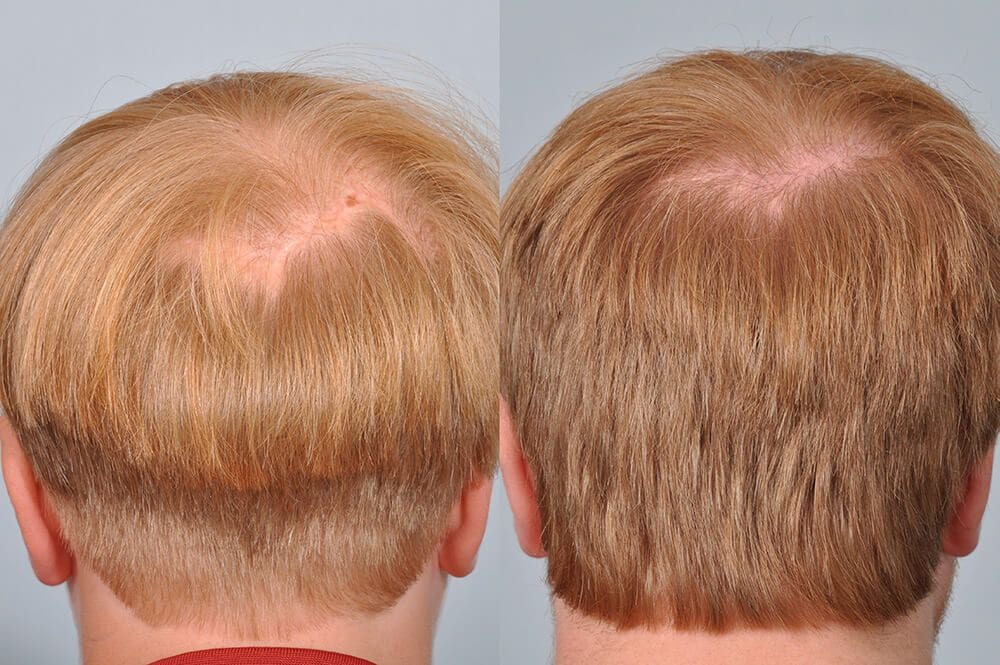
Hair transplant into scars: does it work, and when should you wait?
Scars from burns, surgery or scarring alopecia can often be covered with your own hair. But scar tissue is demanding to work in, and any active disease has to settle first.
Can hair be transplanted into a scar?
Often yes, as long as the scar is stable and your expectations are realistic. Hair lost to burns, surgery or accidents can in many cases be rebuilt. That includes scars from facelifts and from previous hair surgery. The same question comes up with scarring alopecia, where a disease has destroyed the hair follicles.
Even so, this is among the harder tasks in the field. Scar tissue isn't normal skin, and that affects both how much grows and how confidently anyone can predict it beforehand.
Why is scar tissue harder than a normal scalp?
Because the blood supply is usually poorer. Scar tissue is also stiffer and less pliable, and it lacks the healthy environment hair follicles thrive in. A graft lives off the blood supply around it in the first few days, so in a scar fewer grafts may survive than in healthy skin.
That makes the procedure less predictable, not impossible. The surgeon has to take the tissue into account both when planning the grafts and when implanting them.
What's the difference between a stable scar and active disease?
It's the most important dividing line of all. Scars from a burn or a surgical procedure are usually stable. The process that created them is over, and a transplant has a good chance of success.
With scarring alopecia, inflammation may still be going on and destroying hair follicles. In that case the disease must have stayed quiet for a long time before anyone should consider surgery. An active process doesn't distinguish between old and new hairs, and it can destroy the transplanted grafts in the same way. If you suspect something is still active, a dermatologist should look at your scalp before you talk to a surgeon.
How does the surgeon approach a stable scar?
The grafts are placed in or around the scar so that it becomes far less visible. Some surgeons start with a small test session. It shows how well the grafts cope in your particular scar tissue before you plan a larger session. If the blood supply is very poor, steps can sometimes be taken to improve the tissue before the transplant.
If it's a strip scar from an older FUT operation, there are several routes. Read more about repair after previous procedures.
What can you expect from the result?
Less density than in healthy skin, and perhaps more rounds. Because survival in scars can be lower and varies more, the result is often not as dense as a similar procedure in a normal scalp. It may also take more than one session to get where you want to be.
An honest surgeon tells you about these limits before you start. If someone promises you a perfect result in a scar with poor tissue, that's a reason to keep looking.
Who should you contact?
A surgeon who has done this before, ideally many times. Operating in scar tissue, and treating scarring alopecia, are among the most complex jobs in the field, and general scalp experience isn't enough.
Start by gathering what you have: photos of the scar over time, records from previous operations and any findings from a dermatologist. If active disease is suspected, book an appointment with the dermatologist first. If the scar is stable, ask for a free hair analysis and ask the clinic directly how many scar cases the surgeon has treated, and whether you can see photos of them.
This article is general information and doesn't replace a medical assessment of you.
It depends on your donor area, your hair type and where the loss is. Send three photos and the medical team at the clinic at the top of our ranking will suggest a method and number of grafts.
Goes to the clinic at the top of our ranking.