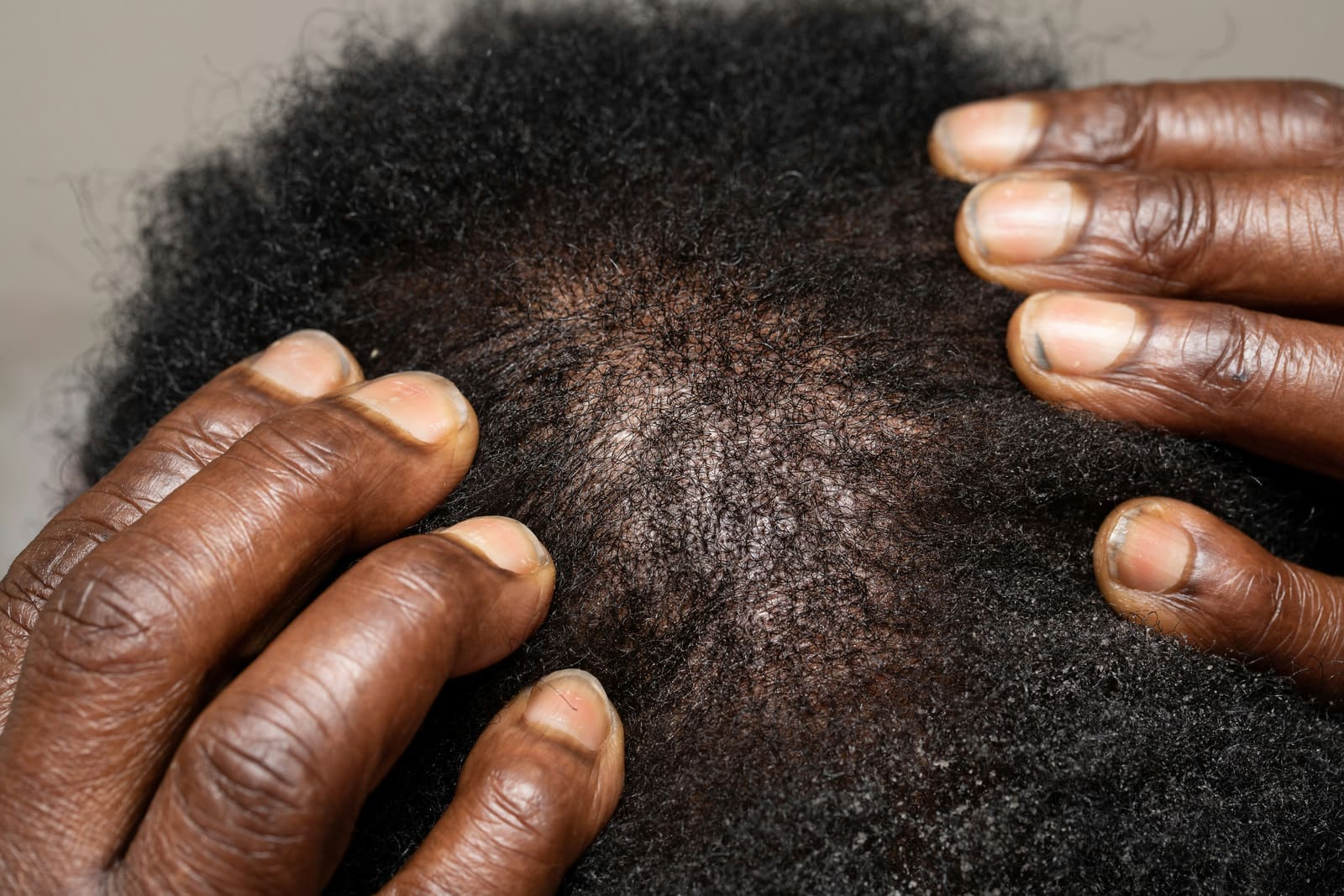
Thinning hair? Four tests you can do at home
Hair in the plughole doesn't necessarily mean hair loss. With four simple tests, the right light and a little patience, you can find out whether your hair really is getting thinner.
How many hairs can you lose without it being abnormal?
Between 50 and 100 hairs a day is perfectly normal for an adult. It's a natural part of the hair growth cycle: hairs finish their resting phase and fall out, and new ones take over. A few strands left on the pillow or in your hairbrush are nothing to worry about.
What decides it is the balance over time. Over several weeks and months, is more hair consistently falling out than growing back? One bad morning with lots of hair in the plughole tells you very little.
Which home tests give a reliable answer?
Four simple tests give a good picture, as long as you do them systematically:
- The parting test: Make a parting in the same place once a month and take a photo. If the parting gets visibly wider, the hair on top is thinning.
- The pillow test: Keep an eye on it over a few weeks. Is there clearly more hair left in your bed and in the shower than you're used to?
- The hairline test: Dig out photos from 2 to 5 years ago and compare them with today. Have your temples crept back?
- The pull test: Take hold of roughly 40 to 60 hairs between your fingers and pull gently. If more than 2 to 3 hairs come loose time after time, it may point to active loss.
Why does lighting fool you?
Because shadows change how dense your hair looks. Strong ceiling light straight from above, the kind many people have in the bathroom, makes the crown look sparse even when it isn't. Soft light from the front, on the other hand, can hide thinning that really is there.
So take your check photos in the same even light, ideally similar to daylight, and from the same angles every time. Stand in the same spot, at the same distance. Then you can compare the photos honestly.
What does the pattern tell you about the cause?
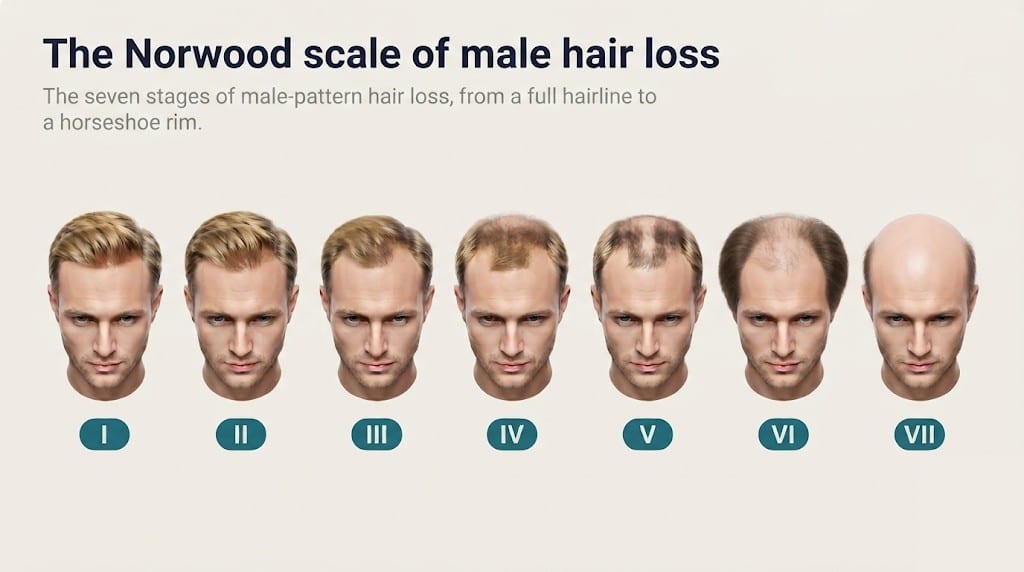
Quite a lot. Look at where the hair is disappearing. Are your temples receding and your crown getting thinner? That points to hereditary hair loss (androgenetic alopecia), which follows the pattern described by the Norwood scale. Read more about the stages in the Norwood scale explained.
If your hair thins evenly across the whole head over a short period, it looks more like telogen effluvium. Behind it there's often a strain such as stress, illness or too little of a nutrient, and it usually passes. See telogen effluvium explained, and the other forms in the overview of causes of hair loss.
When should you see a doctor?
When the thinning has lasted 3 to 6 months without easing, or if you notice round, bald patches. The same goes for a scalp that itches, is red, flakes or hurts. Signs like these can be caused by alopecia areata, a fungal infection or another medical condition that needs different treatment from hereditary hair loss.
Also ask to have your ferritin, vitamin D and thyroid function (TSH) checked in a blood test. This is especially useful when the loss is spread across the whole head.
If you want to go a step further, a dermatologist can examine your scalp with a trichoscope. With magnification, the doctor can see miniaturisation, meaning hair follicles weakening in areas that look healthy. That way loss can be detected before it shows, with a precision no home test comes close to.
What should you do if the tests show you're losing hair?
Starting early gives you the most to gain. Hair follicles that have begun to shrink but are still alive can often be saved with medication. The best documented treatments, finasteride and minoxidil, are covered in the guide to slowing hair loss without surgery. Surgery should wait until the loss has settled down.
Start with the simplest step tonight: take three photos of your parting, hairline and crown in the same light, and save them with the date. Do the same in a month. If you want a plan for what to do after that, you'll find it in early hair loss: what to do first.
If your hair loss has only just started, a procedure may not be the right step yet. The medical team at the clinic at the top of our ranking can look at your photos and tell you honestly whether to wait, start with treatment or consider more.
Goes to the clinic at the top of our ranking.