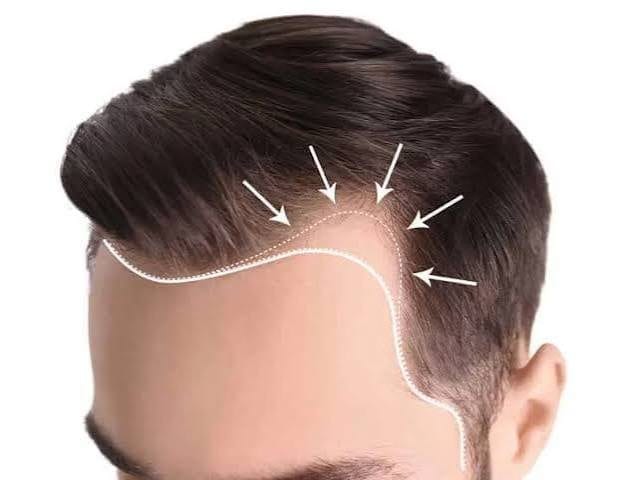
Rebuilt temple points: how do they look after ten years?
The grafts in the temples stay put, but the area around them keeps receding. Over time, that can change how the result looks.
Transplanted temple points sit in an area where the natural hair keeps receding. The grafts themselves don't disappear, but the recession around them narrows the frontal band, and a temple that was built up too heavily looks less and less natural as the years go by.
What are temple points, and why do they matter so much?
Temple points are the small, pointed triangles of hair at the outer corners of the hairline, in front of and above the ears. They frame the face, so when they disappear, the shape of the face changes more than with similar loss elsewhere. That's why many people want them back, and why mistakes there get noticed.
What happens to temple grafts after many years?

The grafts stay, because they come from the stable donor area. Your own hair around them, however, keeps receding in step with the hereditary pattern. After ten to twenty years, the temple point can stand isolated as a dense strip in front of thinner scalp, and the result then looks artificial.
Grafts placed in the temples come from the part of the back of the head that tolerates DHT, and they usually hold. The hair that was already growing there doesn't.
The temples recede at their own pace, as part of the hereditary pattern. A rebuilt temple point in an area that's still receding therefore gradually ends up standing alone, with sparse hair both behind and above it.
Over ten to twenty years, this is one of the main reasons an overambitious hairline ages badly. You get a dense band right at the front, narrowing from both sides, and behind it a scalp that's getting thinner. No single part has changed since the operation. It's the whole picture that gives the procedure away.
Why does temple work leave so little room for error?
The temples need fine single hairs placed almost flat against the skin, pointing down and backwards, just like your own hair there. Coarse grafts, multi-hair grafts, the wrong angle or overly dense placement are mistakes that can't be corrected, and since people see you straight on, differences between the left and right side are easily noticed.
- Fine hair. Temple hair is naturally finer than the hair at the back of the neck. Coarse hairs here always look wrong. Some surgeons therefore use a small number of fine hairs from the nape or the temple area itself for this specific job.
- Flat angle. Hair at the temple lies close to the skin and points steeply down and backwards. The incisions have to be made at the same angle, and if the surgeon misses, you'll see it for the rest of your life.
- Only one hair per graft. Grafts with two or three hairs in a temple point give themselves away immediately.
- Moderate density. Natural temples are sparse. A temple packed too densely is among the clearest signs that someone has had a transplant.
- Even on both sides. Others see your face straight on, so asymmetry between the temples gets noticed.
Why do surgeons deliberately draw slightly receded temples?
Because a mature hairline, with the slight temple recession an adult man normally has, still looks right as the loss continues. Full, teenage-style temples look strange as the years pass, since no older men have them. Those who object tend to compare themselves with photos from when they were twenty.
The sensible solution is to plan with slightly receded temples from the start. The surgeon draws an adult hairline that has room for the recession most men get anyway.
A design like this follows the progression instead of fighting it. If the temples keep receding, the hairline still fits, because it was made for that. A design with full, boyish temples doesn't. No older men have temples like that, and the result stands out.
The reasoning is the same as for how high the hairline should sit, just applied to the corners. The resistance comes from the same place too: the patient holds the result up against photos of himself in his twenties.
What questions should the surgeon answer before the temples are rebuilt?
Ask which hair and what hair thickness will be used, how many grafts it will be and whether each one has a single hair. Also ask how it will look if your temples recede for another fifteen years, and ask to see fully healed results at twelve months. If the surgeon recommends very little temple work for a young patient who's still losing hair, that's the choice that stands the test of time best.
- Are you rebuilding the temples, and if so, how far forward?
- Which hairs are you using there, and how fine are they?
- How many grafts will it be, and are they all single hairs?
- How will this look if my temples keep receding for fifteen years?
- Can I see temple work on your own patients, twelve months after the procedure?
If the surgeon suggests little or no temple work because you're young and your hair loss is still ongoing, you've been given advice that holds up well over time. A clinic that promises you full temples like when you were young is selling a nice after photo, not a result that will look good in twenty years.
Sources
- Maas D, et al. Rethinking the occipital scalp as a control in advanced androgenetic alopecia. Journal of the American Academy of Dermatology, 2026 (ahead of print). pubmed.ncbi.nlm.nih.gov/42398778
- Jimenez F, Ruifernández JM. Distribution of human hair in follicular units. A mathematical model for estimating the donor size in follicular unit transplantation. Dermatologic Surgery, 1999;25(4):294-298. pubmed.ncbi.nlm.nih.gov/10417585
- Rassman WR, Bernstein RM, McClellan R, Jones R, Worton E, Uyttendaele H. Follicular unit extraction: minimally invasive surgery for hair transplantation. Dermatologic Surgery, 2002;28(8):720-728. pubmed.ncbi.nlm.nih.gov/12174065
- Xu Y, et al. Case Report: Paired vertex-occipital assessment reveals donor-area involvement in diffuse unpatterned alopecia. Frontiers in Medicine, 2026;13:1797275. pubmed.ncbi.nlm.nih.gov/41982548
- Romera de Blas C, Vega Díez D, Ricart Vayá JM, Gómez Zubiaur A. Complications in follicular unit excision hair transplantation: current evidence and practical approaches. Frontiers in Medicine, 2026;13:1750989. pubmed.ncbi.nlm.nih.gov/41709896
Here we summarise published research and standard clinical practice as general information. The text is not medical advice and cannot replace what your surgical team tells you. If they say something different from what is written here, their advice is what counts.
Wondering what's possible for your hair?
Send three sharp photos of your hair, from the front, the top and the back. You'll get an honest answer on what can be done, roughly how many grafts it would take and what it costs.
- Free and with no obligation
- Photos are assessed by the clinic's medical team
- Replies usually within an hour in the daytime


A study tells you something about groups. Only a doctor who has seen your photos can say what applies to your hair. The medical team at the clinic at the top of our ranking offers a free assessment.
Goes to the clinic at the top of our ranking.