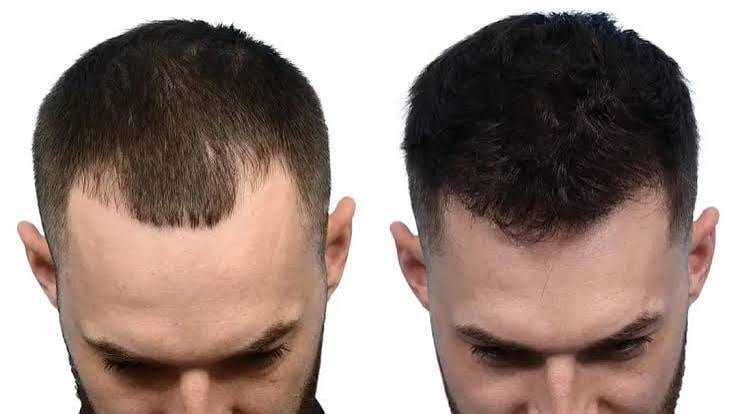
What will a transplanted hairline look like in twenty years?
The hairline stays where it was drawn. Your face and the hair around it keep changing.
The hairline stays where it was drawn on the day of surgery, while your face and the hair around it get older. Conservative, irregular, age-appropriate designs look right for many years. Low, straight, densely packed ones look steadily worse.
Which part of the result never changes?
The hairline. The grafts at the front have fixed positions and stay exactly where the surgeon drew them, whether the rest of your hair thins, your crown goes bare or the rest of your head turns grey. At first that's an advantage. Over the years it becomes a limitation, because your face and the skin around it age.
Which choices help a hairline age well?
A mature height, the kind men in their forties typically have. An irregular transition instead of a straight edge. Single-hair grafts in the first row. Temples that keep some of their recession. And good coverage in the mid-scalp behind, so the front doesn't stand alone.
- Height. An adult hairline, placed where it typically sits in men in their forties, still suits the face as it ages. A youthful line doesn't, since older men don't naturally have hairlines like that.
- Irregularity. Real hairlines aren't lines. They're irregular transitions with a few scattered hairs at the very front and density that changes further back. A straight edge with even density looks constructed at any age, and that becomes more obvious as the surrounding hair thins.
- Single hairs at the front. Grafts with two or three hairs in the first row give a transplant away faster than anything else, and they become more visible as the hair behind disappears and the front row is left on its own.
- Slightly receded temples. If the temples keep some of their angle, the front looks adult. If the temple points are fully rebuilt, it can eventually look like the edge of a wig as the temples beside them keep receding.
- Hair behind the front. If the mid-scalp behind is well covered, the hairline looks like hair. If it's thin, the hairline looks like a band.
How does a transplanted hairline most often age badly?
It ends up as an isolated band. A dense, low front stays put while the rest of the head keeps losing hair, and over five to fifteen years the hair behind and at the sides disappears. What's left is a strip that looks more artificial than untreated hair loss, and it's very hard to do anything about.
The most common way it goes wrong is the band: a dense, low front with an increasingly sparse scalp behind it.
It happens gradually. In the first year your own hair fills in behind the grafts, and everything looks full. Over the next five to fifteen years your own hair is lost, the temples recede on either side, and the transplanted area shrinks to a narrow, obvious strip.
The result looks worse than the hair loss would have looked without surgery, because ordinary male pattern hair loss follows a pattern the eye accepts. A dense band in front of a bare scalp doesn't.
And repairing it is almost impossible. No one can move the grafts backwards, the temples won't come back, and there usually isn't enough reserve to fill the whole area behind the band.
Why do so many people want a hairline that is too low?
Because they compare themselves with photos from when they were twenty, not with the face they'll have at fifty. Surgeons who do what the patient asks buy a happy patient today at the expense of the result in twenty years. Clinical experience suggests that people who were persuaded to accept a higher, more conservative front are almost always grateful for it later.
Practically every patient wants the front lower than the surgeon recommends. It's easy to understand: they picture the photos from when they were twenty, not the face they'll have at fifty.
If the surgeon does what the patient asks, the patient gets what he wants today and sacrifices the long-term result. A surgeon who holds firm is doing their job. According to clinical experience, people who were persuaded to accept a higher front are overwhelmingly happy with it later. The opposite, a front placed too low, is one of the things people most often regret when they seek repair.
The psychological side has been described in the research. In their review of the psychological aspects of hair transplantation, Tan and Jafferany look at patients' expectations and argue that psychological assessment should be part of the work-up before surgery. They also point to screening tools that can pick out high-risk patients.
What should you ask before your hairline is drawn?
Say yes when the surgeon suggests a higher front. Let the surgeon draw the line on your head, and take a photo of it. Find out how many single-hair grafts will go at the very front, how the front will look if you end up at the worst Norwood stage that's realistic for you, and whether the middle of your scalp will be treated too.
- Say yes to the higher front. No single piece of advice in this field holds up better.
- Let the surgeon draw the line directly on your head before the procedure, and take photos of it.
- Ask how many single-hair grafts will go in the first row. If you get a concrete number, someone has done the planning.
- Ask how the front will look if you end up at the worst Norwood stage that's realistic for you.
- Ask whether the middle of your scalp will be treated too, or just the front.
Sources
- Tan IJ, Jafferany M. Psychological Dimensions of Hair Transplantation: A Narrative Review of Current Evidence. Journal of Cosmetic Dermatology, 2025;24(10):e70475. pubmed.ncbi.nlm.nih.gov/40990054
- Maas D, et al. Rethinking the occipital scalp as a control in advanced androgenetic alopecia. Journal of the American Academy of Dermatology, 2026 (ahead of print). pubmed.ncbi.nlm.nih.gov/42398778
- Jimenez F, Ruifernández JM. Distribution of human hair in follicular units. A mathematical model for estimating the donor size in follicular unit transplantation. Dermatologic Surgery, 1999;25(4):294-298. pubmed.ncbi.nlm.nih.gov/10417585
- Maletic A, et al. Impact of Hair Transplantation on Quality of Life. Aesthetic Plastic Surgery, 2024;48(9):1825-1830. pubmed.ncbi.nlm.nih.gov/38123846
- Rassman WR, Bernstein RM, McClellan R, Jones R, Worton E, Uyttendaele H. Follicular unit extraction: minimally invasive surgery for hair transplantation. Dermatologic Surgery, 2002;28(8):720-728. pubmed.ncbi.nlm.nih.gov/12174065
This text is based on published studies and on how specialists usually work. It is meant as general information, not as medical advice for you, and it never overrides what your surgical team has told you. If they say something different from what is written here, their advice is what counts.
Wondering what's possible for your hair?
Send three sharp photos of your hair, from the front, the top and the back. You'll get an honest answer on what can be done, roughly how many grafts it would take and what it costs.
- Free and with no obligation
- Photos are assessed by the clinic's medical team
- Replies usually within an hour in the daytime


A study tells you something about groups. Only a doctor who has seen your photos can say what applies to your hair. The medical team at the clinic at the top of our ranking offers a free assessment.
Goes to the clinic at the top of our ranking.